
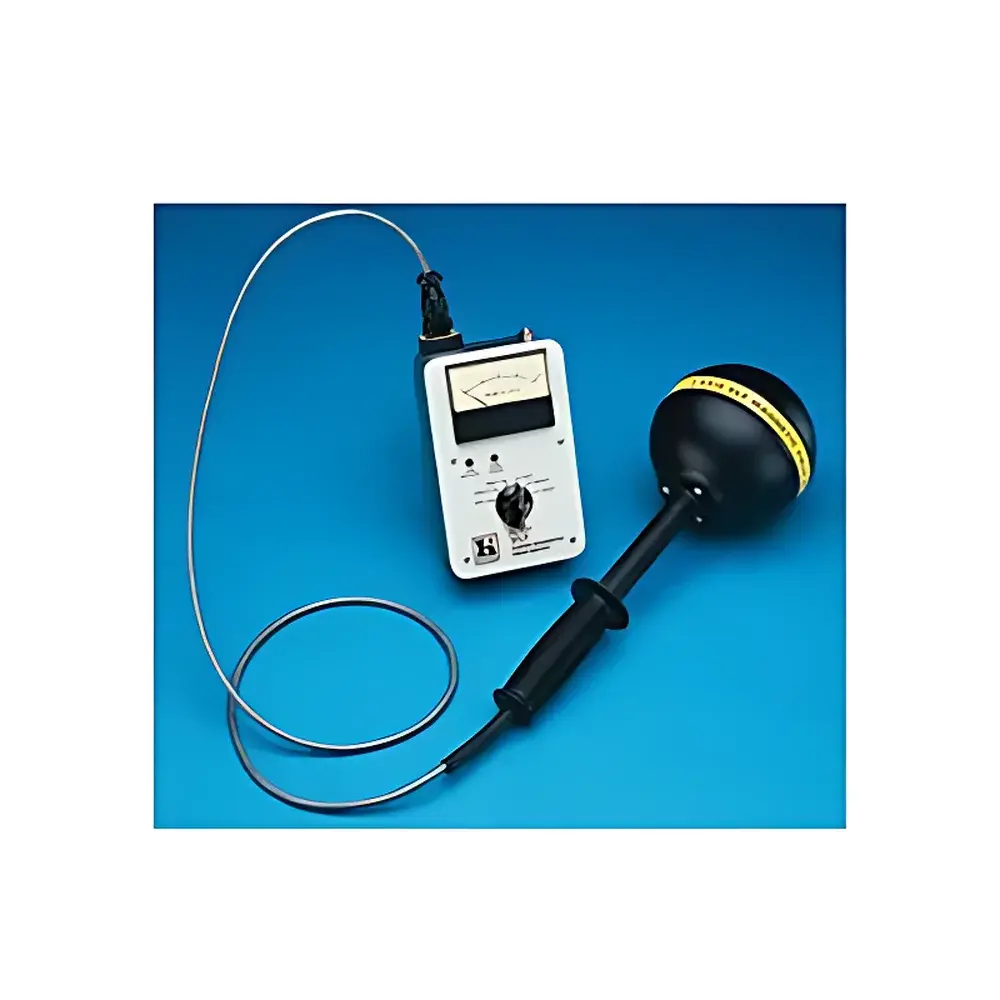
HI-2200 RF Electromagnetic Field Analyzer
| Origin | USA |
|---|---|
| Manufacturer Type | Authorized Distributor |
| Origin Category | Imported |
| Model | HI-2200 |
| Pricing | Upon Request |
| Operating Temperature | −10 °C to 50 °C |
| Host Dimensions | 85 mm × 160 mm × 30 mm |
| Probe Height | 260 mm |
| Weight | 0.6 kg |
| Data Logging Capacity | 65,000 readings |
| Display Units (E-field) | V/m, μW/cm², mW/cm², W/m² |
| Display Units (H-field) | A/m, mA/m, μW/cm², mW/cm², W/m² |
| E100 Probe | Isotropic E-field sensor, 100 kHz–5 GHz, 0.3–800 V/m |
| H200 Probe | Isotropic H-field sensor, 5 MHz–300 MHz, 0.3–10 A/m |
| H210 Probe | Isotropic H-field sensor, 300 kHz–30 MHz, 0.3–30 A/m |
| C300 Probe | E-field % of FCC exposure limits, 100 kHz–8 GHz |
| C310 Probe | E-field % of ICNIRP exposure limits, 100 kHz–8 GHz |
Overview
The HI-2200 RF Electromagnetic Field Analyzer is a portable, handheld instrument engineered for quantitative assessment of radiofrequency (RF) electromagnetic fields in compliance with international exposure standards. It operates on the principle of isotropic field sensing—utilizing three orthogonal sensors within each probe to capture vector components of incident RF energy, enabling true spatial averaging without rotational dependency. Designed for field-deployable operation—including elevated or constrained locations such as telecom tower platforms, rooftop antenna sites, and aircraft hangars—the analyzer delivers real-time RMS field strength measurements across defined frequency bands. Its architecture supports traceable calibration against NIST-traceable reference sources, ensuring metrological integrity for occupational safety surveys, environmental compliance verification, and pre-compliance EMC site evaluations.
Key Features
- Compact, ergonomic handheld design (85 × 160 × 30 mm; 0.6 kg) optimized for extended single-operator use in diverse field environments
- Real-time and spatially averaged measurement display with dual-mode visualization (instantaneous + time-weighted average)
- Integrated data logger storing up to 65,000 timestamped records with user-configurable sampling intervals
- Multi-unit display capability: selectable units include V/m, A/m, μW/cm², mW/cm², W/m² for both electric and magnetic field modes
- Configurable audible/visual alarm thresholds with programmable limit sets aligned to FCC OET Bulletin 65, ICNIRP Guidelines, or custom regulatory criteria
- RS-232 serial interface compliant with EIA/TIA-232-F specifications for bidirectional communication and firmware updates
- Modular probe architecture: all interchangeable isotropic probes (E100, H200, H210, C300, C310) connect directly to the main unit via standardized coaxial interface without external power or signal conditioning
Sample Compatibility & Compliance
The HI-2200 system accommodates a range of calibrated, isotropic broadband probes validated for use in regulated measurement scenarios. Each probe undergoes individual factory calibration with documented uncertainty budgets per ISO/IEC 17025 requirements. The E100 probe (100 kHz–5 GHz, 0.3–800 V/m) and H-series probes (H200: 5 MHz–300 MHz; H210: 300 kHz–30 MHz) are certified for conformance with IEEE Std 1308-2020 and IEC 62232:2017 for RF field strength evaluation near radiocommunication installations. When used with C300/C310 probes, the instrument provides direct percentage-of-limit readouts referenced to FCC §1.1310 and ICNIRP (2020) public/exposure limits—supporting audit-ready reporting for GLP-aligned environmental health and safety programs. The device meets EN 61326-1:2013 for electromagnetic compatibility in industrial environments and carries CE marking under the EU Radio Equipment Directive (2014/53/EU).
Software & Data Management
Data export is supported via RS-232 to PC-based analysis software (Windows-compatible, provided separately), enabling post-processing of logged datasets including statistical summaries (min/max/mean/std dev), spectral trend plots, and geotagged reporting. All stored records retain full metadata: date/time stamp, probe ID, measurement unit, averaging duration, and alarm status flags. Audit trail functionality records configuration changes with timestamps and operator identifiers—facilitating adherence to FDA 21 CFR Part 11 requirements where electronic records are subject to regulatory review. Export formats include CSV and XML, compatible with laboratory information management systems (LIMS) and enterprise environmental monitoring platforms.
Applications
- Regulatory compliance surveys for RF exposure in public spaces adjacent to cellular base stations, broadcast transmitters, and radar installations
- Ongoing occupational safety monitoring in telecommunications infrastructure maintenance, broadcast engineering, and defense electronics facilities
- Pre-compliance testing for electromagnetic compatibility (EMC) during product development and site acceptance trials
- Academic and governmental EMF research requiring traceable, repeatable broadband field characterization
- Airport electromagnetic environment assessments per FAA AC 150/5340-30E and ICAO Annex 10 Vol IV
- Verification of shielding effectiveness in RF-secure rooms and TEMPEST-certified enclosures
- Environmental impact assessments mandated under national radiofrequency protection ordinances
FAQ
What calibration standards does the HI-2200 support?
The HI-2200 and its probe set are calibrated traceably to NIST standards using accredited laboratories operating under ISO/IEC 17025. Calibration certificates include expanded uncertainties at key frequencies across each probe’s operational band.
Can the HI-2200 measure pulsed or modulated RF signals?
Yes—the instrument employs true RMS detection with sufficient bandwidth and sampling rate to accurately characterize amplitude-modulated, TDMA, CDMA, and OFDM waveforms typical of modern wireless systems.
Is firmware upgrade capability available?
Yes—firmware updates are delivered via RS-232 using manufacturer-provided utility software, with version control and rollback functionality to maintain configuration stability in regulated workflows.
Does the HI-2200 meet requirements for legally defensible measurement reports?
When operated with calibrated probes, documented procedures, and appropriate environmental controls, measurement data from the HI-2200 satisfies evidentiary requirements for regulatory submissions under FCC, ICNIRP, and national spectrum management authorities.
How is spatial averaging implemented?
Spatial averaging is computed internally using synchronized readings from three orthogonal sensors within the isotropic probe head, applying root-sum-square (RSS) vector summation to yield a scalar magnitude independent of probe orientation—per IEEE 1308-2020 Section 5.3.2.







