
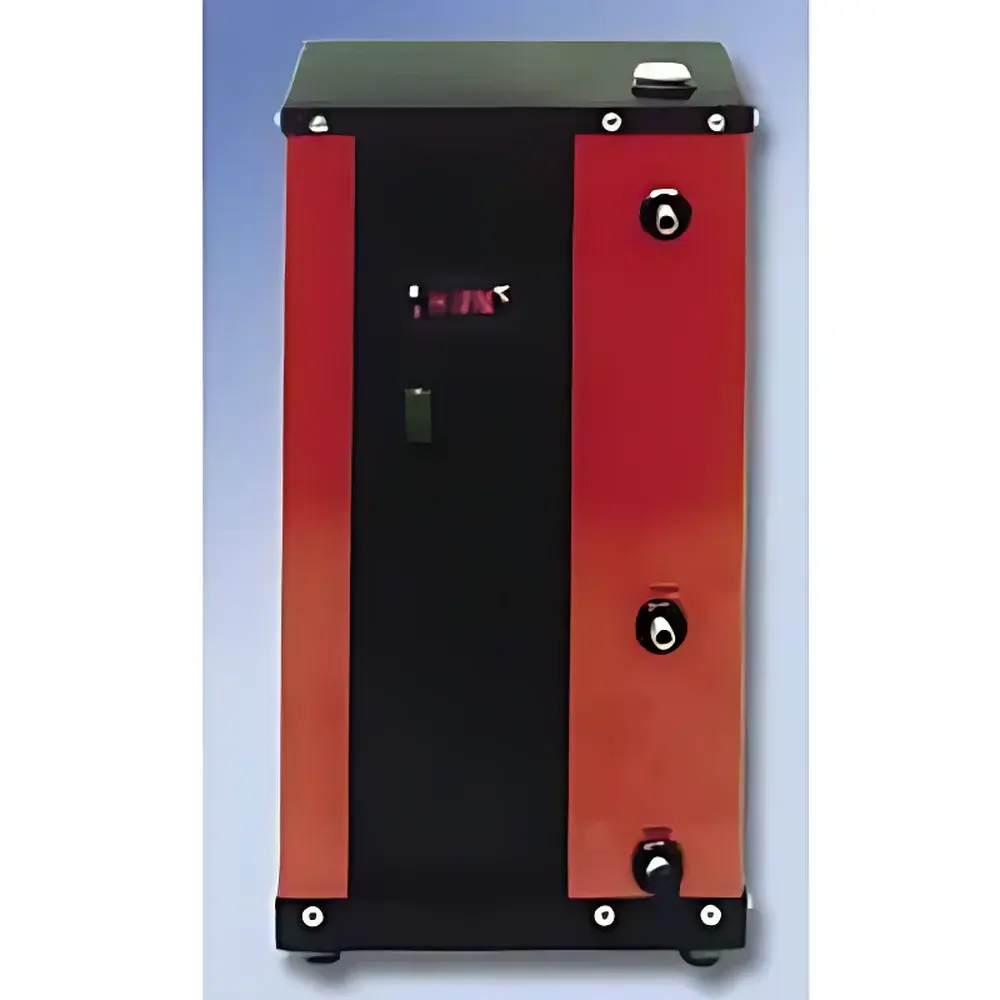
Behr UT12 Circulating Chiller
| Origin | Germany |
|---|---|
| Manufacturer Type | Authorized Distributor |
| Origin Category | Imported |
| Model | Behr UT12 |
| Instrument Type | Integrated Unit |
| Cooling Method | Water-Cooled |
| Temperature Control Range | 5–40 °C |
| Cooling Capacity | 1000 W |
| Temperature Stability | ±0.1 °C |
| Circulation Pump Pressure | 2.0 bar |
| Circulation Flow Rate | 38 L/min |
| Reservoir Volume | 19 L |
| Operation Mode | Continuous |
Overview
The Behr UT12 Circulating Chiller is a precision-engineered, integrated temperature control system designed for stable, continuous thermal management of laboratory equipment requiring external cooling or heating loops. Built in Germany and distributed under strict quality assurance protocols, the UT12 operates on a closed-loop refrigeration cycle with an integrated water reservoir and high-flow circulation pump. It maintains setpoint temperatures within ±0.1 °C across its full operational range of 5–40 °C—making it suitable for applications demanding tight thermal regulation, such as spectrophotometer jacketing, rotary evaporator condensation, HPLC column ovens, and laser source cooling. Unlike air-cooled chillers, the UT12 employs a water-cooled condenser, enabling consistent performance in ambient environments up to 35 °C without derating. Its thermally insulated 19 L stainless-steel reservoir minimizes heat ingress and supports long-duration unattended operation.
Key Features
- Integrated architecture with built-in refrigeration unit, circulation pump, expansion tank, and digital PID controller—no external components required.
- Precision temperature regulation via dual-sensor feedback: internal reservoir sensor plus optional external Pt100 probe input (compatible with third-party temperature controllers).
- High-capacity circulation system delivering up to 38 L/min at 2.0 bar pressure—sufficient to support multiple instruments or extended fluid paths with minimal pressure drop.
- Robust refrigeration circuit using R-410A refrigerant, engineered for low noise (<58 dB(A)), high energy efficiency, and compliance with EU F-Gas Regulation (EU) No 517/2014.
- Digital touchscreen interface with real-time display of setpoint, actual temperature, flow rate, compressor status, and fault diagnostics—including overtemperature, low-level, and flow interruption alerts.
- IP20-rated enclosure with corrosion-resistant housing and leak-detection tray—designed for placement in standard laboratory environments per IEC 61010-1 safety standards.
Sample Compatibility & Compliance
The UT12 is not a sample-contacting instrument; rather, it serves as a thermal transfer medium provider for externally connected devices. Its coolant loop is compatible with deionized water, 30% ethylene glycol/water mixtures, and other non-corrosive, low-viscosity heat-transfer fluids meeting ASTM D1384 specifications. All wetted components—including pump head, reservoir, and heat exchanger—are constructed from AISI 304 stainless steel and EPDM seals to ensure chemical compatibility and longevity. The unit complies with CE marking requirements under the Machinery Directive 2006/42/EC and Low Voltage Directive 2014/35/EU. For laboratories operating under GLP or GMP frameworks, the UT12 supports configurable logging intervals (via optional RS485/Modbus RTU output) and can be integrated into centralized monitoring systems compliant with FDA 21 CFR Part 11 when paired with validated data acquisition software.
Software & Data Management
While the UT12 operates autonomously via its onboard controller, it provides analog (0–10 V / 4–20 mA) and digital (RS485 Modbus RTU) interfaces for integration into facility-wide monitoring platforms. Users may log temperature, flow, and operational status at user-defined intervals (1 s to 60 min) using third-party SCADA or LIMS-compatible software. Optional firmware upgrades enable password-protected parameter locking, audit trail generation (with timestamped event logs), and alarm history export in CSV format—facilitating traceability during regulatory audits. No proprietary software installation is required for basic operation; configuration and diagnostics are accessible via intuitive front-panel navigation.
Applications
- Cooling of analytical instrumentation: UV-Vis spectrophotometers, FTIR accessories, and CCD detectors requiring thermal stabilization.
- Temperature control of rotary evaporators and vacuum distillation systems—maintaining condenser efficiency across variable solvent boiling points.
- Thermal conditioning of HPLC and UHPLC columns to enhance retention time reproducibility and peak resolution.
- Support for laser-based systems including confocal microscopes and Raman spectrometers where diode or solid-state laser heads demand precise junction temperature control.
- Process validation studies requiring documented, repeatable thermal profiles across multi-day experiments.
FAQ
What types of heat-transfer fluids are recommended for use with the UT12?
Deionized water is optimal for temperatures above 5 °C. For sub-ambient operation or freeze protection, a mixture of 30% ethylene glycol and 70% deionized water is approved—provided pH remains between 6.5 and 8.5 and conductivity stays below 10 µS/cm.
Can the UT12 be used for heating applications?
No—the UT12 is a cooling-only chiller. It does not incorporate electric heating elements or heat-pump functionality. For combined heating/cooling, consider the Behr UT20 series or external heater-circulator integration.
Is remote monitoring supported out of the box?
Yes—RS485 Modbus RTU communication is standard. Users may connect to industrial PLCs or PC-based DAQ systems without additional hardware. Ethernet or Wi-Fi modules are available as factory-installed options.
How often should maintenance be performed?
Annual inspection of refrigerant charge, pump seal integrity, and filter condition is recommended. The condenser water inlet filter should be cleaned quarterly if connected to municipal water supply.
Does the UT12 meet ISO/IEC 17025 calibration requirements?
The unit itself is not calibrated as a measuring instrument. However, its temperature sensor inputs (internal and external) support traceable calibration using NIST-traceable Pt100 probes, and all recorded data can be linked to laboratory-specific uncertainty budgets per ISO/IEC 17025:2017 Clause 7.7.



