
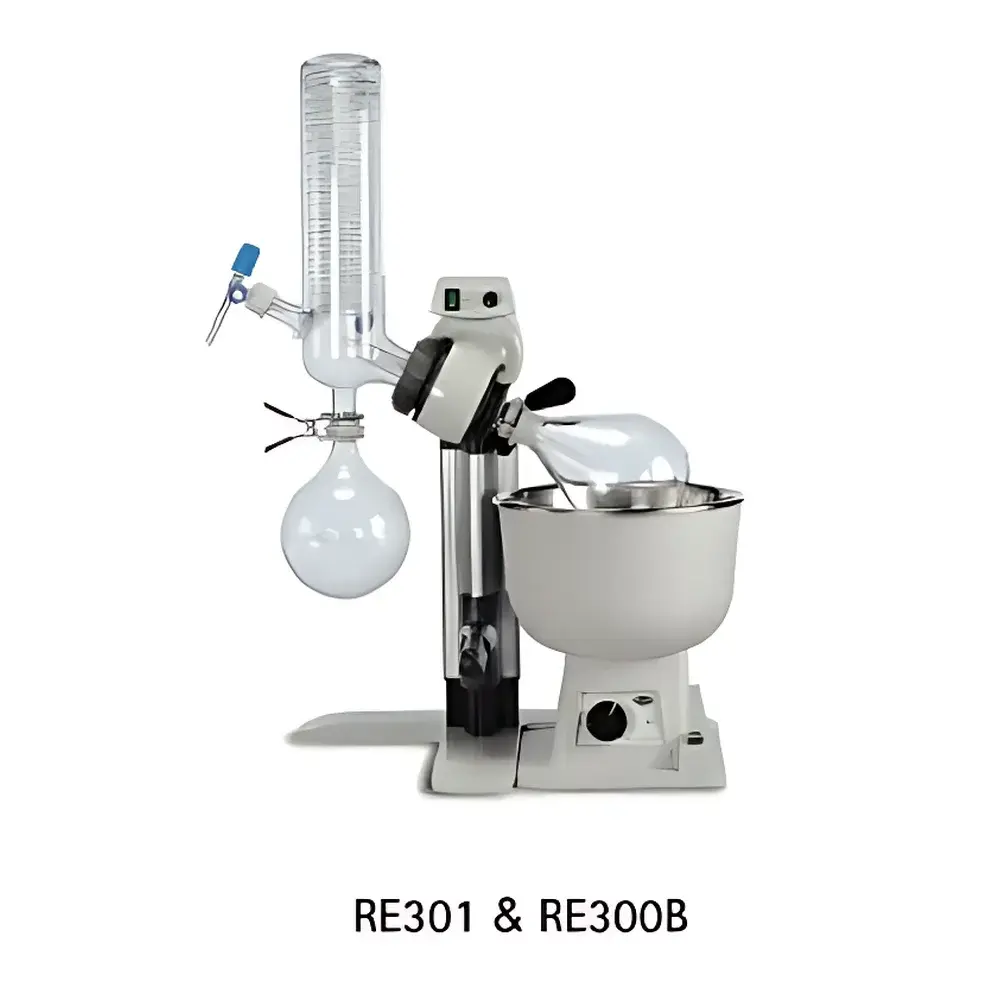
RE-301 Vertical Condenser
| Origin | Germany |
|---|---|
| Manufacturer Type | Authorized Distributor |
| Origin Category | Imported |
| Pricing | Upon Request |
| Rotational Speed Range | 20–190 rpm |
| Vacuum Tolerance | <1 mmHg |
| Vertical Travel Distance | 150 mm |
| Dimensions (W×D×H, excl. glassware) | 385 × 335 × 470–610 mm |
| Power Supply | 220 V, 50/60 Hz, 50 W |
Overview
The RE-301 Vertical Condenser is a precision-engineered component designed for integration into rotary evaporation systems used in analytical chemistry, pharmaceutical development, and synthetic laboratories. Unlike horizontal or diagonal condensers, the RE-301 employs a vertically oriented coil configuration that leverages gravity-assisted condensate flow and minimizes vapor path length—enhancing condensation efficiency under high-vacuum conditions (<1 mmHg). Its compact footprint and optimized geometry are specifically developed to meet spatial constraints within fume hoods, making it suitable for ISO 17025-accredited labs where workflow ergonomics and containment integrity are critical. The unit functions as a passive heat-exchange module, relying on circulating coolant (typically tap water or recirculating chiller fluid at 5–15 °C) through its borosilicate glass coil to achieve rapid phase transition of volatile solvents during distillation or concentration workflows.
Key Features
- Vertical coil design reduces overall system height while maintaining equivalent heat-transfer surface area compared to conventional horizontal condensers—enabling seamless installation in standard laboratory fume hoods (minimum internal width ≥400 mm).
- Base structure engineered to occupy 20% less lateral space than the RE-300 platform, improving benchtop utilization without compromising mechanical stability or thermal coupling.
- Compatible with Quickfit® standardized ground-glass joints (ISO 2955 / DIN 12901), ensuring leak-tight connections across all major rotary evaporator brands including Buchi, IKA, and Yamato.
- Borosilicate 3.3 glass construction (e.g., Schott Duran® or equivalent) meets ASTM E438 Type I, Class A specifications for chemical resistance and thermal shock tolerance up to 150 °C.
- Integrated vertical lift mechanism supports 150 mm travel range, allowing precise alignment with flask necks of varying volumes (50 mL to 5 L) while maintaining consistent vacuum seal integrity.
Sample Compatibility & Compliance
The RE-301 condenser is compatible with a broad spectrum of organic and aqueous solvents—including acetone, ethyl acetate, methanol, dichloromethane, and water-based buffers—provided operating temperatures remain within the glass and joint material limits. It is not intended for use with hydrofluoric acid, hot concentrated alkalis, or halogenated solvents above 60 °C without supplemental cooling. All glass components conform to EN ISO 3585 and BS 1752:1998 for dimensional accuracy and taper consistency. When deployed in GMP-regulated environments (e.g., API purification or QC release testing), the condenser supports audit-ready documentation via traceable batch certification of glassware and compliance with USP and for apparatus qualification.
Software & Data Management
As a passive hardware component, the RE-301 does not incorporate embedded electronics or firmware. However, its mechanical compatibility enables full interoperability with digital rotary evaporator control systems (e.g., IKA RV 10 auto, Buchi R-300 Pro) that log vacuum pressure, bath temperature, rotation speed, and runtime. When integrated into validated workflows, the condenser contributes to 21 CFR Part 11-compliant data integrity by eliminating uncontrolled variables—such as inconsistent condensate pooling or vapor bypass—that could compromise endpoint determination or mass balance calculations.
Applications
- Solvent removal in small-molecule synthesis and natural product isolation.
- Concentration of HPLC fractions prior to NMR or MS analysis.
- Lyophilization pre-concentration steps in biopharmaceutical process development.
- Extraction solvent recovery in solid-phase extraction (SPE) method validation per EPA Method 502.2 and ISO 17993.
- Distillative purification of heat-sensitive compounds where low-temperature operation (<40 °C) and short residence time are essential.
FAQ
Is the RE-301 condenser compatible with non-Quickfit® rotary evaporators?
Yes, provided an appropriate ISO-standardized adapter (e.g., ISO 2955 to NS 29/32) is used; however, direct interchangeability is guaranteed only with Quickfit®-equipped systems.
What coolant flow rate is recommended for optimal performance?
A minimum flow rate of 1.5 L/min at 10 °C is advised for full-coil coverage; lower rates may result in localized dry-out and reduced condensation efficiency.
Can the RE-301 be autoclaved?
No—borosilicate glass condensers must never be subjected to steam sterilization; cleaning is performed using ethanol, acetone, or mild alkaline detergent followed by deionized water rinse and air drying.
Does the RE-301 require calibration?
No calibration is required as it operates without sensors or active controls; however, periodic visual inspection for scratches, etching, or joint wear is recommended per laboratory SOPs.
Is technical support available for integration into automated platforms?
Yes—application engineering support is provided for mechanical interface verification, vacuum leak testing protocols, and cold-trap compatibility assessment.



