
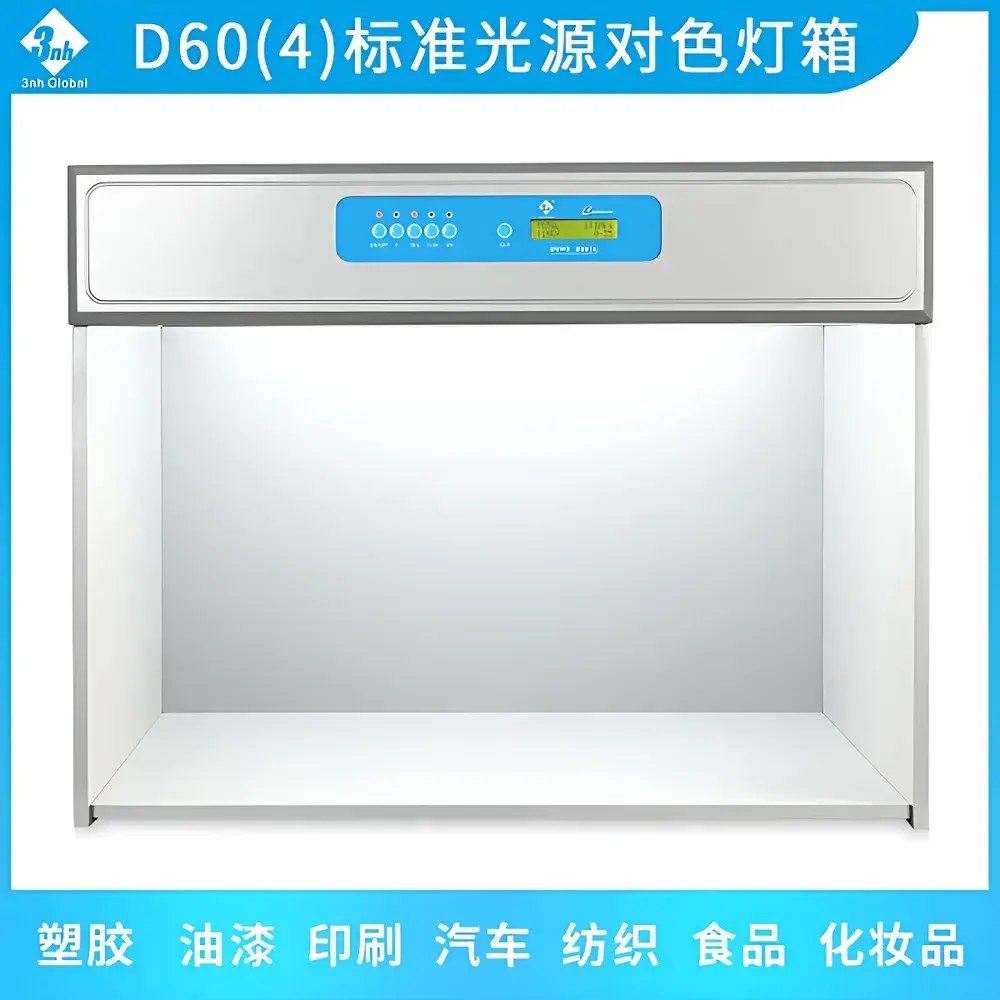
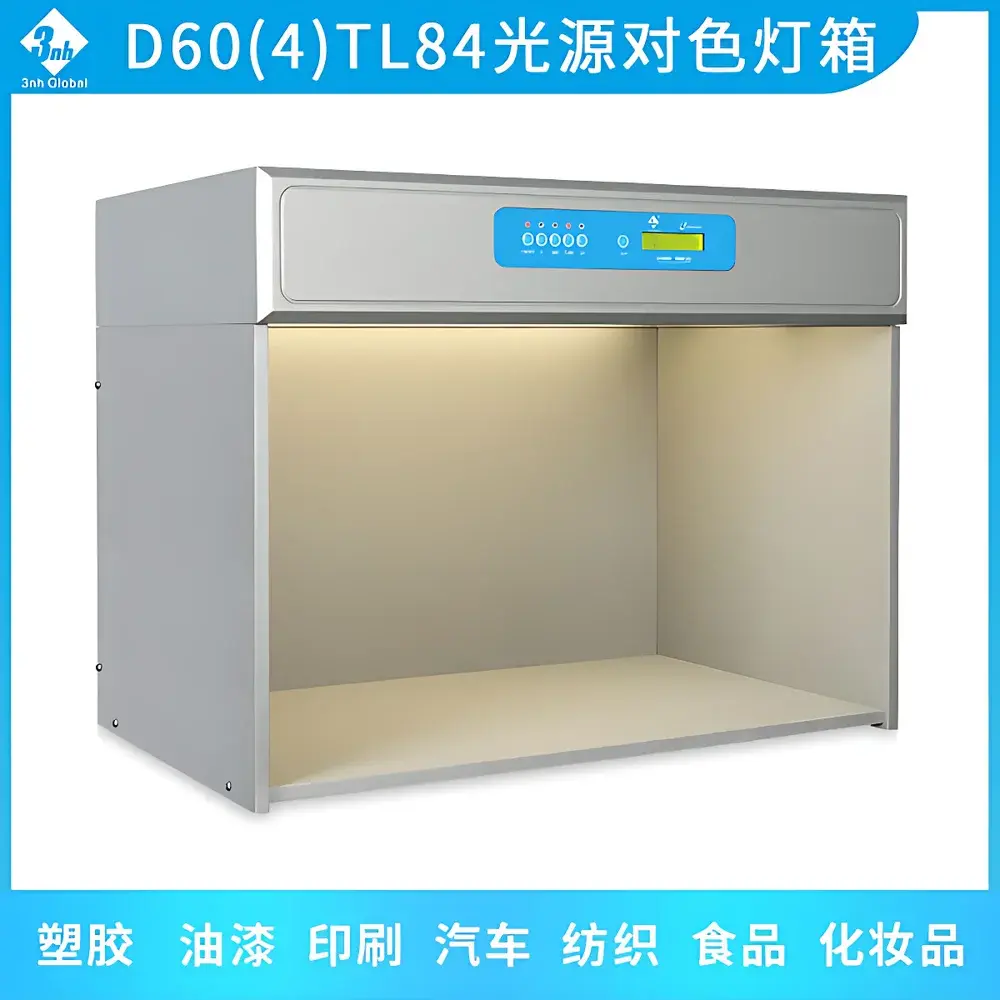
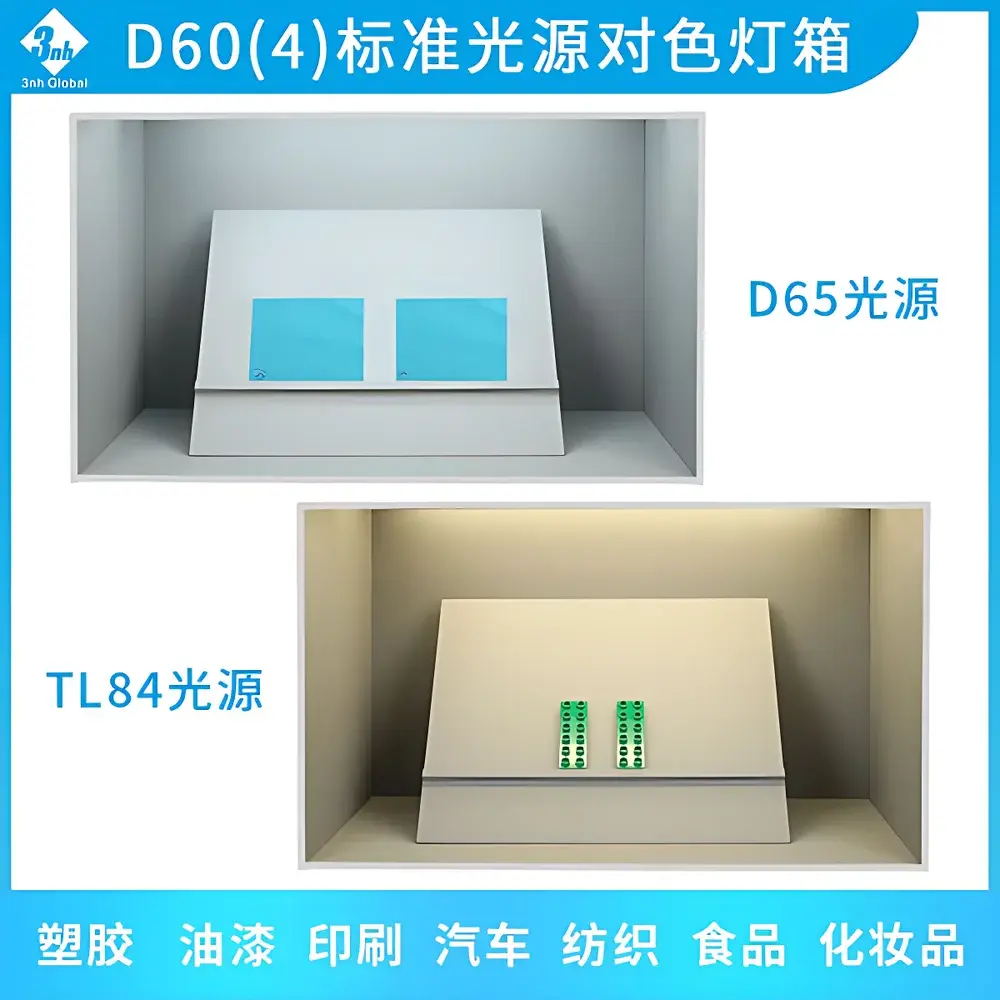
3nh DOHO D60(4) Standard Light Source Color Matching Cabinet
| Brand | 3nh |
|---|---|
| Origin | Guangdong, China |
| Manufacturer Type | Manufacturer |
| Model | D60(4) |
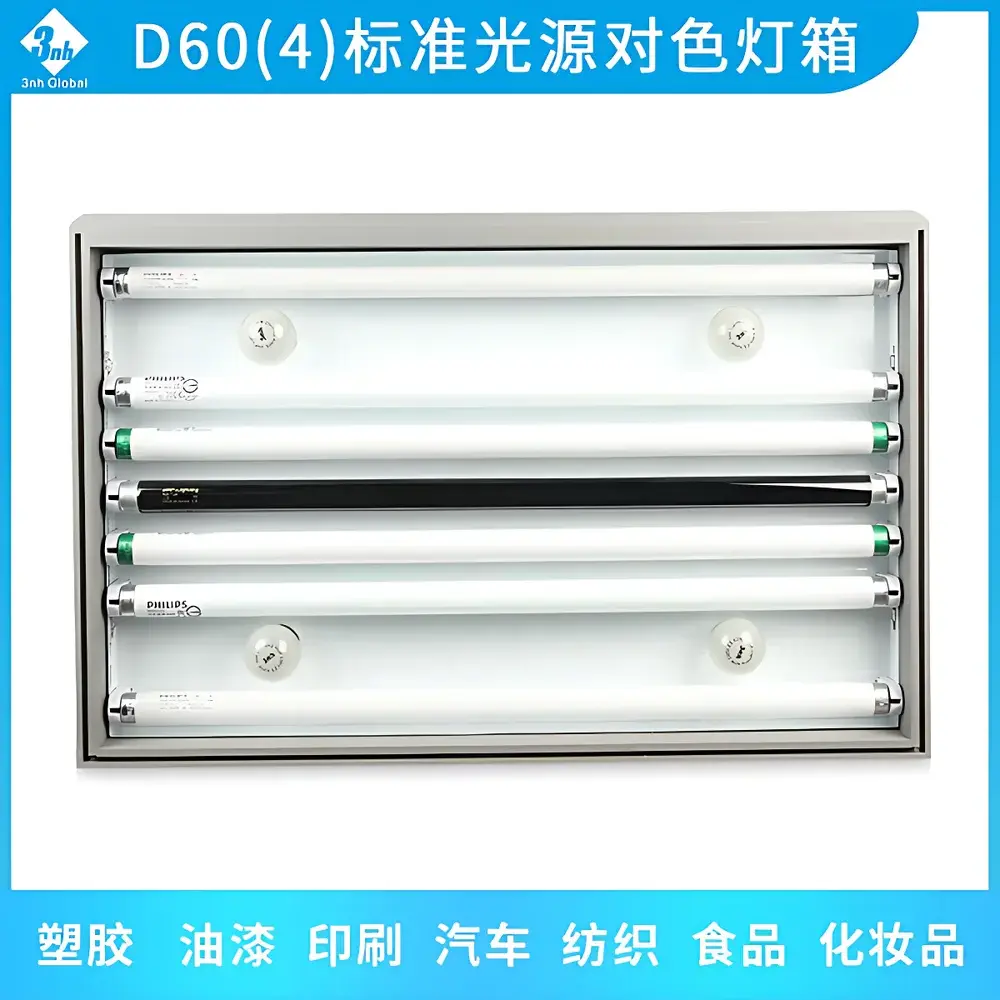
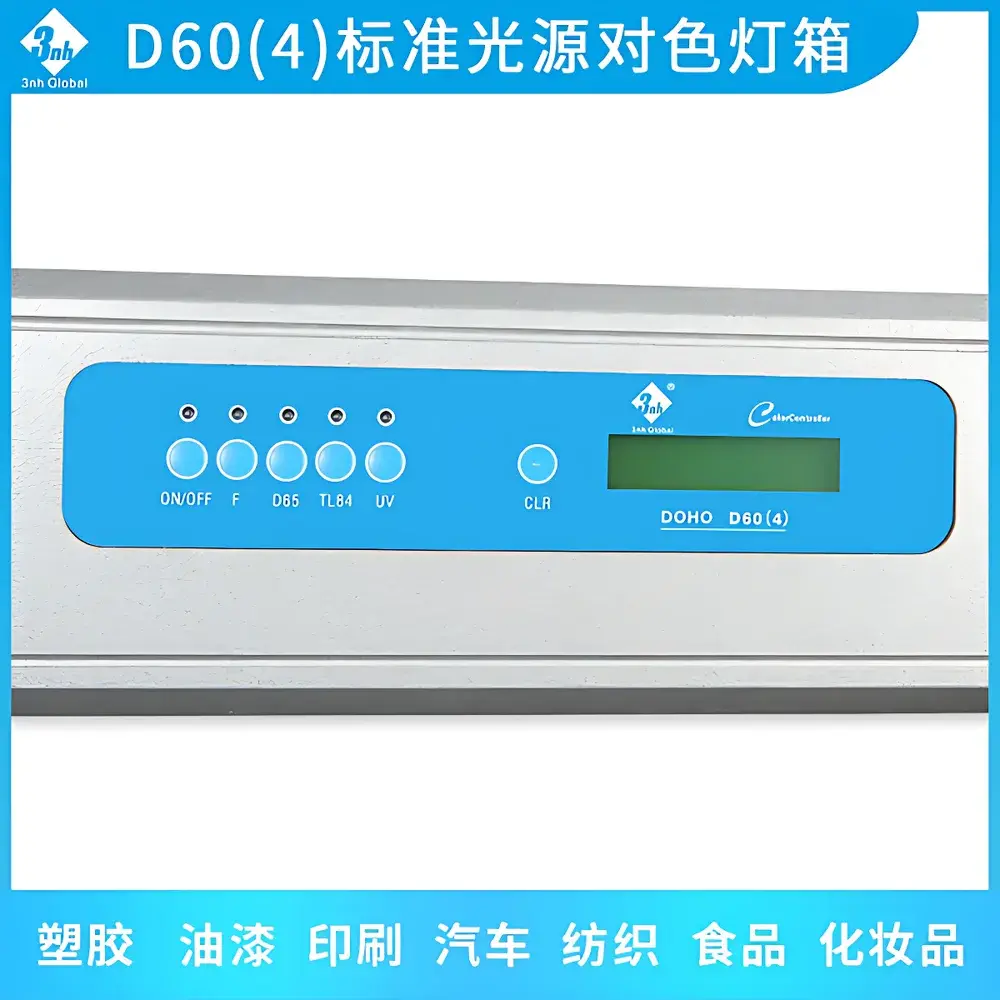
| Light Sources | D65 (6500K, 18W), TL84 (4000K, 18W), F (2700K, 40W), UV (365 nm, 18W) |
| Net Weight | 28 kg |
| Dimensions (W×D×H) | 710 × 405 × 570 mm |
| Compliance | ISO 3664:2009, ASTM D1729, CIE No. 51, GB/T 9761–2008 |
Overview
The 3nh DOHO D60(4) Standard Light Source Color Matching Cabinet is an engineered optical measurement instrument designed to replicate standardized illumination conditions essential for accurate visual color assessment across industrial quality control, R&D, and production environments. It operates on the principle of controlled spectral irradiance simulation—delivering stable, uniform, and spectrally defined light output from four independently switchable光源 modules aligned with internationally recognized viewing standards. The cabinet’s core function is to eliminate metamerism-related evaluation errors by enabling side-by-side comparison of samples under precisely calibrated illuminants, including daylight (D65), commercial retail lighting (TL84), incandescent reference (F), and ultraviolet excitation (UV). Its design adheres to photometric stability requirements specified in ISO 3664:2009 for graphic technology and color proofing, ensuring repeatability across operator shifts and facility locations.
Key Features
- Four independently controllable light sources: D65 (6500 K, 18 W), TL84 (4000 K, 18 W), F (2700 K, 40 W), and UV (365 nm peak wavelength, 18 W), each compliant with spectral power distribution (SPD) tolerances defined in CIE Publication No. 51 and ISO 3664.
- Uniform illumination field (>85% uniformity across 500 × 350 mm viewing area) achieved via optimized reflector geometry and diffuser panel configuration, minimizing hotspot formation and angular dependency.
- Robust steel-and-aluminum chassis with matte black interior finish (reflectance <5%) to suppress stray light and enhance contrast perception during visual matching.
- Integrated digital timer and soft-start circuitry to extend lamp service life and ensure consistent lumen output over time—critical for long-term calibration traceability.
- Ergonomic viewing aperture with adjustable height stand and optional chin rest support, conforming to ISO 3664-recommended observer positioning (45° viewing angle, 0° illumination).
Sample Compatibility & Compliance
The D60(4) accommodates flat or moderately curved specimens up to 450 mm in width and 300 mm in depth, supporting textile swatches, paint chips, plastic injection-molded parts, printed packaging, automotive trim, and coated metal panels. Its internal geometry and light distribution comply with ASTM D1729 for color evaluation of paints and coatings, and meets the ambient lighting and surround requirements of ISO 3664:2009 for graphic arts applications. All light sources are certified per IEC/EN 61000-3-2 for harmonic current emissions and classified as Class I electrical equipment under IEC 61010-1 for laboratory use. The cabinet supports GLP/GMP-aligned workflows through documented lamp replacement logs and routine verification using NIST-traceable spectroradiometers.
Software & Data Management
While the D60(4) is a hardware-only visual assessment platform without embedded software, it integrates seamlessly into enterprise color management ecosystems. Its standardized illuminants serve as physical reference points for validating spectrophotometer measurements (e.g., Konica Minolta CM-700d, X-Rite Ci7800) and calibrating digital imaging systems used in automated color inspection. Users may pair the cabinet with third-party color analysis software (e.g., X-Rite Color iMatch, Datacolor Match Pigment) to correlate visual pass/fail decisions with instrumental ΔE00 tolerances. Audit trails—including light source usage duration, maintenance timestamps, and environmental monitoring records (ambient temperature/humidity)—can be maintained manually or imported into LIMS platforms compliant with FDA 21 CFR Part 11 when linked to external data loggers.
Applications
- Textile and apparel QC: Evaluating dye lot consistency under D65 (daylight) and TL84 (retail store lighting) to detect metamerism before shipment.
- Automotive interior trim validation: Assessing color match between dashboard components, seat fabrics, and door panels under F (incandescent) and D65 lighting to simulate cabin conditions.
- Printing and packaging prepress: Verifying color fidelity of proofs and press sheets against brand standards using D65 and UV to detect optical brightener effects.
- Paint and coating formulation: Supporting visual grading of gloss, texture, and undertone under multiple illuminants during lab-scale development and batch release testing.
- Plastics and polymer manufacturing: Confirming color stability after thermal aging or UV exposure by comparing pre- and post-test specimens under identical D65 and UV illumination.
FAQ
What international standards does the D60(4) comply with?
It conforms to ISO 3664:2009, ASTM D1729, CIE Publication No. 51, and GB/T 9761–2008 for spectral irradiance, uniformity, and geometric viewing conditions.
Can the UV source be used for fluorescence assessment?
Yes—the 365 nm UV lamp is optimized for exciting common optical brightening agents (OBAs) in paper, textiles, and plastics, enabling detection of fluorescence-induced color shifts.
How often should the lamps be replaced?
D65, TL84, and UV lamps require replacement after 2,000 hours of cumulative operation; the F lamp (tungsten-halogen) has a rated life of 1,000 hours. Replacement intervals should be logged for GLP compliance.
Is the cabinet suitable for use in cleanroom environments?
It is not rated for ISO Class 5 or higher cleanrooms due to non-sealed construction and lack of HEPA filtration; however, it may be installed in controlled ambient labs meeting ISO 14644-1 Class 8 specifications.
Does the D60(4) support remote lamp switching or automation integration?
No—it features manual rocker switches only. For automated sequencing, external relay controllers or PLC interfaces must be implemented at system integration level.




