
3nh TS7020 Portable Spectrophotometric Color Difference Meter for Textile Dyeing & Printing
| Brand | 3nh |
|---|---|
| Origin | Guangdong, China |
| Manufacturer Type | OEM/ODM Manufacturer |
| Country of Origin | China |
| Model | TS7020 |
| Product Category | Color Difference Meter |
| Instrument Type | Portable |
| Optical Geometry | d/8° integrating sphere (SCI mode) |
| Illuminants | D65, A, F2 (CWF) |
| Spectral Range | 400–700 nm |
| Repeatability | ΔE*ab ≤ 0.08 (MAV/SCI, after warm-up and calibration, 30 measurements on white tile at 5 s intervals) |
Overview
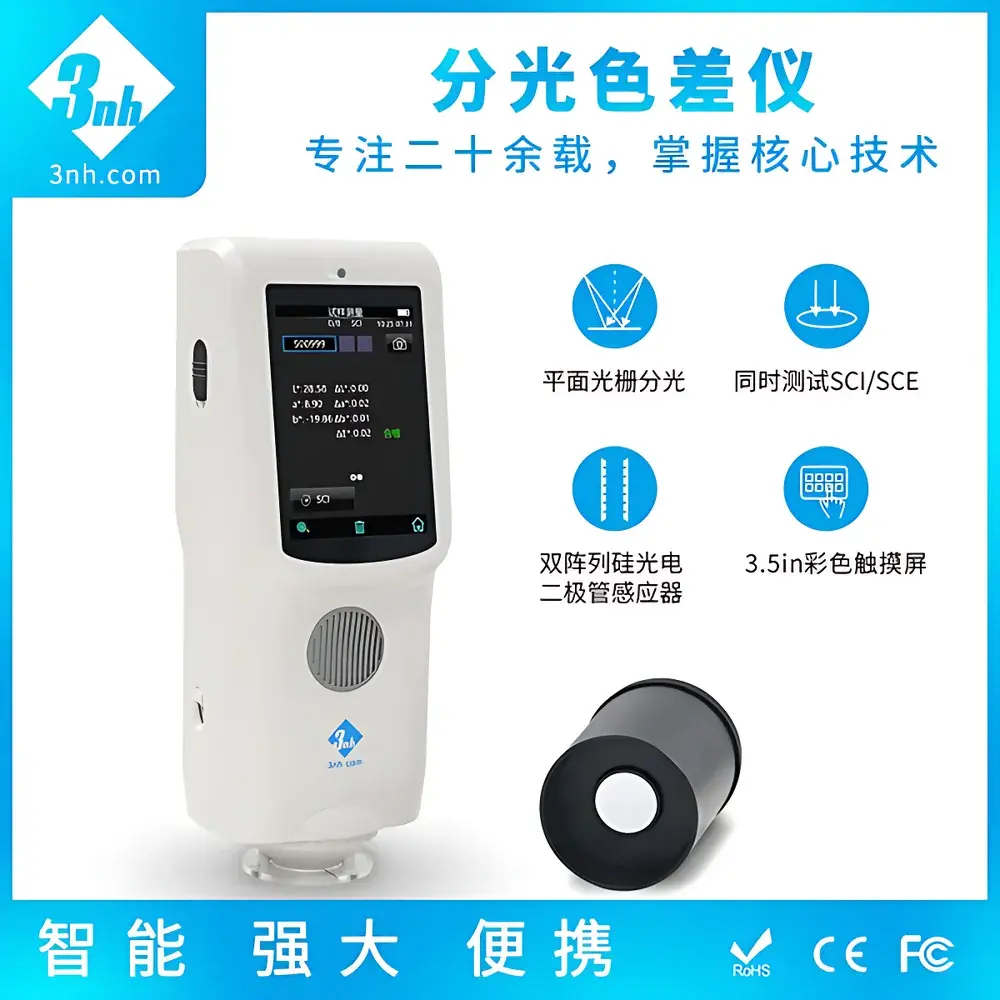
The 3nh TS7020 Portable Spectrophotometric Color Difference Meter is an ISO- and CIE-compliant bench-to-field color measurement instrument engineered for high-reproducibility spectral reflectance analysis in textile dyeing, printing, and related industrial quality control environments. It operates on the principle of diffuse illumination with 8° viewing geometry (d/8°), conforming to CIE Publication No. 15, ISO 7724-1, ASTM E1164, GB/T 3978, and DIN 5033 Teil 7. The device employs a plane grating monochromator coupled with a dual-row 24-element silicon photodiode array sensor, enabling full-spectrum acquisition across the visible range (400–700 nm) at 10 nm wavelength intervals. Its optical architecture supports both specular component included (SCI) measurements—essential for evaluating total color appearance of textured, coated, or matte surfaces—and delivers absolute L*a*b* coordinates traceable to national metrological standards via NIM (National Institute of Metrology, China)-certified calibration protocols.
Key Features
- Full-spectrum LED illumination: Uniformly balanced broad-band LED source ensures continuous spectral power distribution across 400–700 nm, eliminating gaps common in conventional white LEDs and improving spectral fidelity and measurement repeatability.
- Dual 24-channel photodiode array: Larger active sensing area enhances signal-to-noise ratio, extends dynamic range, and maintains linearity under varying sample reflectance—critical for low-gloss textiles and high-contrast dyed fabrics.
- ETC (Every Test Calibration) technology: Integrated reference white tile enables automatic optical recalibration before each measurement, compensating for thermal drift and ambient light interference without manual intervention.
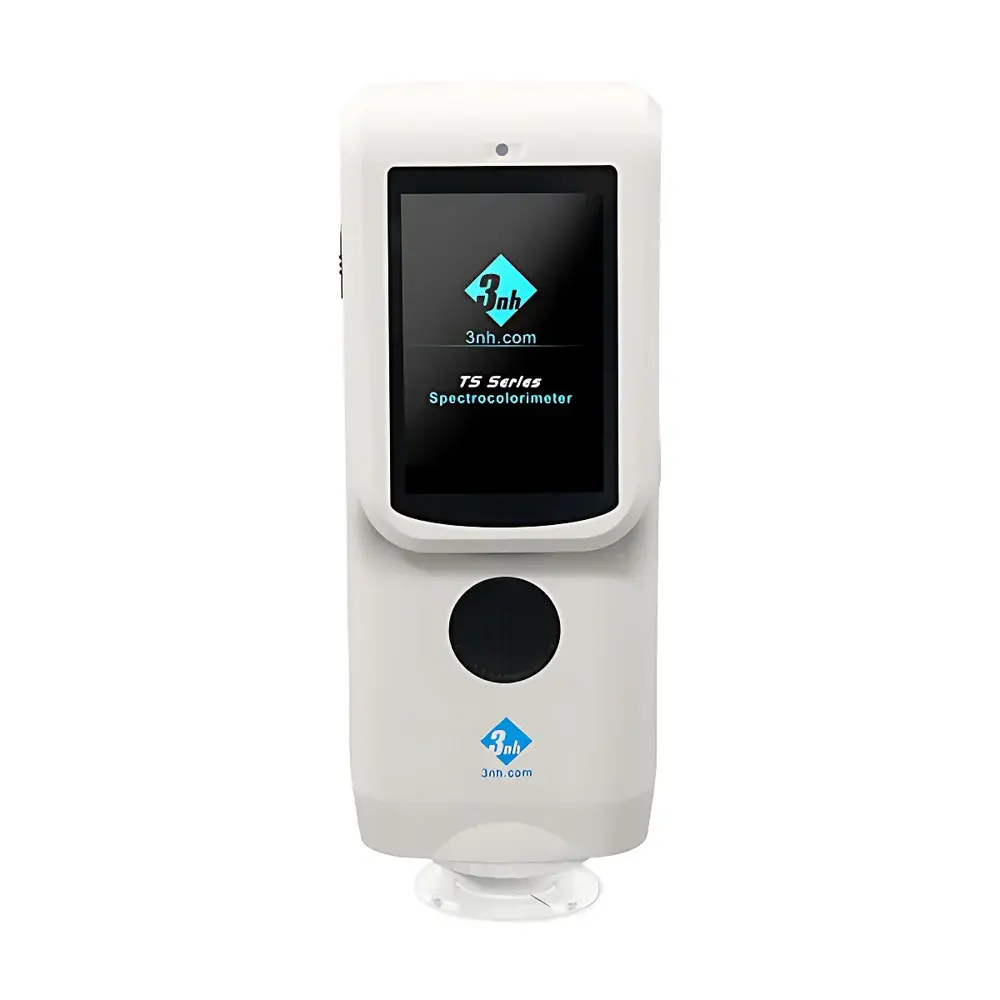
- Ergonomic handheld design: Compact form factor (81 × 71 × 214 mm), 460 g weight, and palm-contoured grip support extended use during inline production checks or lab-to-factory floor audits.
- Traceable metrological validation: Each unit ships with a factory-issued calibration certificate referencing NIM-traceable standards, satisfying GLP-aligned documentation requirements for regulated textile QC workflows.
Sample Compatibility & Compliance
The TS7020 accommodates diverse material geometries through its fixed 8 mm aperture—optimized for flat, flexible, and moderately textured substrates typical in woven/knitted fabrics, printed paper, ceramic glazes, plastic housings, and coated metal surfaces. It complies with ISO 11664-4 (CIE colorimetric observers), ISO 11664-6 (color-difference evaluation), and USP guidelines for instrumental color assessment in regulated manufacturing. While not FDA 21 CFR Part 11–validated out-of-the-box, audit trails generated by SQCX software (when deployed on validated Windows systems) support GMP-compliant data integrity practices per Annex 11 principles.
Software & Data Management
The TS7020 interfaces with 3nh’s SQCX Quality Control Software via USB connection, enabling centralized management of up to 500 standard references and 10,000 sample records. SQCX supports multi-parameter reporting—including ΔE*ab, ΔE00, CMC(2:1), and DIN99—and exports CSV, PDF, and XML files compliant with enterprise LIMS integration. The software provides real-time pass/fail flagging against user-defined tolerances, spectral reflectance curve overlays, batch statistical summaries (X̄, R, Cp/Cpk), and customizable report templates aligned with AATCC TM173, ISO 105-J03, and GB/T 250–2008 textile colorfastness reporting conventions.
Applications
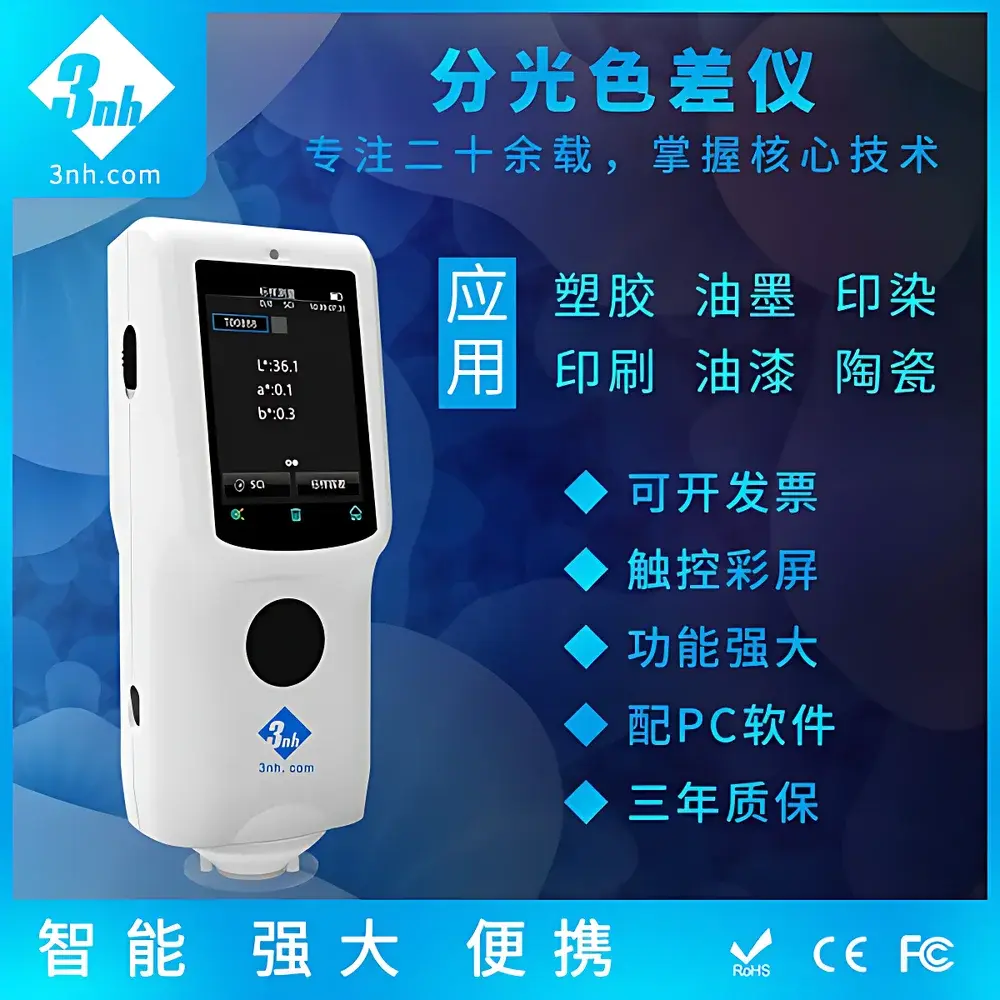
- Textile dye lot consistency verification across fiber types (cotton, polyester, nylon, blends)
- Color matching validation between lab dip samples and bulk production runs
- In-line shade sorting of printed fabrics and garment components
- Quality gate inspection for OEM apparel suppliers serving global brands
- Reflectance profiling of pigment-coated substrates in digital textile printing
- Long-term stability monitoring of dye formulations under accelerated aging conditions
FAQ
What is the measurement repeatability specification under SCI mode?
ΔE*ab ≤ 0.08 (based on 30 consecutive measurements of a certified white tile, 5 s interval, post-warm-up calibration).
Does the TS7020 support multiple observer angles?
Yes—it implements the CIE 10° standard observer exclusively, consistent with textile industry practice for large-field visual assessment.
Can it measure non-flat or curved textile surfaces?
It requires stable contact via the included stabilization plate; highly irregular or pile fabrics should be measured using compression fixtures (e.g., optional textile test kit) to minimize air gaps.
Is spectral data export available for third-party analysis?
Yes—raw 400–700 nm reflectance spectra at 10 nm intervals can be exported as ASCII text for import into MATLAB, Python (NumPy/Pandas), or commercial color science platforms.
How often must the instrument be recalibrated?
Daily zero and white calibration is recommended before critical measurements; ETC technology reduces dependency on external calibration tiles but does not eliminate scheduled verification per ISO/IEC 17025 internal audit schedules.





