
DIC In-Situ Stress Field Measurement and Analysis System – LEI-TECH LK-DSE16
| Brand | LEI-TECH |
|---|---|
| Origin | Tianjin, China |
| Manufacturer Type | Direct Manufacturer |
| Country of Origin | China |
| Model | LK-DSE16 |
| Price | USD 65,000 (FOB Tianjin) |
Overview
The LEI-TECH LK-DSE16 DIC In-Situ Stress Field Measurement and Analysis System is a high-precision optical metrology platform engineered for full-field, non-contact quantification of surface displacement and strain distributions under mechanical loading. Based on Digital Image Correlation (DIC) methodology, the system captures sequential high-resolution monochrome images of a stochastic speckle pattern applied to the specimen surface, then computes sub-pixel-level displacements via intensity-based correlation algorithms. This enables real-time, two-dimensional (2D-DIC) or stereoscopic three-dimensional (3D-DIC) strain mapping with spatial resolution down to 1–5 pixels per strain gauge equivalent and strain sensitivity typically better than ±20 µε (microstrain) under controlled laboratory conditions. Designed for integration into universal testing machines (UTMs), environmental chambers, and fatigue rigs, the LK-DSE16 supports true in-situ mechanical testing—capturing evolving stress–strain states during tensile, compression, bending, creep, or cyclic loading without interrupting the experiment.
Key Features
- High-stability dual-camera stereo imaging architecture optimized for 3D-DIC, with synchronized global shutter CMOS sensors (2048 × 2048 px standard, optional up to 4096 × 4096 px)
- Integrated LED illumination subsystem with adjustable intensity, uniformity control, and flicker-free operation—minimizing thermal drift and motion blur during long-duration tests
- Real-time DIC engine capable of >15 fps at full resolution (2D mode) and >5 fps in stereo 3D mode, with on-the-fly displacement/strain tensor computation
- Modular hardware design supporting interchangeable telecentric or macro-zoom lenses (0.5×–5× magnification range), enabling measurements from millimeter-scale microstructures to meter-scale structural components
- Ruggedized aluminum chassis with passive thermal management, EMI-shielded cabling, and IP52-rated enclosure options for industrial test cell deployment
- Calibration suite compliant with ISO/IEC 17025 traceable procedures—including lens distortion correction, stereo geometric calibration, and uncertainty quantification reports per ASTM E2777-22
Sample Compatibility & Compliance
The LK-DSE16 accommodates specimens ranging from metallic alloys, composites, and polymers to biological tissues and additive-manufactured parts. Surface preparation follows ASTM E837-21 guidelines for speckle pattern application (particle size < 1/10 of smallest feature of interest; contrast ratio ≥ 3:1). The system is compatible with standard mechanical test fixtures and load frames equipped with M6/M8 mounting interfaces. All firmware and calibration data comply with GLP documentation requirements. Audit trails, user access logs, and electronic signatures are supported in accordance with FDA 21 CFR Part 11 when operated with validated software configurations. Full compliance with ISO 10360-7 (coordinate measuring systems) and VDI/VDE 2634 Part 3 (optical 3D measurement systems) is documented in the manufacturer’s Type Examination Report.
Software & Data Management
The proprietary LEI-Vision DIC software (v5.2+) provides an integrated environment for acquisition, processing, visualization, and reporting. Core modules include: real-time monitoring dashboard with live strain contour overlays; batch processing pipeline supporting TIFF, HDF5, and NIfTI export formats; automated ROI definition using edge detection or mask-based segmentation; and post-processing tools for principal strain, von Mises stress, and displacement vector field derivation. Raw image datasets are stored with embedded metadata (timestamp, camera parameters, calibration ID, environmental sensor readings). Data integrity is ensured via SHA-256 checksums and version-controlled project archives. Exported results conform to ASTM E2624-20 (standard practice for reporting DIC data) and support direct import into MATLAB, Python (via NumPy/H5Py), and commercial FEA platforms including ANSYS Mechanical and ABAQUS/CAE.
Applications
- Mechanical characterization of advanced materials: interfacial debonding in fiber-reinforced composites, plastic zone evolution in weld joints, and strain localization in high-entropy alloys
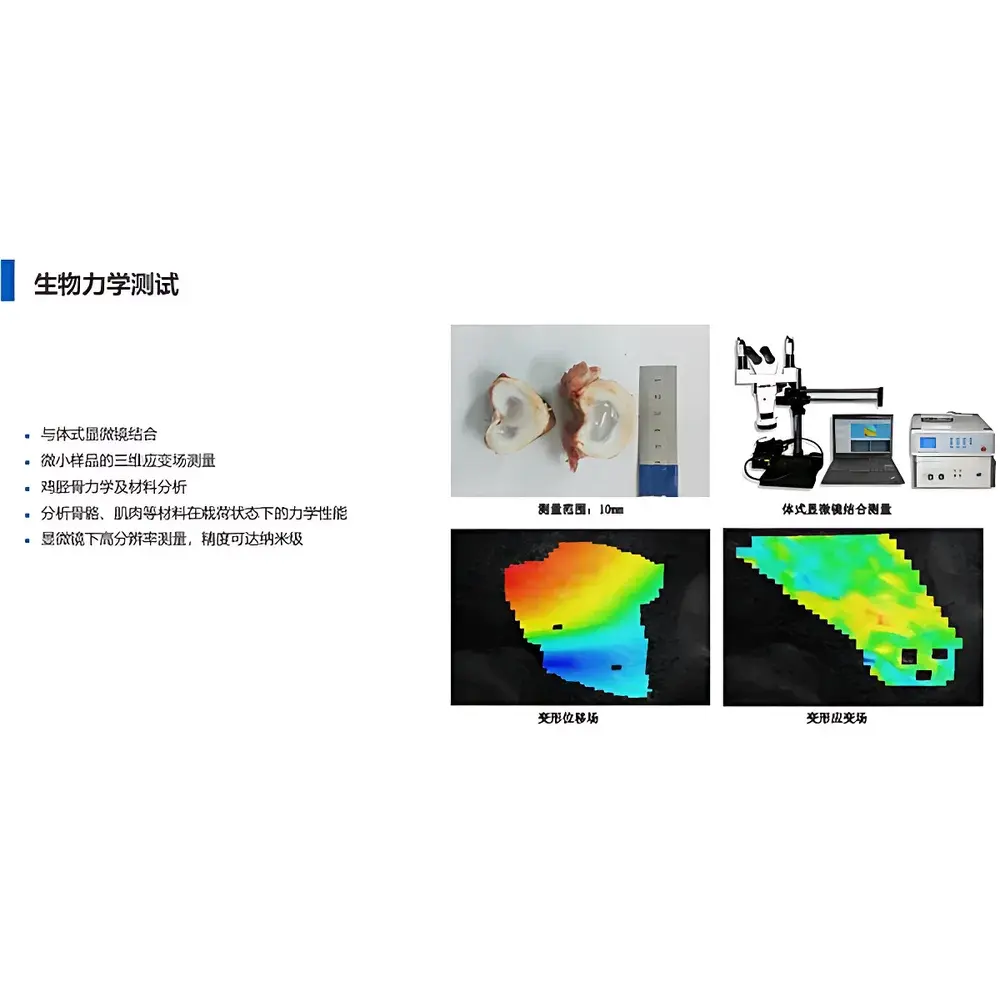
- Biomechanics research: cartilage deformation under compressive loading, tendon strain distribution during cyclic stretching, and scaffold mechanics in tissue engineering constructs
- Failure analysis: crack tip strain fields, notch sensitivity assessment, and residual stress mapping following shot peening or laser shock processing
- Quality assurance in additive manufacturing: in-process distortion monitoring during selective laser melting (SLM), build validation via layer-wise strain accumulation, and post-build heat treatment effect quantification
- Educational use in solid mechanics laboratories: visual demonstration of Saint-Venant’s principle, Poisson’s ratio determination, and elastic–plastic transition identification
FAQ
What is the minimum measurable strain resolution under optimal conditions?
Typical system noise floor corresponds to ±15–25 µε for static measurements using 2048 × 2048 px cameras and 2× magnification; resolution improves with higher magnification, longer exposure, and optimized speckle contrast.
Does the system support synchronization with external load cells or extensometers?
Yes—TTL trigger input/output ports enable hardware-level synchronization with UTM controllers, load cells (±10 V analog or digital RS-422), and clip-on extensometers via programmable delay and frame alignment logic.
Is third-party software integration possible?
The system exposes a documented C++ API and Python SDK for custom automation, real-time feedback control loops, and integration with LabVIEW, ROS 2, or in-house test orchestration frameworks.
What calibration documentation is provided upon delivery?
Each unit ships with a factory calibration certificate referencing NIST-traceable length standards, stereo calibration report (reprojection error < 0.25 px), and uncertainty budget per GUM (JCGM 100:2008) for displacement and strain outputs.
Can the system operate inside environmental chambers?
Yes—optional chamber-integrated versions include vacuum-compatible lens housings, temperature-compensated mounts (−40 °C to +150 °C), and fiber-optic image relay kits for confined or hazardous environments.




