
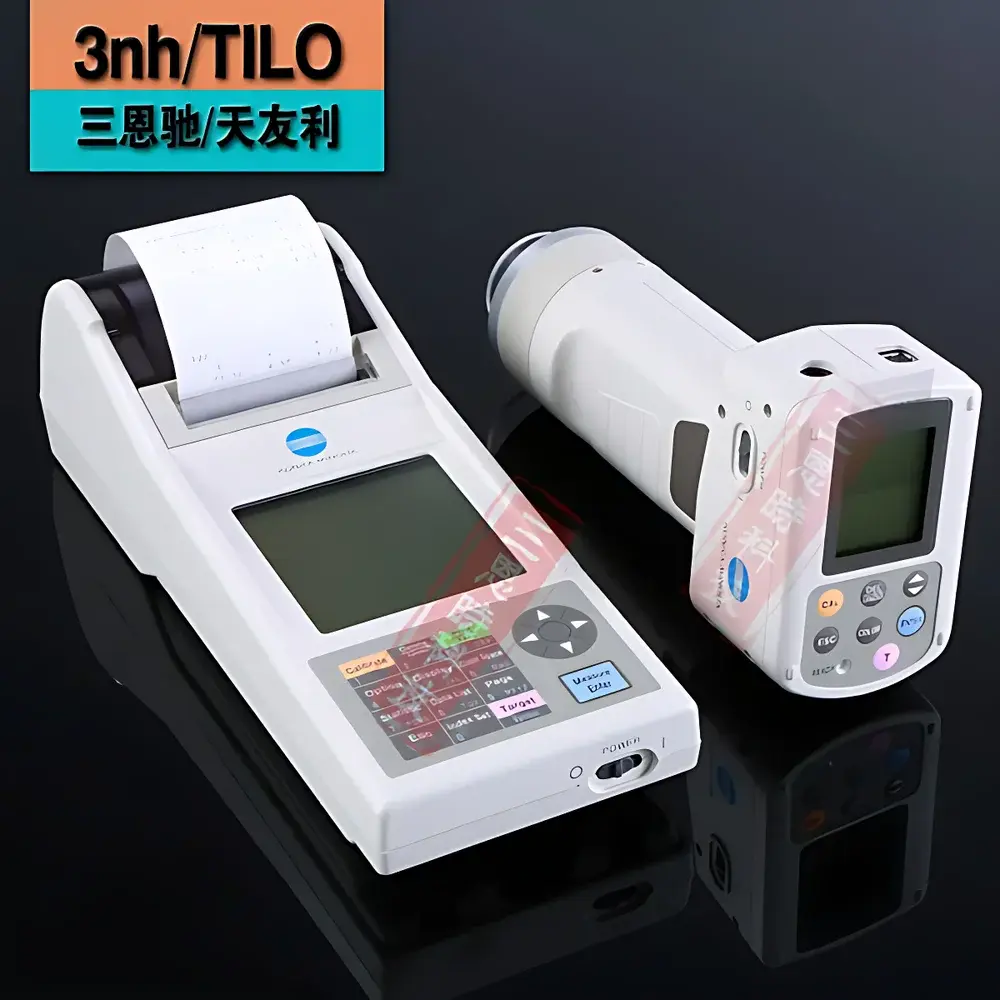

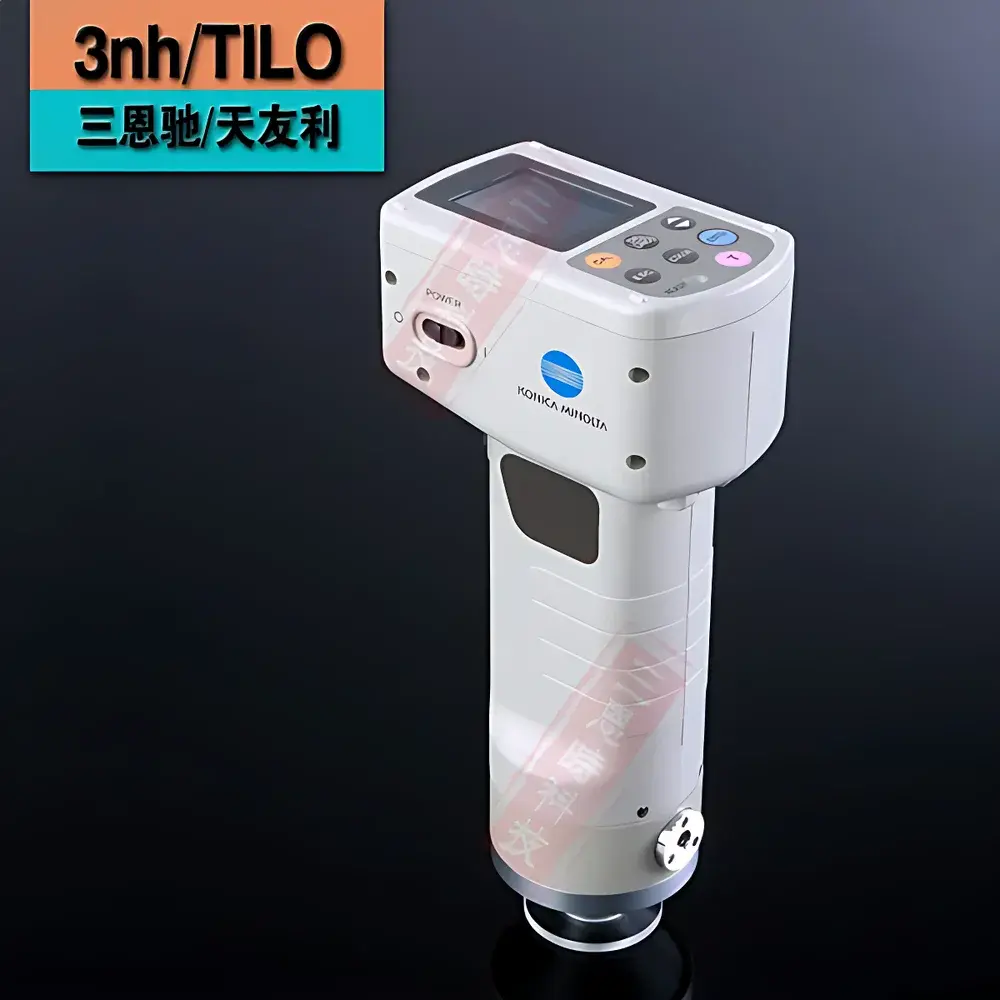
Konica Minolta CR-400 / CR-410 Spectrophotometric Colorimeter
| Brand | Konica Minolta |
|---|---|
| Origin | Shanghai, China |
| Model | CR-400 / CR-410 |
| Type | Portable Spectrophotometric Colorimeter |
| Optical Geometry | d/8° integrating sphere (with specular component included) |
| Light Source | Pulsed xenon arc lamp |
| Spectral Range | 300–700 nm |
| Repeatability | ΔE*ab ≤ 0.07 (after white calibration plate measurement, 30 times at 10 s intervals) |
Overview
The Konica Minolta CR-400 and CR-410 are fourth-generation portable spectrophotometric colorimeters engineered for high-precision, field-deployable color measurement across industrial quality control, R&D, and regulatory-compliant environments. Based on the proven optical architecture of the CR-100/200/300 series, these instruments retain full spectral data compatibility—ensuring seamless historical data continuity during instrument upgrades. Both models operate on the CIE standard d/8° geometry with specular component included (SCI), enabling accurate characterization of both diffuse and directional reflectance from matte, textured, and moderately glossy surfaces. The pulsed xenon arc lamp provides stable, flash-based illumination free from thermal drift or spectral aging—critical for long-term repeatability and inter-instrument agreement. With a spectral response spanning 300–700 nm at nominal 10 nm resolution (interpolated), the CR-400/CR-410 deliver full reflectance spectra used to compute CIE tristimulus values (XYZ), chromaticity coordinates (Yxy), and multiple advanced color difference metrics—including CIEDE2000, CMC (l:c), and CIE94—under standardized observer conditions (2° CIE 1931).
Key Features
- Two interchangeable probe configurations: CR-400 features an 8 mm measurement aperture ideal for small-area or high-spatial-resolution applications; CR-410 integrates a large 50 mm aperture optimized for heterogeneous, granular, or structured surfaces (e.g., textiles, stone, foodstuffs, pharmaceutical tablets), eliminating the need for multi-point averaging.
- Dual-mode operation: The measurement head includes an integrated backlit LCD display, function keys, and independent power supply—enabling standalone use without the main processor unit. Alternatively, it functions as a modular sensor when connected via RS-232C or USB 2.0 (with CR-A105 adapter cable) to host systems running SpectraMagic NX software.
- Comprehensive on-device data handling: Internal memory stores up to 100 reference standards and 1,000 measurement records. Calibration channels include one dedicated white calibration channel (Ch00) plus 19 user-defined channels (Ch01–Ch19) for application-specific calibrations (e.g., different substrates, lighting conditions, or material batches).
- Multi-language interface support: Device firmware supports English (default), German, French, Italian, Spanish, and Japanese—configurable independently for keypad labels and LCD display output.
- Robust mechanical design: Compact housing (105 × 218 × 63 mm for CR-400; 105 × 245 × 63 mm for CR-410), weight under 560 g (including Ni-MH battery pack), and operational range of 0–40°C / ≤85% RH (non-condensing) ensure reliability in factory-floor, lab, and field settings.
Sample Compatibility & Compliance
The CR-400/CR-410 accommodate diverse sample types—from flat, smooth surfaces (paints, plastics, coated metals) to irregular, non-uniform materials (fabric weaves, ground spices, ceramic tiles, biological tissue). The inclusion of SCI mode ensures consistent evaluation of total reflectance, critical for appearance matching where surface texture or gloss variation affects perceived color. Instrument performance conforms to ISO 11664 (CIE colorimetry standards), ASTM E308 (computing color coordinates from spectral data), and ISO/DIS 13655 (spectral measurement geometry). Inter-instrument agreement meets industry benchmarks: ∆E*ab ≤ 0.6 (CR-400) and ≤ 0.8 (CR-410) when measuring the BCRA Series II 12-color tile set—supporting multi-site deployment and cross-facility color transfer protocols. While not FDA 21 CFR Part 11–certified out-of-the-box, audit trails, user access control, and electronic signature capabilities can be implemented via SpectraMagic NX in validated GxP environments (e.g., pharmaceutical QC labs operating under ICH Q5E or USP <1061>).
Software & Data Management
SpectraMagic NX (Windows®-based, sold separately) serves as the primary data acquisition, analysis, and reporting platform. It enables advanced statistical process control (SPC), tolerance mapping (rectangular and elliptical ΔE zones), pass/fail evaluation against user-defined limits, and export of raw spectral data (CSV, TXT) or formatted reports (PDF, Excel). The software supports GLP/GMP-aligned workflows through configurable user roles, electronic signatures, and full audit trail logging—including timestamped edits to standards, tolerances, or calculation formulas. Custom index creation (up to six user-defined formulas per instrument) allows direct computation of application-specific metrics such as whiteness (WI ASTM E313, CIE WI/Tw), yellowness (YI ASTM D1925), or proprietary color indices derived from XYZ, Yxy, or CIELAB inputs.
Applications
- Industrial manufacturing: Paint & coating formulation, plastic extrusion, textile dyeing, automotive interior trim validation.
- Food & beverage: Batch-to-batch consistency of sauces, dairy products, confectionery, and powdered ingredients.
- Pharmaceuticals: Tablet coating uniformity, capsule shell color verification, excipient batch release testing per USP <1061>.
- Cosmetics & dermatology: Skin tone matching, foundation shade development, pigment stability monitoring.
- Academic research: Material science studies involving photochromic or thermochromic behavior, pigment dispersion analysis, and spectral reflectance modeling.
FAQ
What is the difference between CR-400 and CR-410?
The CR-400 uses an 8 mm measurement aperture suitable for homogeneous, flat samples; the CR-410 features a 50 mm aperture optimized for large-area or structurally heterogeneous materials requiring single-point representative measurement.
Does the instrument support CIE 2000 (CIEDE2000) color difference calculation?
Yes—both models compute ΔE₀₀ directly on-device and within SpectraMagic NX, using the full spectral dataset and standardized weighting functions per CIE Publication 142-2001.
Can the CR-400/CR-410 perform measurements under multiple illuminants (e.g., D50, D65, F2)?
Yes—illuminant selection (C, D50, D65, F2, F7, F11) is configurable in both device firmware and SpectraMagic NX, with corresponding CIE observer (2° or 10°) options available in software.
Is spectral data export supported?
Yes—raw 31-point reflectance spectra (10 nm intervals from 300–700 nm) can be exported in CSV format via SpectraMagic NX for third-party spectral analysis or integration into LIMS platforms.
How is calibration traceability maintained?
White calibration is performed using the supplied certified ceramic tile (traceable to NIST SRM 2011 or equivalent national standards); optional annual recalibration services are available through Konica Minolta authorized service centers with documented uncertainty budgets.




