
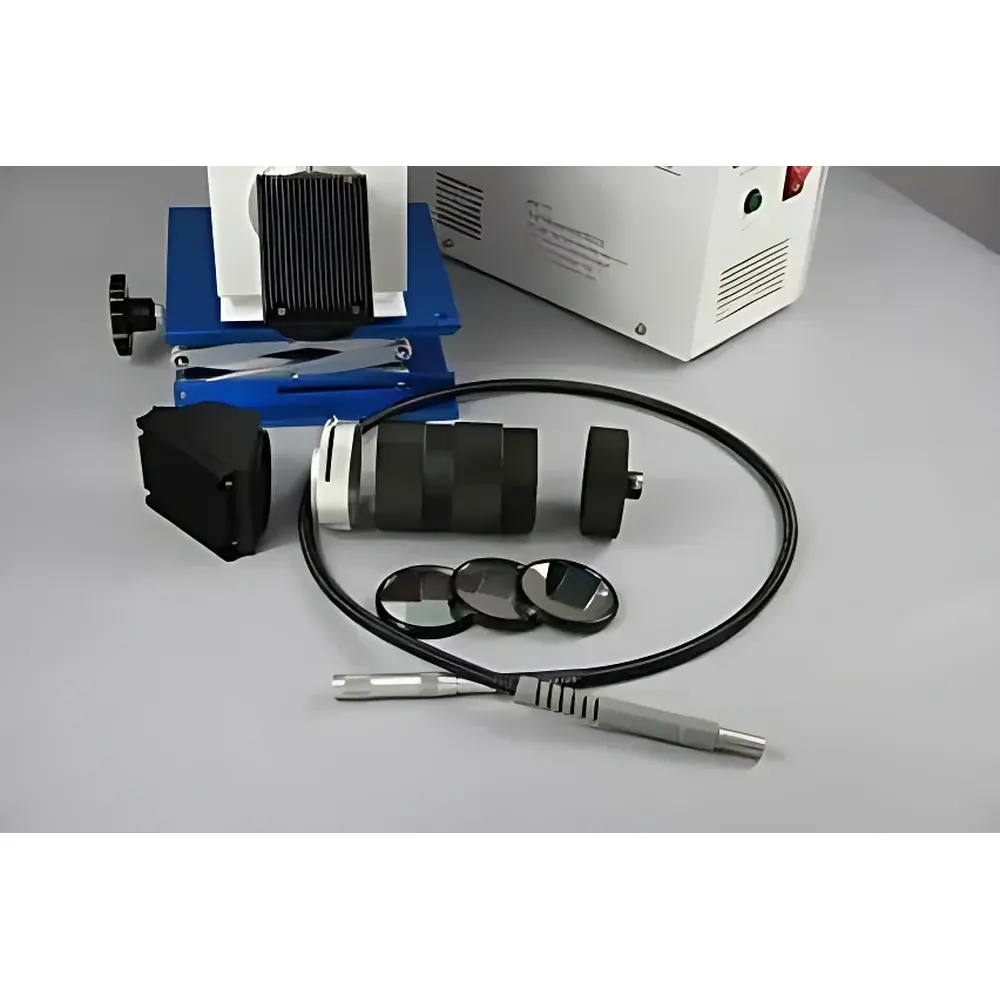
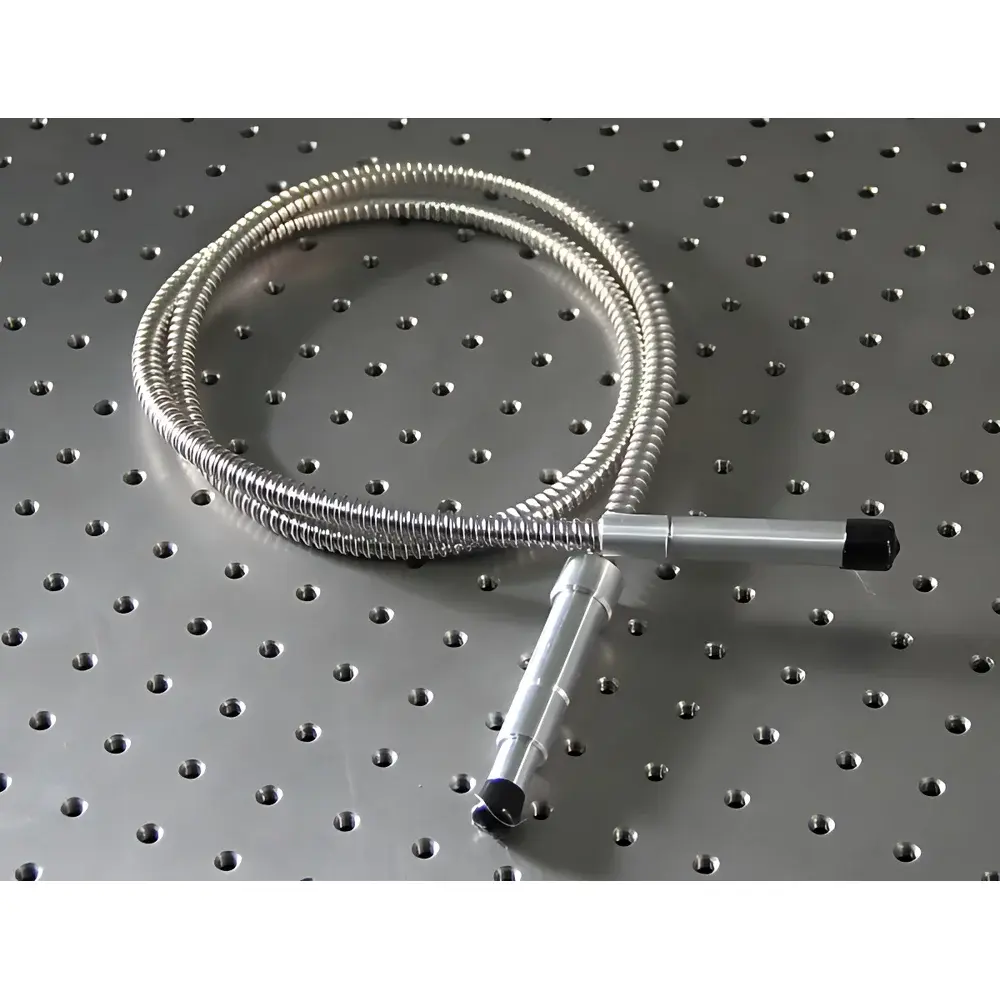
Quartz Optical Fiber
| Brand | CME |
|---|---|
| Origin | Beijing, China |
| Manufacturer Type | OEM/ODM Producer |
| Origin Classification | Domestic (China) |
| Model | Quartz Optical Fiber |
| Price | USD 265 (FOB Beijing) |
Overview
Quartz optical fiber is a high-purity, low-OH synthetic fused silica waveguide engineered for demanding ultraviolet (UV), visible (VIS), and near-infrared (NIR) transmission applications. Unlike standard telecom-grade silica fibers, quartz optical fibers feature ultra-low hydroxyl (OH⁻) content (<1 ppm), enabling exceptional transmission down to 180 nm—critical for deep-UV spectroscopy, excimer laser delivery, plasma diagnostics, and synchrotron beamlines. The core material is manufactured via flame hydrolysis or plasma chemical vapor deposition (PCVD), followed by controlled sintering and drawing under inert atmosphere to preserve stoichiometric integrity and minimize defect-induced attenuation. This product line is supplied as bare, jacketed, or connectorized fiber assemblies—each configured per end-user optical path requirements.
Key Features
- Ultra-low OH⁻ content fused silica core with transmission range spanning 180–2200 nm
- High laser damage threshold (>5 J/cm² at 193 nm, 20 ns pulse, 20 Hz)
- Low intrinsic attenuation: ≤1.5 dB/km @ 244 nm; ≤0.2 dB/km @ 633 nm
- Controlled numerical aperture (NA): 0.12–0.22, selectable per application
- Customizable cladding diameter (80–250 µm), core diameter (50–600 µm), and length (0.5–50 m)
- Optional polymer overjacketing (PEEK, ETFE, or stainless steel loose tube) for mechanical robustness and EMI shielding
- Available with SMA-905, FC/PC, or custom terminations compatible with spectrometers, monochromators, and laser sources
Sample Compatibility & Compliance
This quartz fiber is compatible with standard optical bench mounts, fiber couplers, and collimation optics used in laboratory and industrial analytical systems. It meets material traceability requirements per ISO 9001:2015 and conforms to ASTM F1717-20 (Standard Specification for Optical Fibers Used in Medical Laser Systems) for biocompatible packaging options. While not classified as a medical device, its material certification supports integration into Class I and IIa diagnostic instruments under EU MDR Annex II documentation protocols. All batches undergo spectral transmission verification across UV-VIS-NIR using NIST-traceable reference spectrophotometers and are accompanied by full Certificate of Conformance (CoC) including lot-specific UV cutoff wavelength and proof-test data.
Software & Data Management
As a passive optical component, the quartz fiber itself does not incorporate embedded firmware or software interfaces. However, it is fully interoperable with industry-standard optical system control environments—including Ocean Insight OceanView, Thorlabs Kinesis, and LabVIEW-based DAQ platforms—when integrated into spectrometer or laser delivery subsystems. For calibration-critical applications (e.g., quantitative UV-Vis absorbance or radiometric intensity transfer), users may assign unique identifiers to each fiber batch within their LIMS or ELN (e.g., LabArchives, Benchling) to maintain chain-of-custody for spectral responsivity drift monitoring. Audit trails for fiber installation, recalibration intervals, and end-face inspection logs align with GLP and ISO/IEC 17025 documentation expectations.
Applications
- Deep-UV Raman spectroscopy (193 nm / 248 nm excitation)
- Plasma emission monitoring in semiconductor etch chambers
- Fiber-coupled photoluminescence quantum yield measurement
- Synchrotron beamline light transport (bending magnet and insertion device lines)
- Excimer laser (ArF, KrF) energy delivery for micromachining and surface modification
- In-situ catalytic reaction monitoring under harsh thermal/chemical environments
- Calibration transfer standards for portable NIR analyzers in pharma QA/QC labs
FAQ
Is this fiber suitable for vacuum ultraviolet (VUV) applications below 180 nm?
No—standard high-purity quartz fiber exhibits strong absorption below 180 nm due to electronic band-edge effects. For VUV (10–200 nm), magnesium fluoride (MgF₂) or lithium fluoride (LiF) fiber alternatives are required.
Can I specify polarization-maintaining (PM) properties?
Yes—PM quartz fiber variants with elliptical stress rods or panda-type geometry are available upon request, with extinction ratio ≥20 dB @ 633 nm.
What is the maximum continuous power handling in CW mode?
Thermal limits depend on core size, NA, and cooling environment. For a 200 µm core fiber in free air, maximum safe CW power is typically ≤5 W at 355 nm; active cooling enables up to 15 W.
Do you provide end-face inspection reports with each shipment?
Yes—every terminated fiber includes digital micrographs (200× magnification) of both input and output facets, annotated for scratches, pits, and contamination per MIL-STD-1325D Class 2 criteria.
Is OEM labeling and custom packaging supported?
Yes—custom serialization, barcode labeling, sterile blister packaging, and ISO 7 cleanroom bagging are available under NDA for instrument OEM integration projects.



