
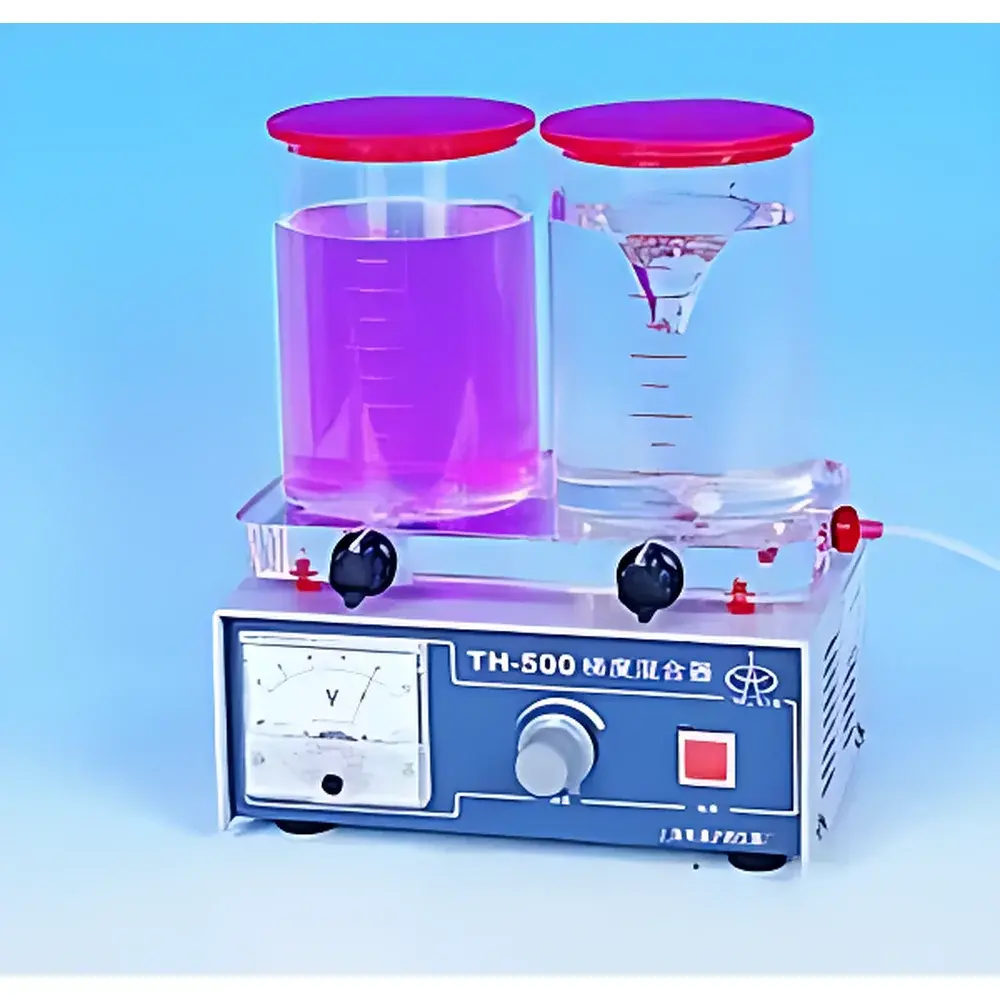
TH-500A Gradient Mixer for Organic Solvents
| Origin | Shanghai, China |
|---|---|
| Manufacturer Type | Authorized Distributor |
| Origin Category | Domestic (China) |
| Model | TH-500A |
| Gradient Volume | 1000 mL |
| Gradient Profile | Linear Only |
| Dimensions (L×W×H) | 291 × 180 × 205 mm |
| Material Compatibility | Chemically Resistant to Common Organic Solvents (e.g., Acetonitrile, Methanol, Chloroform, Ethyl Acetate, DMSO) |
Overview
The TH-500A Gradient Mixer for Organic Solvents is a precision-engineered laboratory device designed to generate stable, reproducible linear concentration gradients during chromatographic and electrophoretic separation workflows. Operating on the principle of dual-reservoir proportional mixing—where two independent solvent reservoirs (concentrated and diluted) are connected via gravity-fed or low-pressure peristaltic flow paths—the TH-500A maintains dynamic liquid-level equilibrium between chambers while enabling continuous, adjustable blending. Its chemically inert fluid path—constructed from fluoropolymer-compatible components (including PTFE-sealed valves, borosilicate glass reservoirs, and solvent-resistant tubing interfaces)—ensures long-term operational integrity when handling aggressive organic solvents such as acetonitrile, methanol, chloroform, ethyl acetate, and dimethyl sulfoxide (DMSO). Unlike pressure-driven gradient systems, the TH-500A relies on passive hydrostatic balance and calibrated flow resistance, eliminating pulsation and minimizing baseline drift in downstream detection—making it especially suitable for preparative HPLC fraction collection, gel electrophoresis buffer preparation, and column equilibration in analytical method development.
Key Features
- Linear gradient generation only—optimized for high-fidelity monotonic concentration transitions across 1000 mL total gradient volume
- Independent adjustment of mixing ratio and outflow rate via dual calibrated needle valves, enabling precise control over gradient slope (e.g., 0–100% B over 20–120 min)
- Gravity-balanced dual-chamber design ensures automatic compensation for differential evaporation rates and maintains consistent head pressure throughout the run
- Chemically resistant construction: borosilicate glass reservoirs (with ground-glass joints), PTFE-coated stopcocks, and EPDM-free fluid-contact materials compliant with USP Class VI and ISO 10993-5 requirements
- Compact footprint (291 × 180 × 205 mm) and modular mounting options facilitate integration into fume hoods, cold rooms, or benchtop chromatography stations
- No external power supply required—fully mechanical operation reduces electromagnetic interference and enhances reliability in regulated environments
Sample Compatibility & Compliance
The TH-500A is validated for use with common organic solvents encountered in reversed-phase HPLC, thin-layer chromatography (TLC), and protein purification protocols. It supports solvent mixtures containing up to 100% organic phase without degradation of sealing integrity or flow stability. While not certified to ISO/IEC 17025 or ASTM D4780 (which apply to automated gradient pumps), its mechanical design adheres to general laboratory equipment safety standards (IEC 61010-1) and material biocompatibility guidelines relevant to GLP-compliant sample preparation. Users performing GMP-regulated work should document valve calibration procedures and perform periodic visual inspection of reservoir seals per internal SOPs.
Software & Data Management
The TH-500A operates as a standalone analog instrument with no embedded firmware or digital interface. Gradient parameters—including starting composition, final composition, and total volume—are defined manually via physical valve positioning and timed volumetric verification. For traceability in regulated labs, users may integrate the mixer into electronic lab notebooks (ELNs) by recording valve settings, reservoir fill volumes, and outflow timing in accordance with ALCOA+ principles (Attributable, Legible, Contemporaneous, Original, Accurate, Complete, Consistent, Enduring, Available). No FDA 21 CFR Part 11 compliance is applicable due to absence of electronic records or signature functionality.
Applications
- Preparative and analytical HPLC method scouting—especially for screening mobile phase compositions under non-pressurized conditions
- Isocratic-to-gradient transition studies in ion-exchange and size-exclusion chromatography
- Gradient gel electrophoresis (e.g., SDS-PAGE, native PAGE) where controlled buffer ion strength ramping improves band resolution
- Column reconditioning and system flushing protocols requiring gradual solvent polarity shifts
- Educational laboratories demonstrating fundamental principles of solution mixing, diffusion kinetics, and chromatographic selectivity
FAQ
Does the TH-500A support nonlinear (curved) gradient profiles?
No. The TH-500A generates linear gradients only, achieved through fixed-resistance flow paths and balanced hydrostatic heads. Nonlinear gradients require programmable pump-based systems.
Can I use the TH-500A with aqueous buffers containing high-salt concentrations?
Yes—provided salt solubility limits are observed. However, crystallization risk increases above ~1 M NaCl; regular cleaning with deionized water is recommended after saline use.
Is calibration required before each use?
Not formally. However, users should verify gradient linearity empirically using conductivity or UV-absorbance monitoring at the outlet port, especially after extended storage or solvent changes.
What maintenance is recommended for long-term organic solvent exposure?
Inspect PTFE seals monthly for swelling or cracking; replace reservoir tubing every 6 months when used continuously with chlorinated solvents.
Can the TH-500A be connected directly to an HPLC autosampler or detector?
It is not pressure-rated for direct inlet connection. Use only with gravity-fed or low-backpressure receivers (e.g., fraction collectors, open waste containers) unless paired with a compatible low-pressure interface module.
Related Products



