
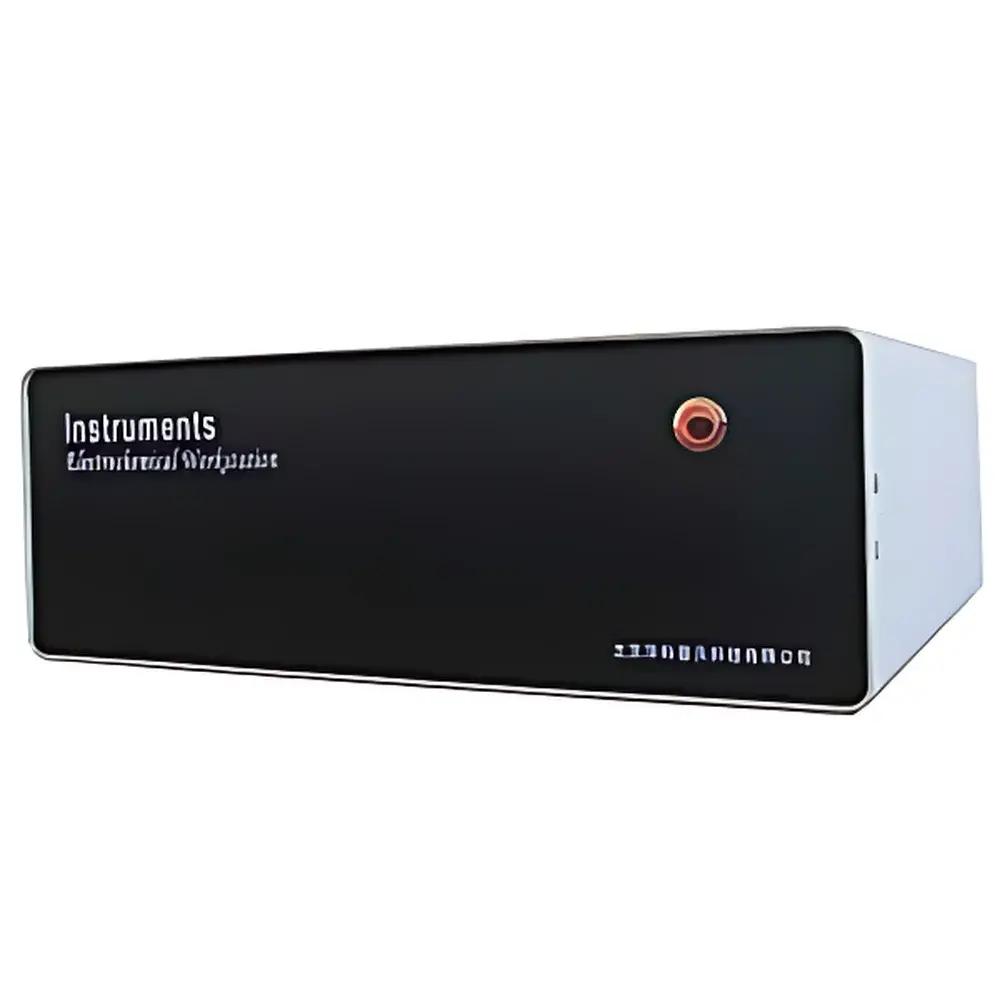
690 Electrochemical Workstation
| Key | Origin: Beijing, China |
|---|---|
| Manufacturer Type | Distributor |
| Origin Category | Domestic |
| Model | 690 |
| Price Range | USD 9,500–13,600 (FOB) |
| Instrument Type | Electrochemical Workstation |
| Channel Count | Single-Channel |
| Current Range | ±400 mA |
| Current Accuracy | ±0.2% of reading |
| Potential Accuracy | < ±1 mV |
| Potentiostatic Range | ±10 V |
| EIS Frequency Range | 10 µHz to 1 MHz |
Overview
The 690 Electrochemical Workstation is a high-performance, modular potentiostat/galvanostat engineered for precision electrochemical characterization in academic research laboratories, industrial R&D centers, and quality control environments. Based on a low-noise, high-bandwidth analog front-end architecture and synchronized dual-channel 16-bit data acquisition, it implements classical three-electrode potentiostatic control with real-time digital iR compensation, fast transient response (<1 µs potential rise time), and ultra-low input bias current (<50 pA). Its core measurement capabilities span cyclic voltammetry (CV), linear sweep voltammetry (LSV), chronoamperometry (CA), chronopotentiometry (CP), differential pulse voltammetry (DPV), square-wave voltammetry (SWV), alternating current voltammetry (ACV), and electrochemical impedance spectroscopy (EIS) across a frequency range from DC to 1 MHz — enabling quantitative analysis of charge-transfer kinetics, double-layer capacitance, diffusion-controlled processes, and interfacial phenomena in aqueous and non-aqueous electrolytes.
Key Features
- High-fidelity potentiostatic control with < ±1 mV absolute potential accuracy and <0.01 mV RMS noise floor
- Wide dynamic current range: ±400 mA standard; expandable to ±2 A (with optional power amplifier module)
- Extended voltage compliance: ±10 V standard potentiostatic range; upgradable to ±120 V via auxiliary high-voltage module
- Ultrafast signal response: <250 ns rise time (no load); 15 V/µs slew rate (no load)
- Dual-channel simultaneous sampling at 1 MHz with 16-bit resolution for synchronized potential/current capture
- Programmable iR compensation (automatic and manual modes) with real-time correction algorithms
- Flexible waveform generation: CV scan rates from 1 µV/s to 5000 V/s; SWV frequencies up to 100 kHz; ACV up to 10 kHz
- Configurable EIS acquisition: 10 µHz–1 MHz frequency coverage with user-defined perturbation amplitude and point distribution
- Scalable architecture supporting expansion to 10 parallel channels (for multi-electrode arrays or simultaneous EIS measurements)
- Optional integration with scanning electrochemical microscopy (SECM) modules for localized surface reactivity mapping
Sample Compatibility & Compliance
The 690 workstation supports standard three-electrode configurations (working, counter, reference) and accommodates microelectrodes, rotating disk electrodes (RDE), thin-film sensors, battery half-cells, corrosion coupons, and printed electrode substrates. It is compatible with common reference electrodes (Ag/AgCl, SCE, Hg/Hg₂SO₄) and inert counter electrodes (Pt wire, graphite rod). All hardware and firmware comply with electromagnetic compatibility (EMC) standards IEC 61326-1 and safety standard IEC 61010-1. Data integrity protocols align with GLP/GMP requirements, including audit-trail-enabled method storage, user-access controls, and timestamped raw-data logging — facilitating regulatory submissions under FDA 21 CFR Part 11 when deployed with compliant software environments.
Software & Data Management
The workstation operates with dedicated Windows-based control software featuring intuitive experiment sequencing, real-time visualization, and post-acquisition analysis tools including Tafel fitting, equivalent circuit modeling (ZView-compatible), derivative CV analysis, and diffusion-limited current extraction. Raw data are saved in ASCII and binary formats with full metadata embedding (method parameters, instrument configuration, calibration history). Export options include CSV, Excel, and Origin-compatible files. The software architecture supports scripting via Python API (PyWin32 interface) for automated batch testing and integration into LIMS or MES platforms. All method files and datasets are digitally signed and version-controlled to ensure traceability across laboratory workflows.
Applications
- Battery material development: Li-ion cathode/anode kinetic profiling, SEI formation analysis, and impedance evolution during cycling
- Corrosion science: Polarization resistance, pitting susceptibility, and coating degradation monitoring per ASTM G5, G102, and ISO 17475
- Biosensor development: Enzyme electrode kinetics, DNA hybridization detection, and amperometric immunoassays
- Electrocatalysis: Oxygen reduction reaction (ORR), hydrogen evolution reaction (HER), and CO₂ reduction mechanism studies
- Conducting polymer characterization: Doping/dedoping dynamics, switching stability, and charge storage capacity
- Environmental electroanalysis: Heavy metal speciation (anodic stripping voltammetry), nitrate/nitrite quantification, and sensor validation
FAQ
What is the maximum EIS frequency supported without optional hardware?
The base system supports electrochemical impedance spectroscopy from DC to 1 MHz.
Can the 690 perform true multi-channel EIS simultaneously?
Yes — with the optional 10-channel expansion module, all channels support concurrent EIS acquisition at full bandwidth.
Is the instrument suitable for ultra-microelectrode experiments requiring sub-picoampere resolution?
While the standard current range starts at ±400 mA, optional high-sensitivity current amplifiers (down to 30 A/V full scale, 12 decades) enable reliable pA-level measurements with <50 pA input bias current.
Does the software support automated method validation per USP & Ph. Eur. guidelines?
Yes — the software includes built-in validation templates for electrochemical methods referenced in USP , , and Ph. Eur. 2.2.45, including system suitability tests and repeatability reporting.
How is data security ensured during long-term corrosion monitoring campaigns?
All acquired data are written with CRC-32 checksums, stored with immutable timestamps, and backed up automatically to network drives via configurable retention policies — meeting ISO/IEC 17025 clause 7.5.2 requirements for data integrity.
Related Products






