
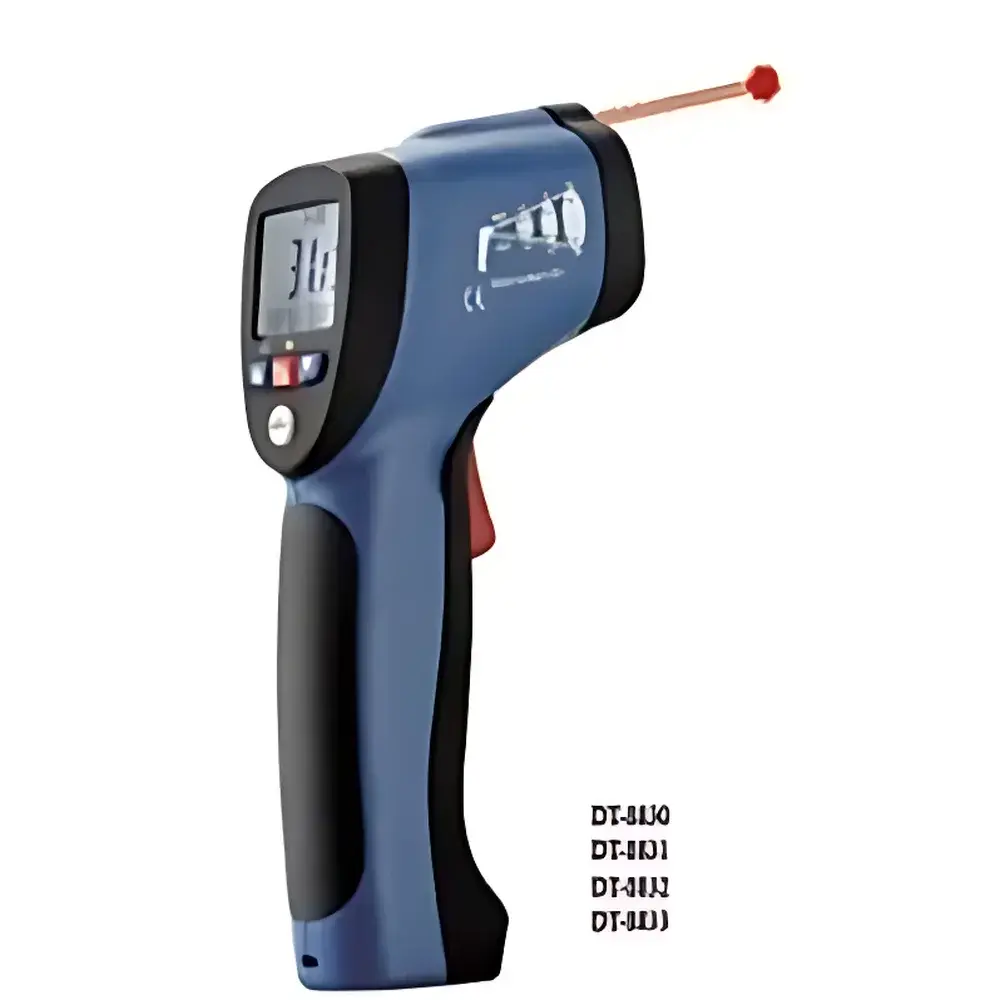
8830 Infrared and Contact Surface Thermometer
| Origin | Other Regions |
|---|---|
| Manufacturer Type | Distributor |
| Domestic Product | Yes |
| Model | 8830 |
| Pricing | Upon Request |
| Infrared Temperature Range | -30 to 360 °C |
| Resolution | 0.1 °C |
| Basic Accuracy | ±1.5% of reading |
| K-Type Thermocouple Input Range | -15 to 1300 °C |
| Data Hold Function | Yes |
| Backlit LCD Display | Yes |
| Data Memory | Yes |
Overview
The 8830 Infrared and Contact Surface Thermometer is a dual-mode handheld instrument engineered for precise, non-contact and contact-based surface temperature measurement in industrial maintenance, quality control, HVAC commissioning, and laboratory support environments. It operates on two complementary sensing principles: passive infrared (IR) radiation detection for rapid, emissivity-compensated surface readings, and thermoelectric voltage measurement via integrated K-type thermocouple input for direct-contact applications requiring higher thermal stability or low-emissivity surfaces. The device conforms to fundamental metrological requirements for portable thermometry per IEC 61234-1 (Infrared Thermometers – Part 1: General Requirements) and supports traceable calibration practices under ISO/IEC 17025-accredited workflows. Its hybrid architecture enables field technicians and QA personnel to validate thermal performance across diverse materials—including painted metal, oxidized steel, plastics, ceramics, and composite laminates—without switching instruments.
Key Features
- Dual-sensing capability: Simultaneous IR spot measurement (distance-to-spot ratio 12:1) and K-type thermocouple input with automatic cold-junction compensation
- Adjustable emissivity setting (0.10–1.00 in 0.01 increments) to minimize measurement error on reflective or textured surfaces
- Backlit 3.5-digit LCD display with auto-rotating orientation and high-contrast segment rendering for low-light or overhead inspection
- Data hold function with manual trigger and auto-freeze-on-stability mode for transient thermal events
- Internal memory stores up to 99 timestamped readings (date/time stamp enabled when connected to optional PC interface)
- Rugged ABS+PC housing rated IP54 for dust and splash resistance; operating ambient range: 0 to 50 °C, <80% RH non-condensing
- Battery life: Up to 12 hours continuous IR operation on two AAA alkaline cells; low-battery indicator with auto-power-off after 15 minutes idle
Sample Compatibility & Compliance
The 8830 accommodates a broad spectrum of physical samples without sample preparation: flat or curved metallic surfaces, insulated piping, electrical enclosures, rotating machinery housings, polymer extrusion dies, and printed circuit board assemblies. It is not intended for medical use, internal cavity measurement, or highly polished mirrors without applied matte tape. For regulatory alignment, the instrument supports documentation workflows compliant with ISO 9001 clause 7.1.5 (monitoring and measuring resources), ASTM E1965-21 (Standard Specification for Infrared Thermometers for General Purpose Use), and EU Directive 2014/30/EU (EMC Directive). Calibration certificates traceable to NIM (China National Institute of Metrology) or equivalent national metrology institutes are available upon request for GLP/GMP audit readiness.
Software & Data Management
While the 8830 operates as a standalone field instrument, its optional USB-to-serial adapter enables data export to Windows-based software platforms including proprietary CSV loggers and third-party tools such as LabVIEW™ and MATLAB® via standard ASCII serial protocol (9600 baud, 8N1). Exported records include measured value, unit, timestamp, emissivity setting, thermocouple status flag, and battery voltage. Audit trail functionality is maintained through sequential internal memory indexing; no onboard user authentication or electronic signature capability is provided. For FDA 21 CFR Part 11 compliance, external validation protocols must be implemented at the system level during integration into regulated manufacturing execution systems (MES).
Applications
- Preventive maintenance: Bearing temperature trending, motor winding hot-spot detection, transformer bushing monitoring
- Process validation: Oven and dryer belt surface uniformity mapping, curing oven profile verification, solder reflow thermal profiling
- Energy auditing: Insulation integrity assessment, steam trap functionality screening, HVAC duct surface loss quantification
- Materials testing: Polymer melt temperature verification prior to injection molding, glass annealing furnace exit zone monitoring
- Electronics reliability: PCB component thermal stress screening, power supply heatsink performance evaluation, battery pack surface gradient analysis
FAQ
What is the recommended distance-to-spot ratio for accurate IR measurements?
The 8830 uses a fixed 12:1 optical resolution; for a 10 mm target, maintain ≤120 mm distance to ensure full spot coverage and avoid background radiation interference.
Can the K-type probe be calibrated independently of the IR sensor?
Yes—K-type input calibration is performed separately using certified dry-well or bath references; IR calibration requires blackbody source traceability and is typically conducted at authorized service centers.
Does the device support emissivity correction for stainless steel or aluminum surfaces?
Yes—emissivity can be manually set between 0.10 and 1.00; reference values for common metals (e.g., 0.31 for polished Al, 0.55 for oxidized SS) are provided in the user manual Appendix B.
Is the memory function retained after battery replacement?
No—internal memory is volatile; users must download stored readings before battery change or enable auto-export via serial link during active logging sessions.
What environmental conditions limit IR accuracy?
Heavy steam, dust-laden air, or intense ambient IR sources (e.g., open furnaces within line-of-sight) degrade signal-to-noise ratio; measurements should be taken in stable atmospheric conditions per ISO 18434-1 guidelines.



