
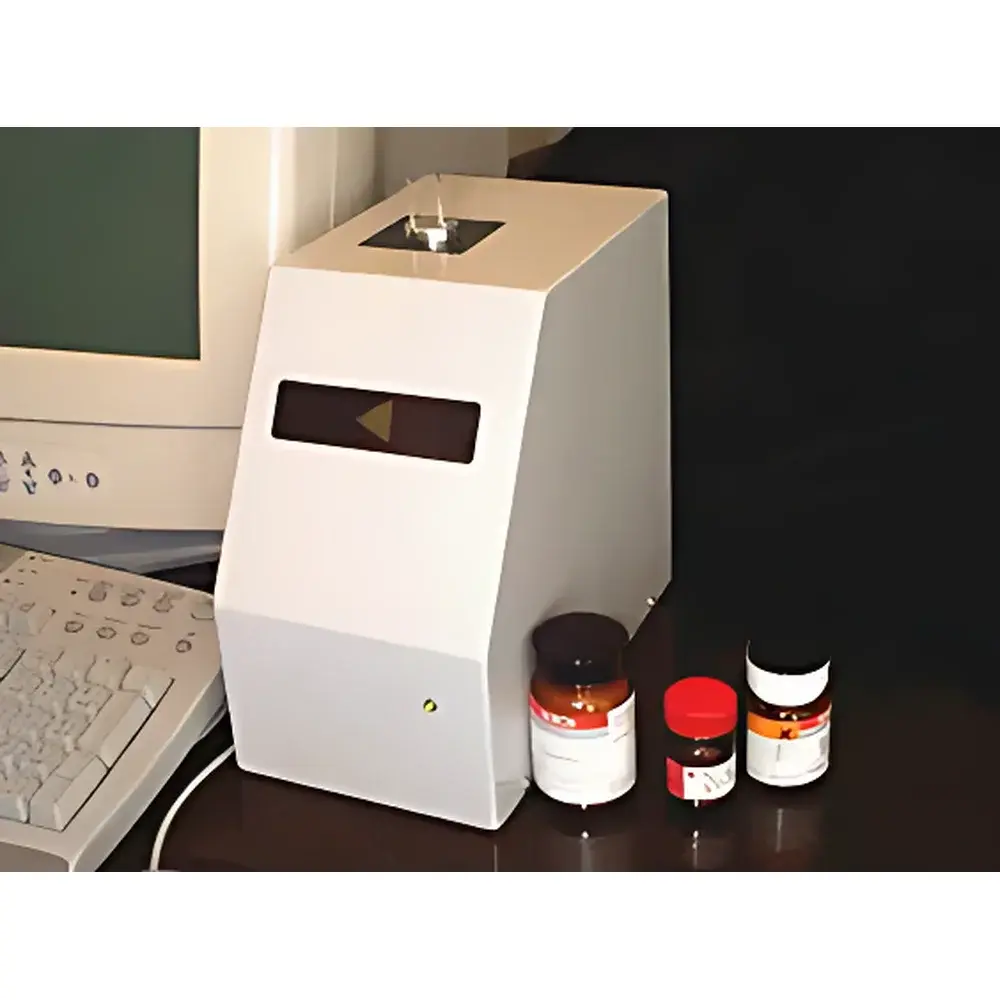
AccuMelt Automatic Melting Point Apparatus
| Origin | USA |
|---|---|
| Manufacturer Type | Authorized Distributor |
| Origin Category | Imported |
| Model | AccuMelt |
| Pricing | Upon Request |
Overview
The AccuMelt Automatic Melting Point Apparatus is an advanced thermal analysis instrument engineered for precision, reproducibility, and operational efficiency in pharmaceutical, chemical, and academic laboratories. It employs real-time optical monitoring combined with adaptive thermal control to determine melting point onset and range according to internationally recognized principles—specifically, the visual detection of solid-to-liquid phase transition under controlled heating, as defined in USP , EP 2.2.14, and ASTM E324. Unlike conventional fixed-rate melters, the AccuMelt implements patented variable-heating-rate technology (patent pending), dynamically modulating thermal ramp speed based on real-time sample behavior. This eliminates the need for preliminary coarse scans followed by secondary fine scans—a workflow inefficiency common in legacy instruments. By maintaining high ramp rates (up to 4 °C/min) during inert thermal zones and automatically decelerating upon onset of melt initiation (down to 0.25 °C/min), the system achieves both time savings and metrological rigor without operator intervention.
Key Features
- Adaptive heating algorithm with up to 20-stage rate modulation, enabling simultaneous rapid screening and high-resolution endpoint determination
- Temperature range: ambient to 300 °C; resolution: ±0.01 °C; repeatability: better than ±0.1 °C (verified per ISO 80000-5 and NIST-traceable calibration)
- Selectable fixed heating rates: 0.25, 0.5, 1, 2, and 4 °C/min; fully programmable variable ramp (0.5–4 °C/min)
- Fast cooling capability: 200 °C → 50 °C in ≤15 minutes, minimizing turnaround between sequential analyses
- RTD platinum resistance thermometer (Pt100) for long-term stability and linearity across the full operating range
- Triple-point auto-calibration using certified reference standards (e.g., benzophenone, vanillin, cholesterol) traceable to NIST SRMs
- Simultaneous triple-sample measurement with independent capillary positioning and synchronized thermal profiling
- High-intensity LED illumination (>50,000 h lifetime), eliminating filament degradation and intensity drift associated with incandescent sources
- Compact benchtop footprint (23.8 × 13.2 × 21.5 cm); net weight: 2.73 kg
Sample Compatibility & Compliance
The AccuMelt accommodates standard 1-mm OD glass capillaries (supplied with GT100/GT1000 kits) and supports opaque, thermally labile, or decomposition-prone compounds—including APIs, polymorphs, and natural product isolates—without requiring derivatization or solvent dilution. Its optical design permits direct visual confirmation of melt events, satisfying GLP audit requirements for operator verification. The system complies with FDA 21 CFR Part 11 for electronic records when paired with validated software configurations, and supports audit trails, user access controls, and electronic signatures. All thermal protocols adhere to pharmacopeial guidelines (USP , Ph. Eur. 2.2.14, JP 2.60), and calibration procedures align with ISO/IEC 17025:2017 requirements for testing laboratories.
Software & Data Management
Controlled via Windows-compatible application (Windows 10/11, 64-bit), the AccuMelt software provides full parameter scripting, real-time video overlay, dual-curve visualization (temperature vs. time + derivative dT/dt), and automated report generation in PDF or CSV format. Data files include metadata such as operator ID, date/time stamp, calibration status, and environmental conditions. RS232 serial interface enables integration into LIMS environments and supports scheduled batch processing. Software validation documentation (IQ/OQ/PQ templates) is available upon request for regulated environments operating under GMP or ISO 9001 frameworks.
Applications
- Pharmaceutical quality control: identity verification, purity assessment, and polymorph screening per ICH Q5A and Q6A
- Organic synthesis monitoring: reaction endpoint confirmation and intermediate characterization
- Academic research: thermal behavior studies of novel materials, eutectic systems, and hydrate/anhydrate transitions
- Regulatory submissions: generation of compliant melting data for ANDA, NDA, and CMC sections
- Reference standard qualification: assignment of certified melting ranges for internal working standards
FAQ
Does the AccuMelt require manual pre-scan optimization before final measurement?
No. Its adaptive heating eliminates the need for preliminary coarse scans—the instrument autonomously adjusts ramp rate in real time based on observed thermal response.
Can the system validate compliance with pharmacopeial monographs?
Yes. It supports configurable ramp rates and visual endpoint criteria aligned with USP , EP 2.2.14, and JP 2.60, and includes calibration traceability to NIST standards.
Is the LED light source replaceable by the end user?
No replacement is required during normal operation; the integrated high-luminance LED has a rated service life exceeding 50,000 hours and does not degrade in output intensity over time.
What sample preparation tools are recommended?
The optional MP1 mortar and pestle set is provided for consistent particle size reduction prior to capillary loading, ensuring reproducible packing density and melt kinetics.
How is temperature accuracy maintained over extended use?
Automatic triple-point calibration using supplied reference standards (benzophenone, vanillin, cholesterol) ensures ongoing traceability without external calibration equipment.



