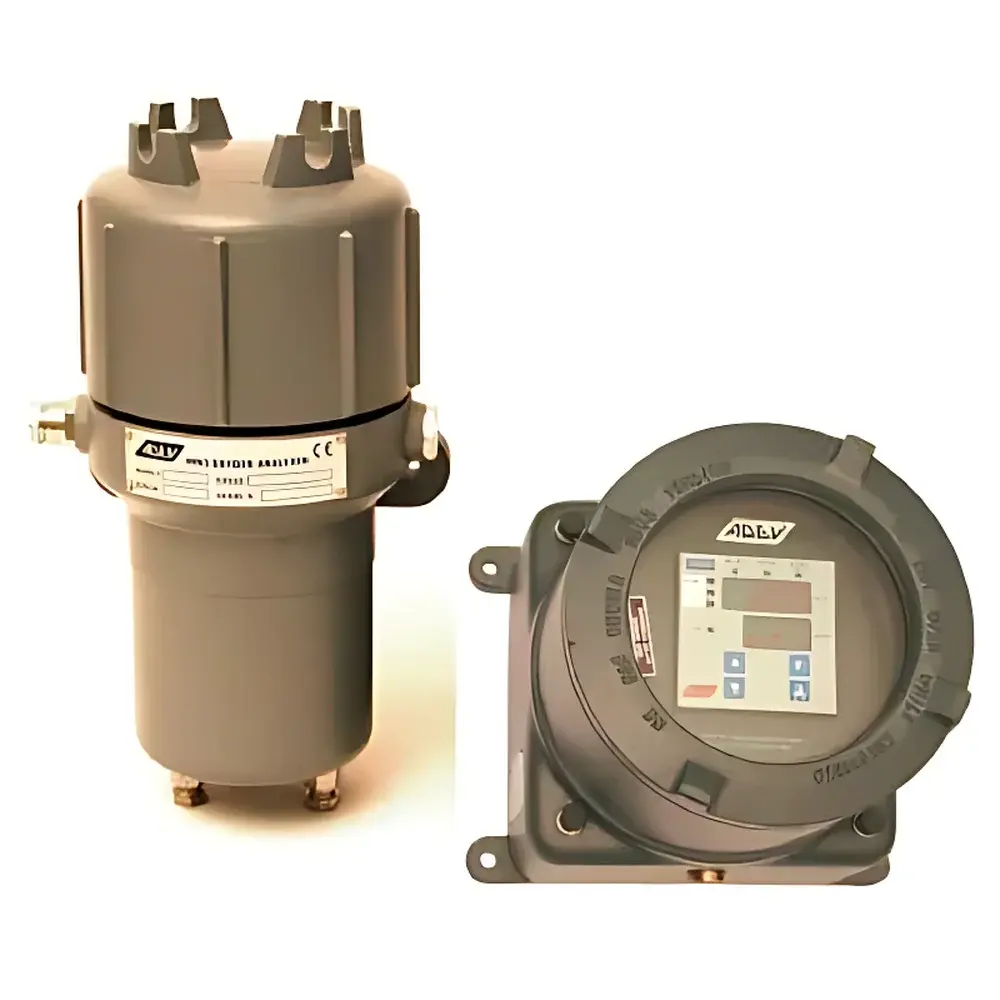
ADEV 8866TR Intrinsically Safe Thermal Conductivity Hydrogen Analyzer for Coal Chemical Industry
| Origin | Italy |
|---|---|
| Manufacturer Type | Authorized Distributor |
| Origin Category | Imported |
| Model | 8866TR |
| Pricing | Upon Request |
Overview
The ADEV 8866TR is a certified intrinsically safe thermal conductivity gas analyzer engineered specifically for continuous, real-time hydrogen concentration monitoring in demanding coal chemical processing environments. It operates on the fundamental physical principle of differential thermal conductivity — measuring the relative heat dissipation rate between a reference gas (typically air or nitrogen) and the sample gas stream. Since hydrogen exhibits a thermal conductivity approximately seven times greater than that of nitrogen and over eight times greater than air, the 8866TR achieves high inherent sensitivity to H₂ across wide dynamic ranges — from trace-level detection (0–1% H₂) to ultra-high-purity applications (95–100% H₂). Its dual-chamber micro-thermal detector architecture — comprising a precisely temperature-stabilized reference cell and an active measurement cell — ensures stable zero-point performance and minimizes drift under fluctuating process conditions typical in syngas generation, coal gasification, and ammonia synthesis loops.
Key Features
- Intrinsically safe design certified to ATEX Directive 2014/34/EU: II 2G Ex d IIC T6 Gb / II 2D Ex tb IIIC T85°C Db — approved for installation in Zone 1 and Zone 21 hazardous areas.
- Multi-range configurable measurement capability: supports up to 14 factory-programmable spans including 0–1%, 0–10%, 0–75%, 80–100%, 95–100%, and 98–100% H₂ — optimized for both purity control in hydrogen-cooled generators and safety-critical leak detection in coal gasifiers.
- Response time validated per IEC 60770: <1 s for initial H₂ signal rise; t₆₀ = 13 s, t₉₀ = 24 s, t₉₉ = 40 s — enabling rapid process feedback during transient operational events.
- High-reproducibility thermal sensor assembly with dual-chamber micro-bridge construction, utilizing platinum-iridium alloy sensing elements and fused quartz reference cells for long-term baseline stability.
- Sample conditioning interface compatible with 1/4″ VCR or 6 mm Swagelok compression fittings; internal wetted materials include 316 stainless steel, 303 stainless steel, borosilicate glass, PTFE, and FKM elastomers — suitable for aggressive coal-derived syngas containing H₂S, CO, CH₄, and particulate traces.
- Power-flexible operation: accepts either 24 VDC (50 VA) or universal AC input (115–220 VAC, 50/60 Hz, 40 VA), supporting integration into both distributed control systems (DCS) and standalone skid-mounted analyzers.
Sample Compatibility & Compliance
The 8866TR is validated for continuous analysis of binary, ternary, and quaternary gas mixtures where hydrogen is the target analyte — including but not limited to H₂/N₂, H₂/CH₄, H₂/CO, H₂/He, and H₂/Ar systems common in coal-to-chemicals infrastructure. It complies with ISO 14644-1 (cleanroom classification support), IEC 61511 (functional safety for SIS integration), and meets electromagnetic compatibility requirements per EN 61326-1. For regulated coal chemical facilities operating under ISO 9001, ISO 14001, or OHSAS 18001 frameworks, the analyzer’s documented calibration traceability (NIST-traceable standards), audit-ready configuration logs, and non-volatile event history support GLP/GMP-aligned quality documentation practices.
Software & Data Management
Local configuration and diagnostics are executed via embedded web server accessible through standard Ethernet (RJ45) or RS232/RS485 serial interface. Firmware supports Modbus RTU/TCP protocol for seamless DCS/SCADA integration. All calibration events, alarm triggers (e.g., low-H₂ threshold, sensor fault, flow deviation), and configuration changes are timestamped and stored in non-volatile memory with ≥12 months of cyclic logging capacity. Optional data export via CSV over USB or network enables trend analysis in third-party platforms such as DeltaV, Emerson DeltaV SIS, or Siemens Desigo CC — fully compliant with FDA 21 CFR Part 11 requirements when deployed with user access control and electronic signature modules.
Applications
- Real-time H₂ purity monitoring in coal gasification syngas streams prior to Fischer–Tropsch synthesis or methanol synthesis reactors.
- Leak detection and purge verification in hydrogen-cooled turbine generators within integrated coal-fired power plants.
- Process optimization of ammonia synthesis loops by tracking H₂/N₂ ratio deviations in recycle gas.
- Quality assurance in hydrogen production units using steam methane reforming (SMR) or coal-based water-gas shift processes.
- Concentration verification in inerting and blanketing systems for coal pulverizer enclosures and coal slurry storage tanks.
- Support of ISO 8573-1 Class 2 compressed air/hydrogen purity certification in coal chemical packaging lines.
FAQ
Is the 8866TR suitable for high-moisture syngas streams commonly found in coal gasification?
Yes — optional integrated thermoelectric cooler (TEC) and hydrophobic membrane filter kits are available to condition sample gas down to dew points ≤ −20°C while preserving H₂ response integrity.
Can the analyzer be recalibrated in-situ without process shutdown?
Yes — zero and span calibration can be performed using certified N₂ and H₂ standard gases via the front-panel quick-connect calibration port, requiring no disassembly or venting of the main sample line.
Does the device support redundant 4–20 mA outputs for safety instrumented systems (SIS)?
Yes — dual isolated 4–20 mA analog outputs are configurable for primary measurement and diagnostic status (e.g., sensor health, flow OK, temperature OK) per IEC 61508 SIL2 requirements.
What is the recommended maintenance interval under continuous coal chemical operation?
Sensor module replacement is recommended every 24 months; quarterly verification with certified span gas and annual full system validation against traceable standards are advised per ISO/IEC 17025 guidelines.
Related Products