
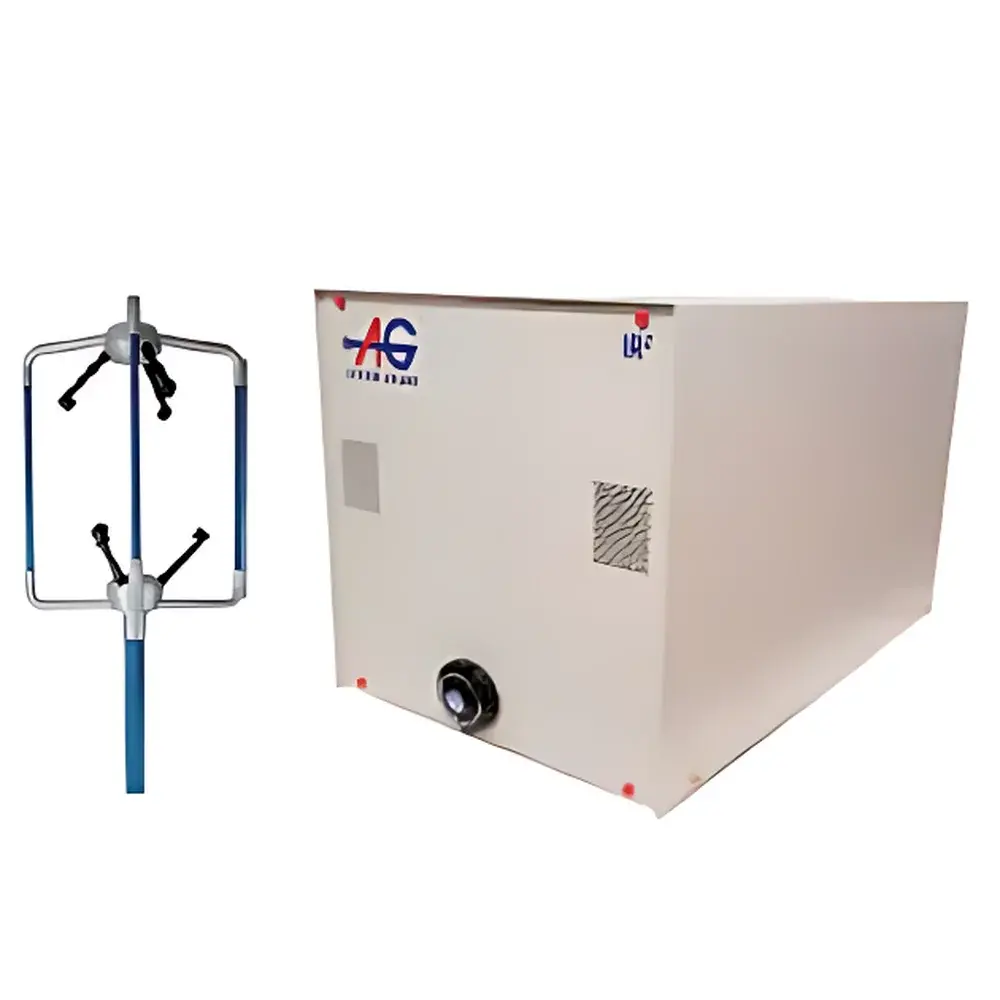
AG1000-F High-Frequency CO₂ Isotope Analyzer
| Origin | USA |
|---|---|
| Manufacturer Type | Authorized Distributor |
| Origin Category | Imported |
| Model | AG1000-F |
| Pricing | Upon Request |
Overview
The AG1000-F High-Frequency CO₂ Isotope Analyzer is a precision optical instrument engineered for continuous, real-time measurement of carbon isotope ratios (δ¹³C) and total CO₂ concentration in ambient air. It operates on the principle of tunable diode laser absorption spectroscopy (TDLAS) integrated with infrared isotope ratio (IR²) technology—specifically utilizing semiconductor-based mid-infrared lasers coupled to a compact hollow-waveguide measurement cell. This architecture enables high-sensitivity detection without cryogenic cooling or vacuum pumping systems. The analyzer achieves sub-ppbv detection limits for CO₂ and delivers isotopic precision of <0.1‰ (1σ, 5-minute averaging) and <0.3‰ (1σ, 0.1-second integration), making it uniquely suited for eddy covariance isotope flux studies in ecosystem-scale carbon cycle research.
Key Features
- Ultra-low-volume optical cavity (<0.1 mL) enabling rapid gas exchange and high temporal resolution (up to 10 Hz sampling rate)
- No requirement for high-vacuum pumps, liquid nitrogen, or specialized power conditioning—operates on standard 100–240 VAC, 50/60 Hz input
- Native Ethernet interface supporting remote configuration, real-time data streaming, and firmware updates via TCP/IP
- Optimized for seamless synchronization with commercial 3D ultrasonic anemometers (e.g., Gill WindMaster, R.M. Young 81000 series) using TTL trigger and PPS inputs
- Onboard data logging with internal SD card storage (optional) and configurable output formats (CSV, NetCDF) compliant with FLUXNET metadata standards
- Robust thermal management system ensuring stable cavity temperature control (±0.01°C) across ambient operating ranges of –20°C to +45°C
Sample Compatibility & Compliance
The AG1000-F is designed for direct analysis of unmodified ambient air, soil gas efflux, and chamber headspace samples with minimal sample conditioning. It meets ISO 17025 requirements for calibration traceability when operated with NIST-traceable CO₂ reference gases (e.g., NOAA CMDL standards). Instrument performance adheres to ASTM D6348–19 guidelines for isotopic analysis of atmospheric CO₂ and supports GLP-compliant operation through audit-trail-enabled software logging. No sample pre-concentration or chemical conversion is required, eliminating memory effects and cross-contamination risks common in IRMS-based workflows.
Software & Data Management
The analyzer ships with proprietary acquisition and control software compatible with Windows and Linux platforms. It provides real-time spectral visualization, automatic baseline correction, pressure/temperature compensation algorithms, and δ¹³C calculation using dual-wavelength referencing against calibrated absorption line intensities. Data export supports time-synchronized merging with meteorological datasets (wind speed, temperature, humidity) and integrates natively with EddyPro® and TK3 post-processing pipelines. All raw spectra and processed values are timestamped with GPS-synchronized UTC, satisfying 21 CFR Part 11 requirements for electronic records when configured with user authentication and change logging.
Applications
- Ecosystem-scale carbon flux partitioning via eddy covariance δ¹³C measurements
- Soil respiration source attribution (autotrophic vs. heterotrophic) in biogeochemical studies
- Urban CO₂ plume characterization and fossil fuel emission quantification
- Validation of atmospheric transport models and satellite-based isotope retrievals (e.g., OCO-2/3, GOSAT)
- Controlled-environment plant physiology experiments requiring sub-second isotopic response tracking
- Long-term monitoring networks (e.g., ICOS, AmeriFlux) where reliability, low maintenance, and network operability are critical
FAQ
What is the minimum detectable CO₂ concentration and associated δ¹³C precision?
The AG1000-F achieves a CO₂ detection limit of 0.2 ppbv (1σ, 1-second integration) with δ¹³C precision of ≤0.3‰ at 0.1 s and ≤0.1‰ at 5-minute averaging under typical ambient conditions (400 ppm CO₂, 25°C, 1013 hPa).
Does the instrument require external calibration gases during routine operation?
Yes—daily or weekly span calibration using two-point (low/high) NIST-traceable CO₂ standards is recommended for optimal long-term accuracy; automated calibration sequences can be scheduled via software.
Can the AG1000-F operate unattended in remote field sites?
Yes—it supports solar/battery-powered deployments with watchdog timers, automatic reboots, and heartbeat telemetry. Enclosure options include IP65-rated weatherproof housings with active thermal regulation.
Is the data output compatible with FLUXNET Level 4 processing protocols?
Yes—output includes all required variables (CO₂ mixing ratio, δ¹³C, pressure, temperature, water vapor, time stamps) in CF-compliant NetCDF format, fully aligned with FLUXNET2015 and ICOS Tier 1 specifications.
How is spectral interference from H₂O and CH₄ mitigated?
The IR² platform employs wavelength modulation spectroscopy (WMS-2f) at optimized CO₂ absorption lines (2002 cm⁻¹ region), combined with real-time H₂O cross-sensitivity correction derived from co-measured water vapor absorption features within the same spectral window.



