
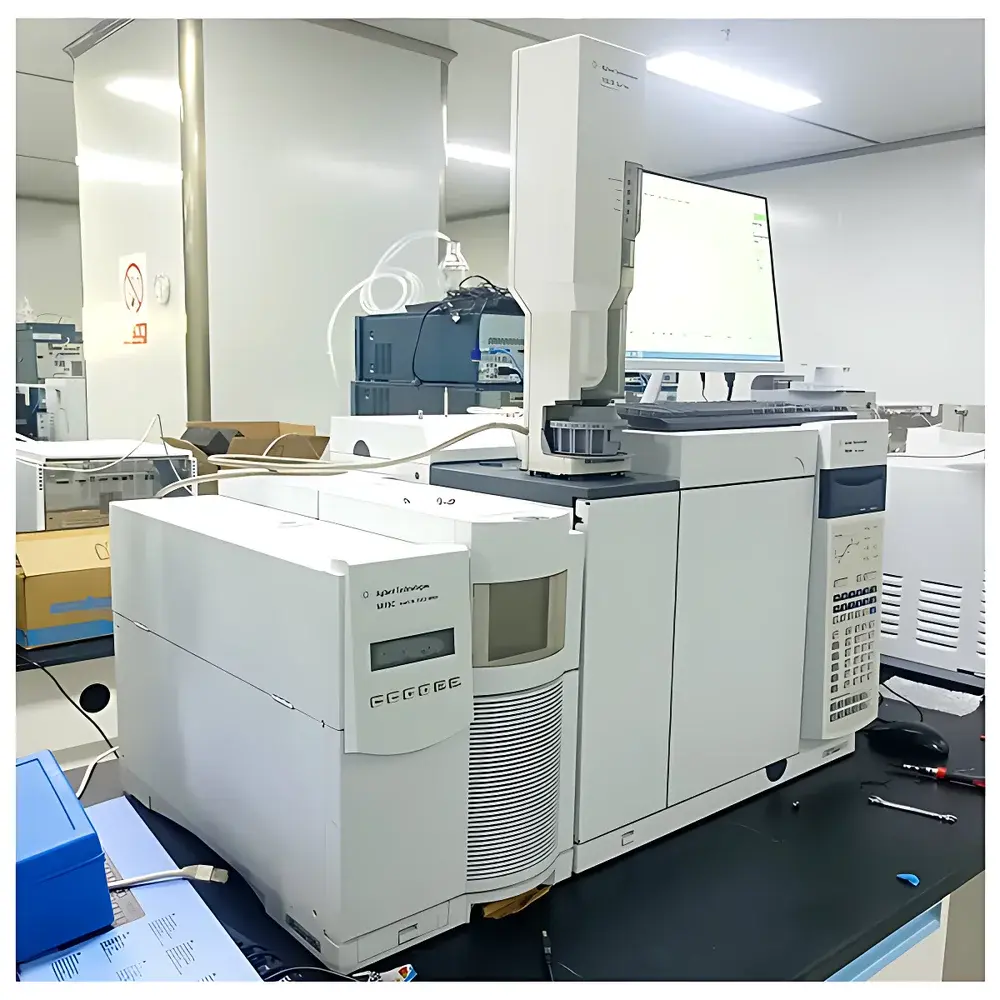
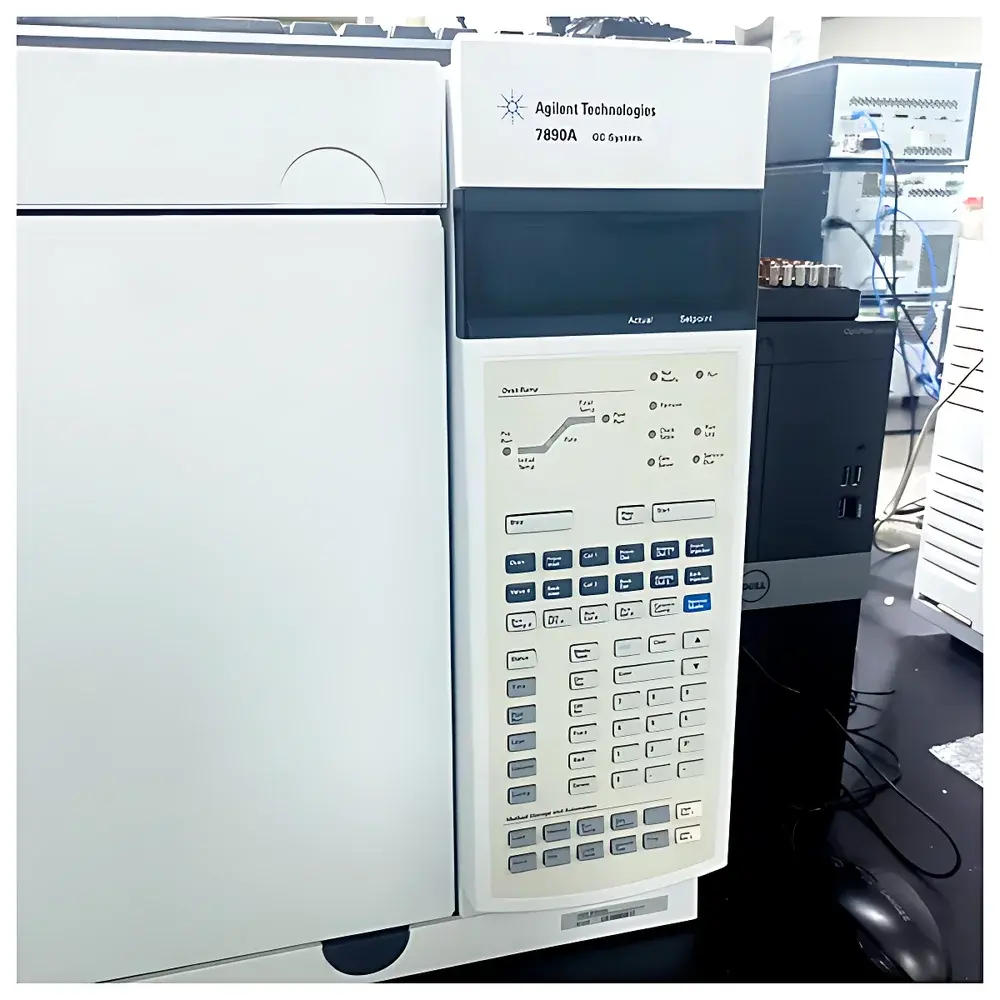
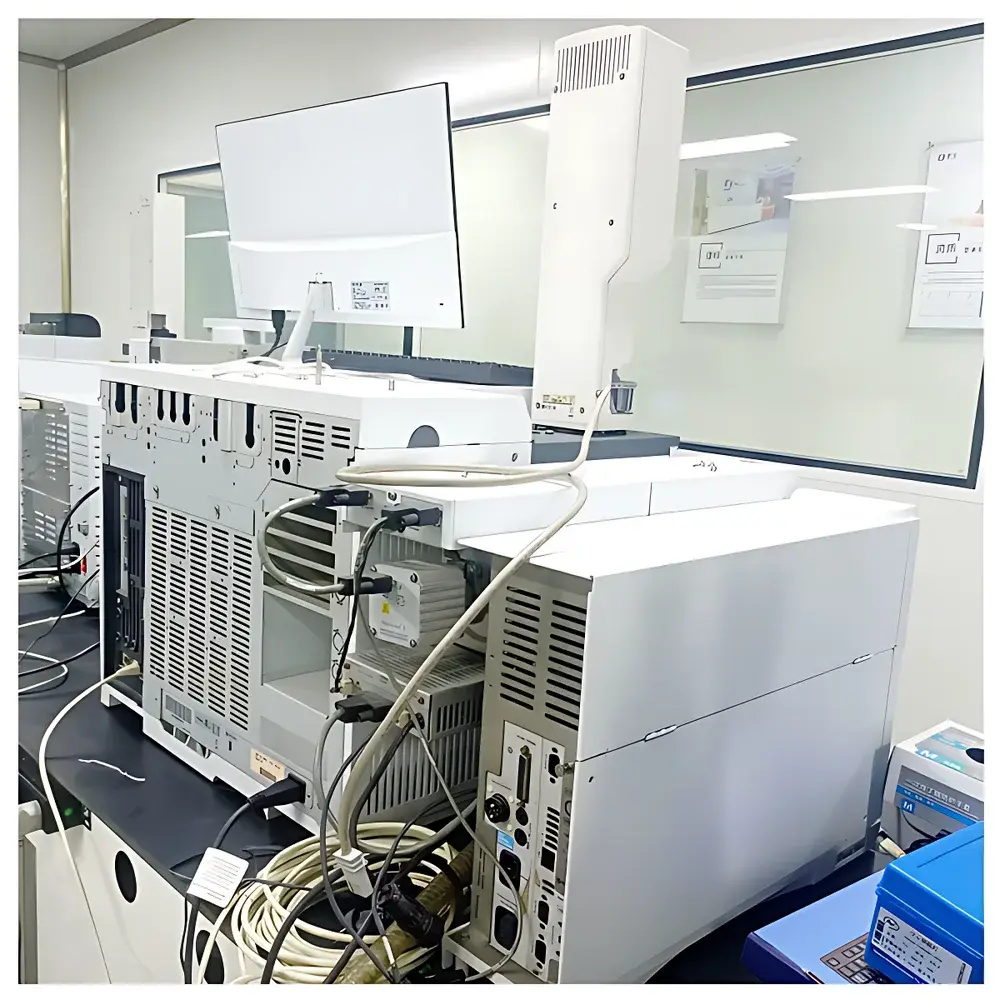
Agilent 7890A-5975C Gas Chromatography-Mass Spectrometry System
| Brand | Agilent Technologies |
|---|---|
| Origin | USA |
| Model | 7890A-5975C |
| Instrument Type | Single Quadrupole Mass Spectrometer |
| GC Configuration | Conventional Capillary GC-MS |
| Mass Range | 10–1000 m/z |
| Resolution | Unit resolution (10% valley) |
| Sensitivity | 300:1 S/N for 1 pg octafluoronaphthalene (OFN) in Electron Ionization (EI) mode |
| Scan Speed | 12,500 u/s (maximum) |
| Mass Accuracy | ±0.1 u over 48 h |
| Oven Ramp Rate | Up to 125 °C/min |
| Pressure Control Precision | ±0.001 psi |
| Detector | Dual Off-Axis Electron Multiplier |
| Ion Source Temperature | Up to 350 °C |
| Quadrupole Temperature | Heated, dual-curved rod assembly |
| TID Mode | Trace Ion Detection enabled |
| Carrier Gas Options | Helium, Hydrogen, Nitrogen |
| Retention Time Locking (RTL) | Supported |
| DRS Library | 926 deconvoluted reference compounds |
| Mass Axis Stability | 0.1 amu/48 hr |
Overview
The Agilent 7890A-5975C Gas Chromatography-Mass Spectrometry (GC-MS) System is a robust, high-performance benchtop instrument engineered for routine and research-grade qualitative and quantitative analysis of volatile and semi-volatile organic compounds. It integrates Agilent’s industry-proven 7890A gas chromatograph—featuring advanced electronic pressure control (EPC), precise oven temperature programming, and microplate flow technology—with the 5975C inert triple-axis mass spectrometer. The system operates on electron ionization (EI) and optional chemical ionization (CI) sources, employing a heated, dual-curved single quadrupole mass analyzer with true axial ion transmission geometry. Its design adheres to fundamental principles of mass spectrometric detection: compound separation via capillary GC followed by mass-selective detection based on m/z-dependent ion filtering and amplification. This architecture ensures reproducible retention time alignment, stable mass calibration, and high-fidelity spectral acquisition across extended operational cycles—critical for compliance-driven laboratories performing environmental monitoring, food safety testing, forensic toxicology, and pharmaceutical impurity profiling.
Key Features
- High-sensitivity EI source: Delivers ≥200:1 signal-to-noise ratio for 1 pg octafluoronaphthalene (OFN), validated per ASTM D5845 and USP <621> guidelines
- Ultra-inert, high-temperature ion source (up to 350 °C): Minimizes active site adsorption and enables reliable analysis of thermally labile or high-boiling-point analytes (e.g., pesticides, PAHs, sterols)
- Trace Ion Detection (TID) mode: Enhances selectivity and detection limits in complex matrices by isolating diagnostic ions without full-scan compromise
- Heated, dual-curved quadrupole mass filter: Maintains optimal ion transmission efficiency (>75%) and eliminates need for periodic rod cleaning or realignment
- Off-axis secondary electron multiplier detector: Reduces background noise from neutral species and scattered electrons, improving S/N by up to 3× versus conventional on-axis configurations
- Hydrogen carrier gas compatibility: Enables faster elution and improved peak capacity while reducing consumable costs—validated per ISO 17025 method validation protocols
- Retention Time Locking (RTL): Allows cross-instrument and cross-method retention time transfer with ≤0.02 min deviation, supporting method migration and laboratory network harmonization
- Deconvolution Reporting Software (DRS) with 926 pre-validated, library-matched spectra: Supports automated identification in co-eluting peaks without manual integration
Sample Compatibility & Compliance
The 7890A-5975C accommodates liquid, solid (via thermal desorption or purge-and-trap), and gaseous samples introduced through split/splitless injectors, programmable temperature vaporizers (PTV), or headspace autosamplers. It supports EPA Methods 502.2, 524.2, 8270D, and 8260C; EU EN 16642:2015; and ISO 11843-7 for limit-of-detection verification. All data acquisition, processing, and reporting workflows comply with FDA 21 CFR Part 11 requirements when deployed with Agilent MassHunter Workstation vB.08 or later—including full audit trail, electronic signatures, and role-based access control. The system meets GLP/GMP documentation standards for regulated QC environments and supports IQ/OQ/PQ qualification packages aligned with ASTM E2500-13.
Software & Data Management
Controlled exclusively via Agilent MassHunter Workstation, the platform provides integrated GC method setup, real-time spectral monitoring, automated tune optimization (Gain Normalization, Autotune), and batch-processed quantitation using internal standard or external calibration curves. Raw data (.D files) are stored in vendor-neutral formats compatible with third-party spectral libraries (NIST, Wiley). Audit trails record every parameter change, tune event, and report generation timestamp. Data integrity safeguards include checksum validation, write-protected archives, and configurable backup policies. Optional MassHunter Quantitative Analysis modules support isotopic dilution assays, multi-analyte calibration, and uncertainty propagation per GUM (JCGM 100:2008).
Applications
This GC-MS configuration is routinely deployed for residual solvent analysis in APIs (ICH Q3C), pesticide residue screening in produce (EU MRLs), polycyclic aromatic hydrocarbon (PAH) quantification in soil (EPA 8270D), volatile organic compound (VOC) profiling in drinking water (EPA 524.2), and flavor/aroma compound characterization in beverages. Its RTL and DRS capabilities make it especially suitable for longitudinal studies requiring inter-laboratory comparability—such as biomonitoring programs tracking persistent organic pollutants (POPs) across national health surveys.
FAQ
Does the 5975C support chemical ionization (CI)?
Yes—optional CI source kits (methane, isobutane, ammonia) are available and fully supported within MassHunter Tune Manager.
What is the maximum operating temperature of the GC oven?
The 7890A oven supports temperatures from –10 °C to 450 °C, with ramp rates up to 125 °C/min and hold precision of ±0.01 °C.
Is hydrogen carrier gas safe for routine use?
When used with Agilent’s certified hydrogen generators and leak-tested pneumatic modules, H₂ operation meets OSHA 1910.103 and NFPA 55 safety requirements.
How often does the system require mass calibration?
With standard tuning, mass axis stability remains within ±0.1 u for ≥48 hours; daily autotune is recommended for regulatory submissions.
Can raw data be exported for reprocessing in open-source tools?
Yes—MassHunter supports .mzXML export via MSConvert (ProteoWizard), preserving centroided peak lists and acquisition metadata.





