
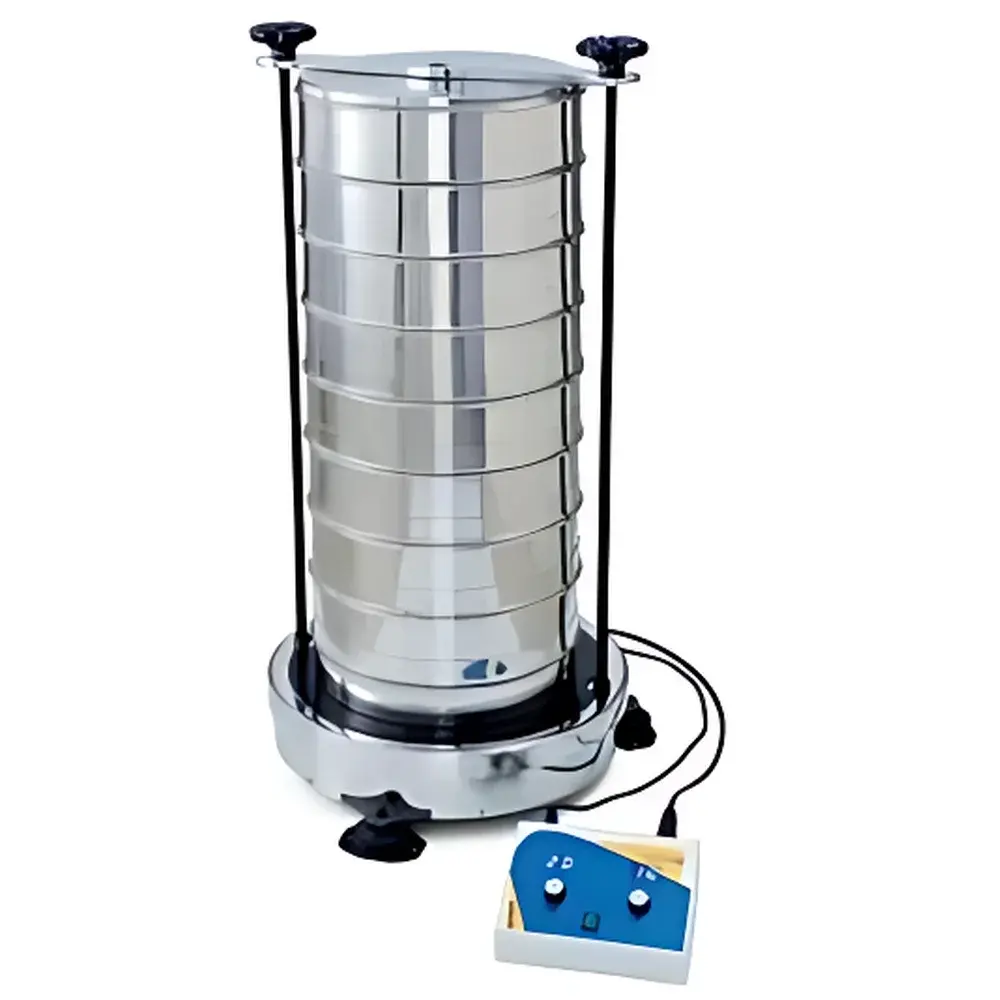
CISA BA400N Electromagnetic Digital Sieve Shaker
| Brand | CISA |
|---|---|
| Origin | Spain |
| Model | BA400N |
| Sieve Diameter | 350 / 400 / 450 mm |
| Max. Load Capacity | 50 kg |
| Vibration Mode | Electromagnetic with Rotational + Vertical Motion |
| Sieve Stack Capacity | Up to 8 sieves (Ø400 mm) |
| Power Supply | 230 V–50 Hz / 110 V–60 Hz |
| Max. Power Consumption | 1400 W |
| Dimensions (with sieves) | Ø540 mm × H1200 mm |
| Net Weight | 50 kg |
| Compliance | ISO 3310-1:2000, ISO 3310-2:1999, ISO 3310-3:2000, BS 410:2001, ASTM E161-2000, AFNOR NF X11-504 |
Overview
The CISA BA400N Electromagnetic Digital Sieve Shaker is a precision-engineered particle size distribution analyzer designed for rigorous laboratory and industrial quality control environments. Built upon over a century of CISA’s heritage in mechanical sieving instrumentation, the BA400N implements a dual-axis electromagnetic drive system—combining controlled rotational displacement with vertical oscillation—to ensure uniform sample agitation across stacked sieve decks. This motion profile minimizes particle segregation and nesting while maximizing stratification efficiency, particularly for cohesive or irregularly shaped powders. Unlike mechanical cam-driven shakers, the electromagnetic actuation delivers repeatable amplitude and frequency profiles without mechanical wear, supporting long-term calibration stability and traceable performance under GLP/GMP conditions.
Key Features
- Electromagnetic digital drive with programmable vibration parameters—including amplitude, duration, and pause intervals—enabling method-specific reproducibility across batch testing.
- Robust stainless steel frame fabricated from high-alloy corrosion-resistant steel; fully weld-seam polished for cleanability and compliance with pharmaceutical and food-grade hygiene requirements.
- Modular sieve column assembly with integrated locking mechanism: front clamps, tension bars, and rapid-release safety latches ensure secure stacking and operator safety during high-load operation (up to 50 kg).
- Support for up to eight standard Ø400 mm test sieves (ISO 3310-compliant mesh), accommodating both dry and wet sieving configurations when paired with optional liquid-tight accessories.
- Universal power input (230 V/50 Hz or 110 V/60 Hz) with thermal overload protection and real-time current monitoring to prevent motor saturation during extended duty cycles.
- Compact footprint with vertical tower architecture optimized for benchtop integration in regulated QC laboratories—no external air supply or compressed gas required.
Sample Compatibility & Compliance
The BA400N is validated for analysis of free-flowing and moderately cohesive particulates, including metal powders, ceramic granules, pharmaceutical excipients, agricultural seeds, mineral ores, and recycled construction aggregates. It accommodates samples with bulk densities ≥0.8 g/cm³ and is compatible with both dry sieving and wet sieving (with optional filtration manifold and spray nozzles). All structural and metrological specifications conform to international standards governing sieve analysis methodology: ISO 3310-1 (test sieves—metal wire cloth), ISO 3310-2 (perforated plate sieves), ISO 3310-3 (electroformed sieves), BS 410:2001 (specifications for test sieves), ASTM E161-2000 (standard specification for metal-wire cloth test sieves), and AFNOR NF X11-504 (particle size analysis—sieving methods). The instrument’s mechanical design supports audit-ready documentation per FDA 21 CFR Part 11 when interfaced with compliant LIMS or ELN platforms.
Software & Data Management
While the BA400N operates as a stand-alone analog-digital hybrid unit with intuitive front-panel controls, its timing and motion parameters are fully configurable via onboard keypad and LCD interface. For automated reporting and data integrity, optional RS-232 or USB connectivity enables integration with third-party laboratory software (e.g., LabWare LIMS, Thermo Fisher SampleManager) for timestamped run logs, operator ID tagging, and electronic signature capture. All vibration cycles are logged with start/stop timestamps, total elapsed time, and applied amplitude settings—satisfying minimum ALCOA+ data governance criteria for raw data retention and traceability.
Applications
- Quality assurance of active pharmaceutical ingredients (APIs) and excipients per USP <786> and EP 2.9.32.
- Particle size grading of cement, sand, and recycled concrete aggregates in civil engineering labs.
- Classification of battery cathode/anode powders (e.g., LiCoO₂, graphite) prior to electrode slurry formulation.
- Feedstock verification for additive manufacturing (powder bed fusion) per ASTM F3049.
- Environmental screening of soil and sediment fractions for regulatory compliance (EPA Method 1699).
- Routine QC of food-grade starches, spices, and dairy powders under HACCP and BRCGS protocols.
FAQ
What sieve diameters does the BA400N support?
The BA400N accommodates standard test sieves with nominal diameters of 350 mm, 400 mm, and 450 mm—fully aligned with ISO 3310 series dimensional tolerances.
Can the BA400N perform wet sieving?
Yes—when equipped with the optional wet sieving kit (including sealed sieve holders, water manifold, and drain tray), the BA400N complies with ISO 2591-1 for aqueous particle size analysis.
Is the electromagnetic drive serviceable in the field?
The solid-state electromagnetic actuator contains no brushes, belts, or gearboxes; routine maintenance is limited to periodic inspection of mounting fasteners and electrical connections—no scheduled replacement parts are required within the first 10 years of operation.
Does the BA400N meet FDA 21 CFR Part 11 requirements?
The base unit does not include electronic audit trail functionality; however, when connected to validated external software with electronic signature and change-control modules, it supports full Part 11 compliance for regulated submissions.
What is the maximum allowable sample mass per run?
The recommended maximum load is 50 kg distributed evenly across the full sieve stack; exceeding this limit may compromise amplitude consistency and accelerate mechanical fatigue of the tensioning system.



