
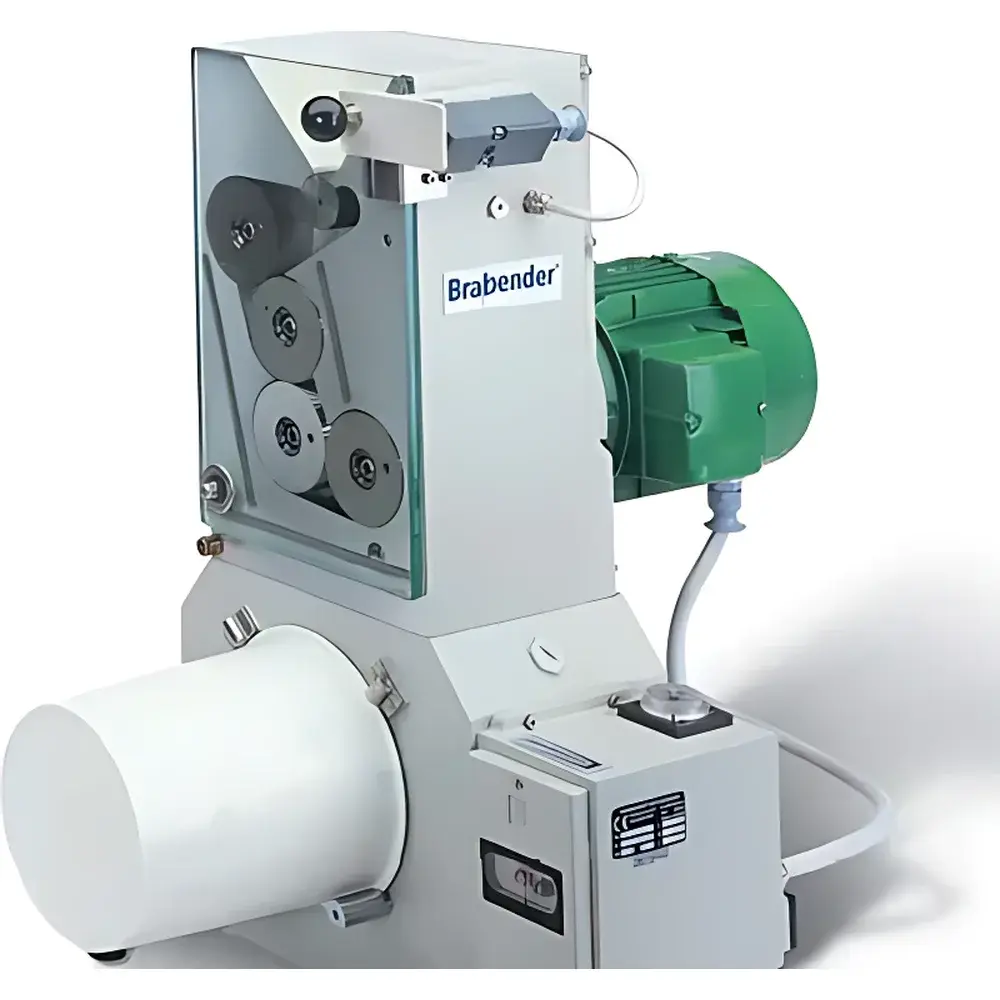
Brabender Sedimat Zeleny Sedimentation Test Mill
| Brand | Brabender |
|---|---|
| Origin | Germany |
| Model | Sedimat |
| Application | Dedicated mill for Zeleny sedimentation test sample preparation (ICC 116, ICC 118, ISO 5529) |
| Throughput | ~100 g flour in ≈3 min |
| Grinding Principle | Three-stage roller milling (3 pairs of corrugated rolls) |
| Sieving | Integrated automatic sieving |
| Roll Material | Hardened steel, wear-resistant design |
| Compliance | Designed to meet ICC and ISO standard sample preparation requirements |
Overview
The Brabender Sedimat Zeleny Sedimentation Test Mill is a precision-engineered laboratory instrument developed specifically for standardized sample preparation in the Zeleny sedimentation test—a widely accepted method for evaluating wheat flour quality and gluten functionality. Unlike general-purpose laboratory mills, the Sedimat implements a defined three-stage roller milling process—passing whole grain or tempered kernels through three successive pairs of corrugated rolls—to replicate the physical shear and compression forces that govern protein matrix development during industrial milling. This controlled mechanical action ensures consistent liberation and structural modification of gluten proteins without thermal degradation or excessive starch damage. The resulting flour exhibits reproducible particle size distribution and protein surface exposure, which are critical prerequisites for accurate Zeleny value determination. As specified in ICC Standard Methods 116 and 118 and ISO 5529, the Sedimat delivers flour samples with minimal operator variability, enabling reliable correlation between sedimentation volume and functional properties such as dough elasticity, gas retention capacity, proof tolerance, and final loaf volume.
Key Features
- Three-pair roller grinding system with precisely calibrated roll gap and differential speed control, ensuring uniform particle size reduction and optimal gluten network exposure.
- Integrated automated sieving unit (typically 250 µm mesh) that separates coarse bran and germ fractions, delivering only the fine, protein-rich endosperm fraction required for Zeleny testing.
- Reproducible throughput of approximately 100 g of standardized flour in under 3 minutes, minimizing batch-to-batch variation and supporting high-throughput QC workflows.
- Hardened steel rolls engineered for dimensional stability and negligible wear over extended operation—eliminating recalibration drift and preserving long-term measurement integrity.
- Compact benchtop footprint with CE-compliant electrical safety and dust-tight enclosure, suitable for ISO/IEC 17025-accredited laboratories and GLP environments.
Sample Compatibility & Compliance
The Sedimat is validated for use with soft, hard, and durum wheat varieties, as well as rye and triticale, provided grain moisture content falls within the 14–15.5% (w.b.) range recommended by ICC 116. It complies with the mechanical preparation requirements outlined in ICC Method 116:2022 (“Determination of the Zeleny sedimentation value of wheat flour”) and ICC Method 118:2021 (“Preparation of flour for sedimentation tests”). Its output meets the particle size and compositional specifications referenced in ISO 5529:2020 (“Cereals and cereal products — Determination of Zeleny sedimentation value”), including strict limits on residual bran fragments and starch granule integrity. The instrument is routinely included in method validation protocols for laboratories seeking accreditation to ISO/IEC 17025 for cereal testing.
Software & Data Management
The Sedimat operates as a standalone electromechanical system without embedded firmware or digital interface; however, its deterministic performance supports full traceability when integrated into LIMS-driven workflows. Each milling cycle is manually logged with timestamp, sample ID, grain lot number, and environmental conditions (temperature/humidity), satisfying documentation requirements for GLP and GMP audits. When paired with Brabender’s optional Sedimat Logbook template (PDF/Excel), users can maintain compliant records aligned with FDA 21 CFR Part 11 principles—particularly audit trail generation, user authentication, and data integrity controls for regulated baking quality assurance programs.
Applications
- Standardized flour production for Zeleny sedimentation analysis in cereal breeding programs and commercial wheat procurement.
- Quality control in flour mills and bakeries to monitor raw material consistency and detect deviations in gluten strength prior to dough formulation.
- Research applications investigating correlations between milling parameters (roll gap, feed rate, moisture) and sedimentation behavior across genetic lines.
- Reference laboratory use in inter-laboratory comparison studies and proficiency testing schemes administered by AACC International or ICC.
- Complementary operation with Brabender Sedimat Shaker units (e.g., model SED-SHAKER-20) to complete the full ICC 116 workflow from milling to sedimentation reading.
FAQ
Is the Sedimat compatible with non-wheat cereals such as rye or barley?
Yes—the instrument has been verified for rye and triticale under ICC 116 guidelines; barley is not recommended due to inherent differences in protein solubility and sedimentation kinetics.
Does the Sedimat require calibration or periodic verification?
Roll gap and sieving mesh integrity should be verified annually using NIST-traceable gauges and certified test sieves per ISO 2591-1; no electronic calibration is needed.
Can the Sedimat replace other laboratory mills for general flour production?
No—it is purpose-built for Zeleny testing and does not replicate the break and reduction sequence of commercial milling; its output is not suitable for Farinograph or Extensograph analysis.
What maintenance is required to ensure long-term repeatability?
Daily cleaning of the grinding chamber and sieve housing with compressed air; biannual inspection of roll surface finish and bearing preload per Brabender Service Bulletin SB-SED-2023.





