
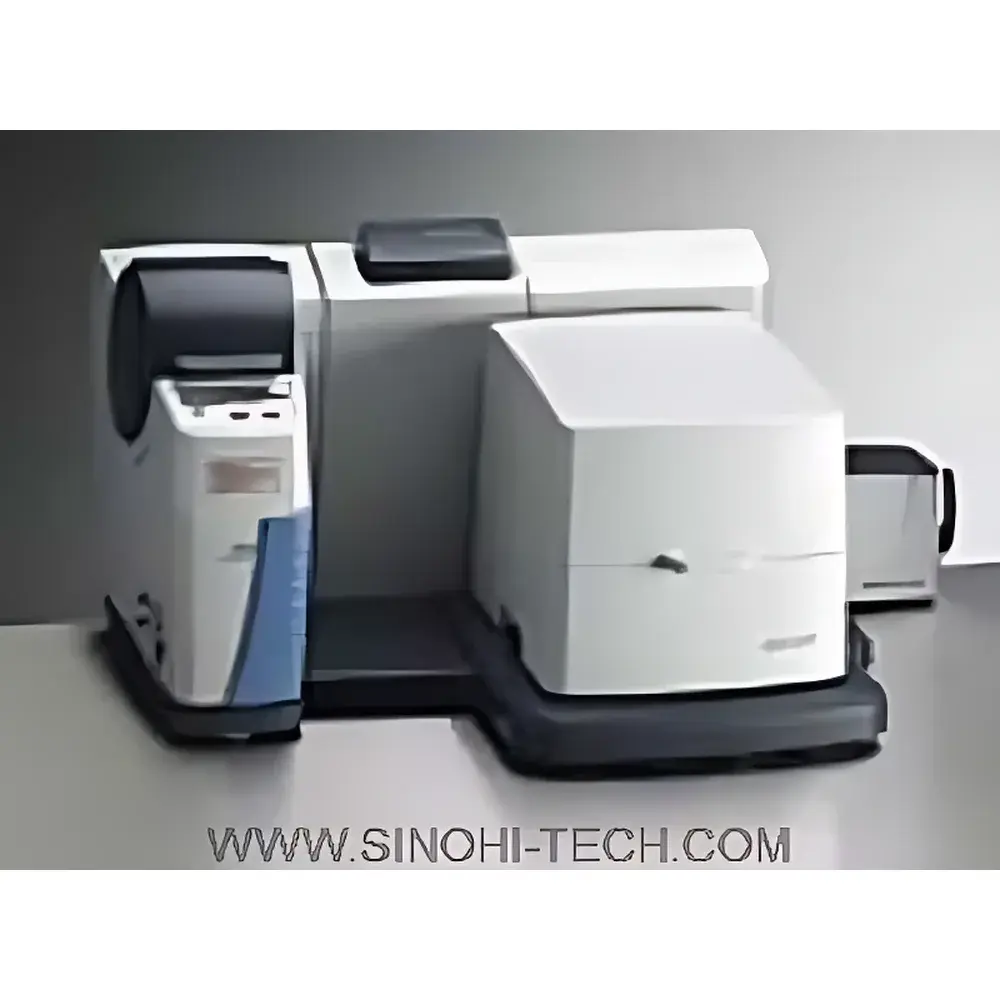
Thermo Scientific DXR SmartRaman Spectrometer
| Origin | USA |
|---|---|
| Manufacturer Type | Authorized Distributor |
| Origin Category | Imported |
| Model | DXR |
| Pricing | Upon Request |
Overview
The Thermo Scientific DXR SmartRaman Spectrometer is a fully automated, research-grade benchtop Raman spectrometer engineered for high-throughput, routine analytical laboratories requiring robust performance with minimal operator intervention. Based on dispersive Raman spectroscopy using a holographic grating and CCD detector array, the system delivers high signal-to-noise ratio spectra across the standard spectral range (typically ~200–3500 cm⁻¹), enabling molecular fingerprinting of solids, liquids, gels, and suspensions—non-destructively and through transparent packaging materials such as glass vials, plastic containers, blister packs, and multi-well plates. Its optical architecture incorporates patented laser alignment stabilization and real-time wavelength calibration, ensuring long-term spectral fidelity without manual recalibration or scheduled downtime. Designed to complement FTIR in quality control and R&D workflows, the DXR excels where IR-inactive modes dominate (e.g., symmetric vibrations, homonuclear bonds) and provides orthogonal confirmation for polymorph identification, crystallinity assessment, and chemical impurity detection.
Key Features
- Intelligent Auto-Focus: Dynamically optimizes focal position in real time to maximize Raman signal intensity and reproducibility across heterogeneous or uneven sample surfaces.
- Auto-Exposure Algorithm: Calculates optimal integration time and number of accumulations per spectrum to achieve maximum sensitivity while avoiding detector saturation—adaptive to sample fluorescence and scattering efficiency.
- Smart Background Collection: Acquires background spectra during instrument idle periods, eliminating manual background acquisition steps and improving workflow continuity.
- Variable Dynamic Point Sampling (VDPS): Enables spatially resolved analysis across non-uniform samples by dynamically steering the laser spot across defined surface areas, preserving spectral integrity without beam dispersion loss.
- Cosmic Ray Rejection: Proprietary real-time algorithm identifies and removes cosmic ray spikes from individual frames prior to spectral averaging—no post-acquisition editing required.
- Multi-Laser Platform: Supports three interchangeable diode lasers (e.g., 532 nm, 633 nm, 785 nm) with software-controlled selection, allowing optimization of fluorescence suppression, penetration depth, and signal intensity per sample class.
- Self-Identifying Smart Accessories: All sampling modules—including autosamplers, tablet holders, vial cradles, 180° reflection probes, and universal stages—feature embedded RFID tags recognized automatically by OMNIC software, enabling full traceability and method portability.
Sample Compatibility & Compliance
The DXR accommodates diverse sample formats without preparation: powders in plastic pouches or amber glass vials; liquids and slurries in microtiter plates (96-/384-well); tablets in blister packaging; capillary tubes; and bulk solids on planar stages. Its non-contact, through-container capability reduces contamination risk and complies with Good Manufacturing Practice (GMP) and FDA 21 CFR Part 11 requirements when deployed with audit-trail-enabled OMNIC software configurations. The system supports ASTM E1840 (Standard Guide for Raman Shift Standards), ISO 8573 (compressed air purity for pharmaceutical environments), and USP (Raman Spectroscopy for Pharmaceutical Analysis). Routine performance qualification (PQ) is simplified via built-in NIST-traceable polystyrene and silicon reference standards.
Software & Data Management
Controlled exclusively by Thermo Scientific OMNIC Specta software, the DXR integrates spectral acquisition, processing, library searching, and reporting into a single validated platform. OMNIC supports full array automation for high-content screening, including plate mapping, batch processing, and pass/fail criteria evaluation against user-defined spectral thresholds. InterpretIR™ chemometric tools enable multivariate analysis (PCA, PLS-DA) for classification and quantitation. The integrated Raman spectral library contains over 25,000 reference spectra—curated from peer-reviewed literature, pharmacopeial standards, and industrial material databases—with hierarchical search functionality (by functional group, compound class, or similarity index). All raw and processed data are stored in vendor-neutral .spa format, supporting long-term archival and third-party data exchange under GLP-compliant metadata tagging.
Applications
- Pharmaceutical: Polymorph screening, API-excipient compatibility studies, counterfeit drug detection, and blend uniformity analysis in solid dosage forms.
- Materials Science: Carbon nanotube chirality assignment, graphene layer counting, stress/strain mapping in composites, and catalyst characterization.
- Forensics: Identification of illicit substances, explosives residues, and trace pigments in questioned documents or paint chips.
- Academic Research: In situ reaction monitoring, electrochemical interface probing, and temperature-dependent phase transition studies.
- Quality Assurance: Raw material verification, cleaning validation swab analysis, and packaging integrity assessment (e.g., leachables in polymer containers).
FAQ
Does the DXR require daily calibration or alignment maintenance?
No. The system employs continuous internal wavelength calibration using a built-in neon lamp and motorized grating alignment—requiring no user intervention between scheduled PQ checks.
Can OMNIC software generate 21 CFR Part 11-compliant reports?
Yes—when configured with electronic signatures, audit trails, and role-based access control, OMNIC meets regulatory requirements for data integrity in GxP environments.
Is it possible to analyze samples inside opaque or colored containers?
Analysis is limited to optically transparent or semi-transparent packaging. Strongly absorbing or highly scattering containers (e.g., black HDPE, frosted glass) may attenuate signal; alternative sampling geometries (e.g., 180° reflectance) can be evaluated case-by-case.
What level of technical expertise is needed to operate the DXR routinely?
Operators require only basic spectroscopy literacy. Method creation, instrument setup, and result interpretation are guided by context-sensitive wizards and preconfigured application templates.
How does VDPS differ from traditional mapping or raster scanning?
VDPS performs rapid, single-point spectral acquisition at multiple locations without stage movement—reducing mechanical wear and measurement time—while maintaining laser focus and power density consistency across all points.



