
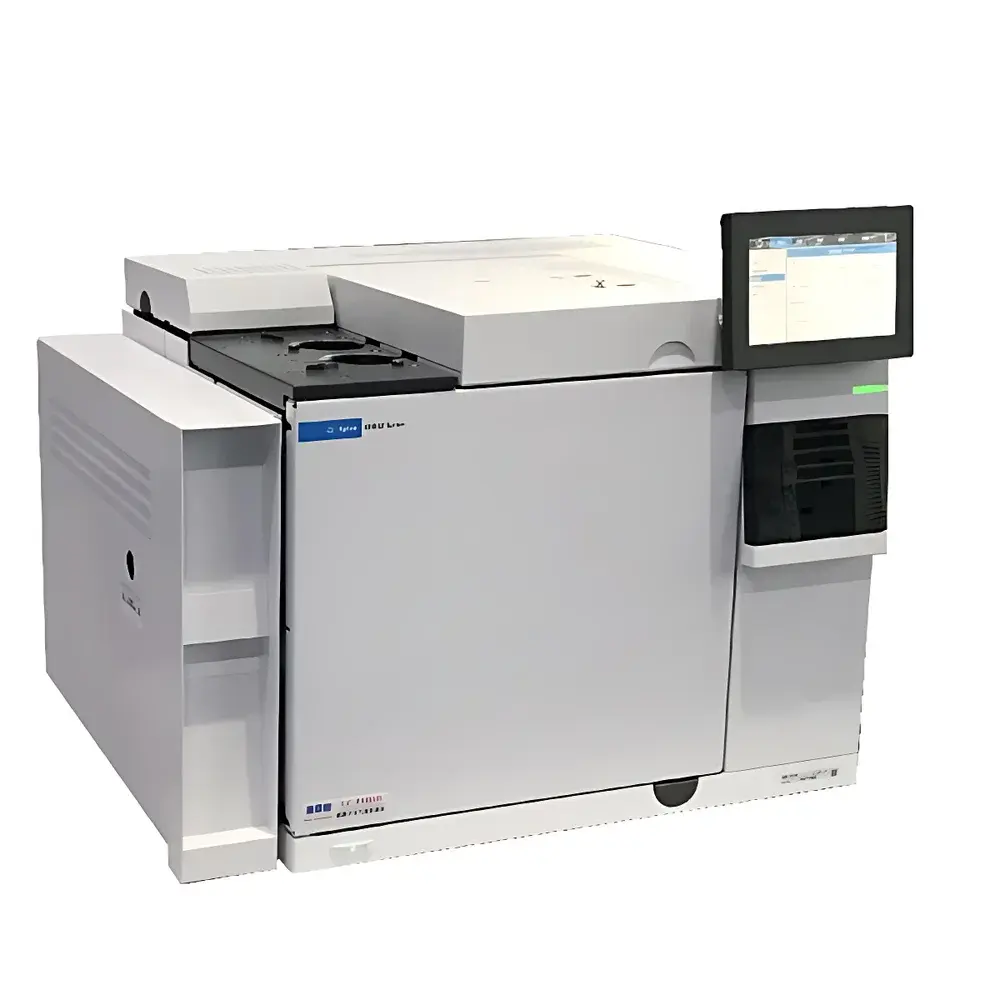
Agilent 8890 PDD Helium Ionization Gas Chromatograph for Ultra-High-Purity Air Separation Gas Analysis
| Brand | Agilent Technologies |
|---|---|
| Origin | Zhejiang, China |
| Manufacturer Type | Authorized Distributor |
| Regional Category | Domestic (China) |
| Model | Agilent 8890 PDD |
| Pricing | Available Upon Request |
| Detection Principle | Pulsed Discharge Helium Ionization Detection (PDHID) |
| Column Oven Range | 40 °C above ambient to 450 °C |
| Temperature Stability | < 0.01 °C per 1 °C ambient fluctuation |
| Max Ramp Rate | 120 °C/min |
| Cooling Time | ≤6 min (450 °C → 50 °C at 22 °C ambient) |
| LOD | 5–25 ppb (gas-dependent) |
| Compliance | GB/T 28726-2012, JJG 700-2016, GB/T 8979-2008, GB/T 4842-2006, GB/T 4844.3-2005, GB/T 3634.2-2011, GB/T 6052-2011 |
Overview
The Agilent 8890 PDD is a dedicated gas chromatograph engineered for trace-level impurity analysis in ultra-high-purity (UHP) and high-purity (HP) air separation gases. It employs pulsed discharge helium ionization detection (PDHID), a universal, non-destructive detection technique optimized for permanent gases and light hydrocarbons. Unlike flame ionization or thermal conductivity detectors, PDHID provides exceptional sensitivity (sub-ppb LODs) and linear dynamic range (>105) without requiring hydrogen or air combustion gases—critical for safe, stable operation in inert gas production facilities. The system is configured for routine analysis of He, H2, N2, Ar, CO2, CH4, CO, O2, and C2+ hydrocarbons in matrices exceeding 99.999% purity. Its architecture supports both laboratory-based QC/QA and integration into semi-automated process monitoring workflows, with full compliance to Chinese national standards governing industrial gas quality control.
Key Features
- Double-channel pulsed discharge helium ionization detector (PDHID) with independent power control and real-time pulse synchronization for enhanced signal-to-noise ratio and baseline stability.
- High-precision column oven with 20-step/21-platform temperature programming, 0.1 °C resolution, and rapid cooling (<6 min from 450 °C to 50 °C), enabling high-throughput multi-gas analysis cycles.
- Robust thermal management system ensuring <0.01 °C oven temperature drift per 1 °C ambient variation—essential for retention time reproducibility across shifts and seasons.
- Integrated electronic pressure control (EPC) on all carrier and make-up gas lines, supporting precise flow optimization for capillary and packed column configurations.
- Pre-configured analytical method packages for ISO/GB-compliant testing of UHP helium (GB/T 4844.3-2005), nitrogen (GB/T 8979-2008), argon (GB/T 4842-2006), hydrogen (GB/T 3634.2-2011), and CO2 (GB/T 6052-2011).
- Self-diagnostic firmware with early maintenance feedback, component usage logging, and automated performance verification protocols aligned with GLP audit requirements.
Sample Compatibility & Compliance
The Agilent 8890 PDD is validated for direct injection of gaseous samples ranging from ambient-pressure cylinder gas to pressurized process streams (up to 10 bar via optional pressure-regulated sampling valves). It accommodates standard stainless-steel sampling loops (0.25–1.0 mL), heated sample transfer lines (up to 150 °C), and custom-built online interface modules for continuous monitoring of cryogenic air separation unit (ASU) off-gas streams. All hardware surfaces contacting sample gas are electropolished and passivated to minimize adsorption and memory effects—particularly critical for reactive species such as CO, O2, and moisture-sensitive analytes. The system meets the metrological requirements of JJG 700-2016 (Verification Regulation for Gas Chromatographs) and implements measurement traceability to NIM (National Institute of Metrology, China) reference standards. Data integrity controls—including electronic signatures, audit trails, and user-access tiering—are configurable to support FDA 21 CFR Part 11 readiness when deployed in regulated manufacturing environments.
Software & Data Management
Controlled via Agilent’s OpenLab CDS ChemStation Edition (localized Chinese UI with English technical terminology), the platform delivers full instrument automation, sequence scheduling, and report generation compliant with ISO/IEC 17025 documentation practices. Raw data files (.D format) are stored with embedded metadata including instrument configuration, calibration history, and operator ID. Built-in system suitability tests assess peak symmetry, resolution, and retention time repeatability prior to sample analysis—generating auto-flagged alerts if criteria fall outside pre-defined limits. Reporting templates include customizable ASTM-style purity certificates, multi-point calibration summaries, and trending dashboards for long-term impurity drift analysis. All software modules undergo annual validation against GB/T 28726-2012 Annex B verification procedures, and electronic logs record every parameter change, run initiation, and maintenance event with timestamp and user attribution.
Applications
- Quality assurance of UHP helium, nitrogen, argon, hydrogen, and carbon dioxide supplied to semiconductor fabrication fabs (SEMI F57-0317 compliance support).
- Trace oxygen, moisture, and hydrocarbon verification in ASU product streams prior to cryogenic distillation column feed.
- Residual solvent and catalyst bleed monitoring in hydrogen production units (PEM electrolysis, steam methane reforming).
- Leak detection and purity verification in inert blanketing systems used in pharmaceutical lyophilization and battery electrode coating lines.
- Method transfer and inter-laboratory comparison studies under CNAS-accredited testing programs for industrial gas certification bodies.
FAQ
What detection technology does the Agilent 8890 PDD employ, and why is it preferred for UHP gas analysis?
It uses pulsed discharge helium ionization detection (PDHID), which offers superior sensitivity for permanent gases and light hydrocarbons without combustible gases—reducing explosion risk and improving baseline stability in high-purity matrix analysis.
Does the system support automated unattended operation for 24/7 monitoring?
Yes—when integrated with optional autosamplers and pneumatic valve manifolds, it supports fully automated sequences up to 999.99 minutes, including periodic calibration injections and system flushing protocols.
Can the instrument be validated for use in GMP-regulated environments?
The hardware and OpenLab CDS software support IQ/OQ/PQ execution; electronic audit trails, user access controls, and electronic signatures are configurable to meet FDA 21 CFR Part 11 and EU Annex 11 expectations.
What column chemistries are recommended for simultaneous O2/Ar/N2 separation?
A 30 m × 0.53 mm ID porous layer open tubular (PLOT) column with alumina/KCl or molecular sieve 5Å stationary phase is typically deployed, delivering baseline resolution of these co-eluting diatomic gases within <8 minutes.
Is remote diagnostics and firmware updates supported?
Yes—via secure TLS-encrypted network connection, authorized service engineers can perform remote health checks, parameter optimization, and controlled firmware upgrades while maintaining local data sovereignty and cybersecurity compliance.





