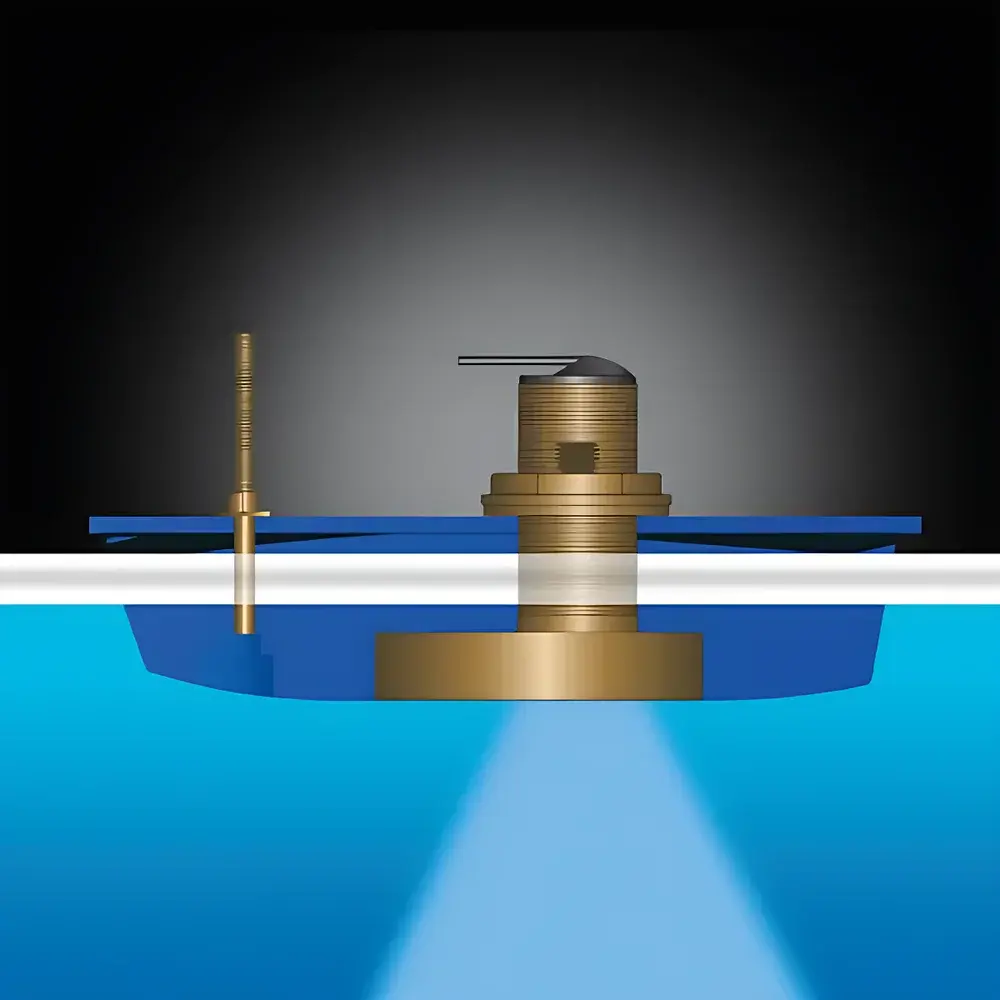
AirMar B765LM Dual-Band Chirp Through-Hull Depth Sounder
| Brand | AirMar |
|---|---|
| Origin | USA |
| Model | B765LM |
| Frequency Bands | Low Band 40–75 kHz (300 W, 32°–21° beamwidth) / Medium Band 80–130 kHz (600 W, 24°–16° beamwidth) |
| Total Bandwidth | 85 kHz |
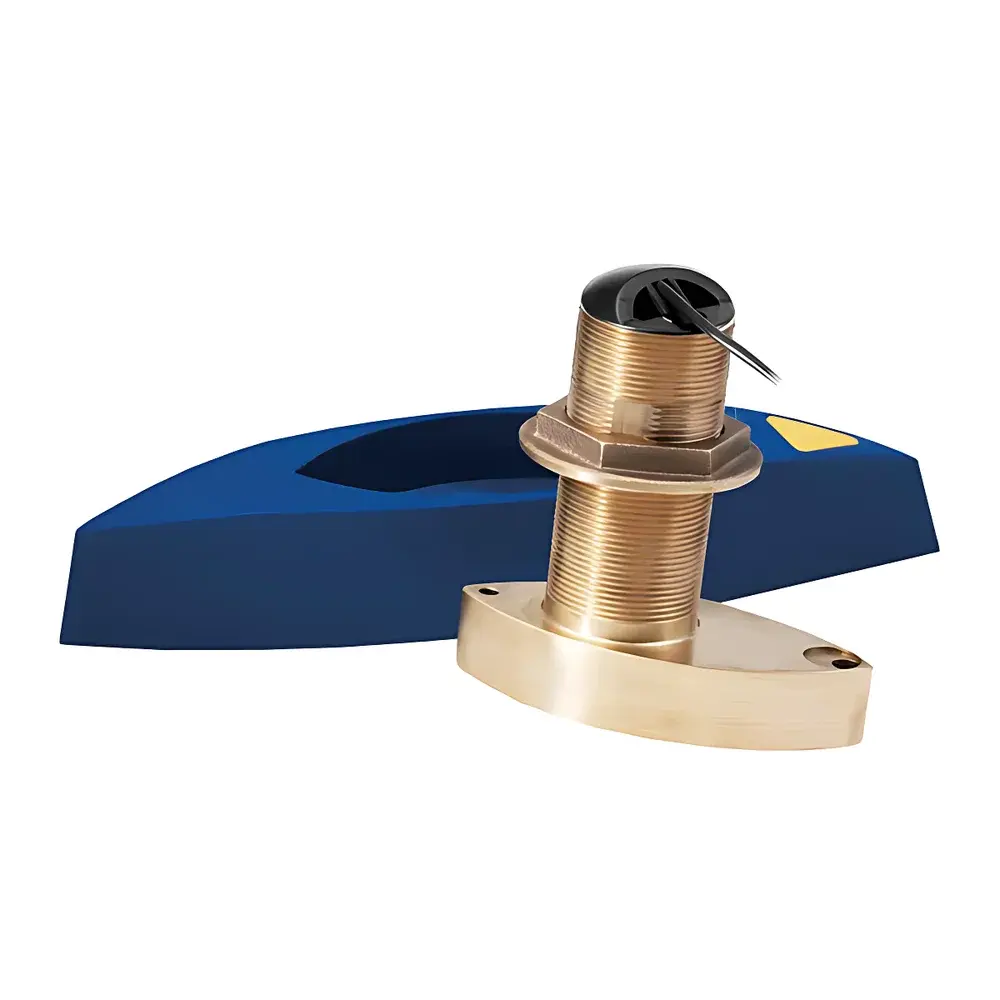
| Transducer Material | Bronze housing with polyurethane fairing |
| Mounting | Through-hull with integrated fairing |
| Hull Compatibility | Fiberglass or wood hulls, max deadrise up to 24° |
| Hole Size | 51 mm |
| Stub Length | 121 mm |
| Cable Length | 10 m |
| Integrated Temperature Sensor | Yes |
| Weight | 2.5 kg |
| Max Operating Depth | 3000 m |
| Compliant Frequencies | 50 kHz, 88 kHz, 107 kHz |
Overview
The AirMar B765LM is a dual-band, through-hull mounted Chirp sonar transducer engineered for high-fidelity bathymetric and fish-finding performance in commercial and recreational marine applications. Unlike conventional pulsed-echo depth sounders, the B765LM employs frequency-modulated continuous-wave (FMCW) Chirp technology—transmitting swept-frequency signals across two distinct bands—to achieve superior range resolution, signal-to-noise ratio, and target discrimination. Its low-band (40–75 kHz) operation delivers extended bottom detection capability down to 3,000 meters, while the medium-band (80–130 kHz) provides enhanced lateral resolution for identifying discrete biological targets—including baitfish schools, game species, and submerged structural features—within the water column. Designed for vessels ≥9 m with fiberglass or wooden hulls and deadrise angles up to 24°, the B765LM integrates a precision thermistor-based water temperature sensor directly into the transducer housing, enabling synchronous environmental monitoring without external probe installation.
Key Features
- Dual-band Chirp architecture with independent low-band (40–75 kHz, 300 W) and medium-band (80–130 kHz, 600 W) transmission channels, supporting simultaneous multi-frequency echo processing.
- Patented Xducer ID® technology enables automatic transducer identification and configuration by compatible chartplotters and multifunction displays (MFDs), reducing setup complexity and minimizing manual parameter entry errors.
- Optimized beam geometry: low-band beamwidth narrows from 32° to 21° across its sweep; medium-band beamwidth compresses from 24° to 16°, delivering progressive focusing that improves depth accuracy and lateral target separation.
- Robust bronze transducer body with molded polyurethane fairing ensures hydrodynamic stability, cavitation resistance, and acoustic impedance matching for consistent energy coupling into seawater or freshwater.
- Integrated high-stability NTC thermistor calibrated per IEC 60751 Class B standards, providing real-time water temperature readings with ±0.5°C accuracy over 0–35°C operating range.
- Through-hull mounting design includes pre-drilled 51 mm aperture specification and 121 mm stub length—optimized for standard hull thicknesses and alignment tolerance in small-craft installations.
Sample Compatibility & Compliance
The B765LM is validated for use on rigid, non-metallic hulls including cured fiberglass-reinforced polymer (FRP) and solid timber constructions. It is not rated for aluminum, steel, or cored composite hulls due to acoustic attenuation and impedance mismatch risks. The transducer complies with FCC Part 15 Subpart B (unintentional radiator) and CE Directive 2014/53/EU (Radio Equipment Directive) for electromagnetic compatibility. Its mechanical design conforms to ISO 8846:2018 (marine equipment—electrical safety) and ABYC E-11 (boat electrical systems). While not certified for Class I Division 1 hazardous locations, it meets IP67 ingress protection when installed with OEM-sealed through-hull fittings.
Software & Data Management
The B765LM outputs raw echo data via NMEA 2000 (via optional adapter) or proprietary analog/digital interfaces compatible with Raymarine Axiom, Garmin GPSMAP, Furuno TZtouch, and Simrad NSS evo3 platforms. Real-time echo logs and temperature metadata are timestamped and structured per NMEA 2000 PGN 128267 (Depth, Temperature) and PGN 128277 (Water Temperature). When used with NMEA 2000-certified MFDs supporting GLONASS/GPS time synchronization, the system supports traceable data logging compliant with ISO/IEC 17025 documentation requirements for marine survey applications. Firmware updates are delivered via AirMar’s official utility software, which maintains full audit trail of version history and calibration status.
Applications
- Commercial small-boat fisheries requiring accurate bottom contour mapping and pelagic biomass differentiation in continental shelf and slope environments.
- Scientific limnological surveys where concurrent depth, temperature, and echo signature analysis support phytoplankton bloom tracking and benthic habitat classification.
- Recreational offshore angling operations targeting tunas, marlins, and billfish using 50/88/107 kHz harmonized frequency sets for optimal target contrast against thermal layers.
- Coastal hydrographic reconnaissance missions involving shallow-to-deep transition zones (e.g., fjords, canyons), where dual-band Chirp enables seamless vertical profiling without mode switching latency.
- OEM integration into autonomous surface vehicles (ASVs) and remotely operated towed bodies, leveraging its low-power standby mode and stable thermal drift characteristics.
FAQ
Is the B765LM suitable for metal-hulled vessels?
No. Acoustic coupling efficiency is significantly degraded on aluminum or steel hulls due to high acoustic impedance mismatch and internal resonance effects. Installation is restricted to solid fiberglass or wood hulls only.
What is the maximum recommended deadrise angle for installation?
The transducer is rated for hull deadrise angles up to 24° when used with the included polyurethane fairing. Beyond this, beam skew and bottom return distortion increase measurably.
Does the unit require external power regulation or cooling?
It operates directly from standard 12 VDC marine power systems (10.8–16 V nominal) and relies on passive thermal dissipation via the bronze housing—no active cooling or voltage regulation circuitry is required.
Can the temperature sensor be recalibrated in-field?
No. The NTC thermistor is factory-calibrated and sealed within the transducer housing. Recalibration requires return to an AirMar-authorized service center with traceable reference standards.
Is firmware update capability available via NMEA 2000 network?
Firmware updates must be performed using AirMar’s dedicated PC-based utility and USB-to-NMEA interface cable. Over-the-network updates are not supported for security and integrity reasons.