
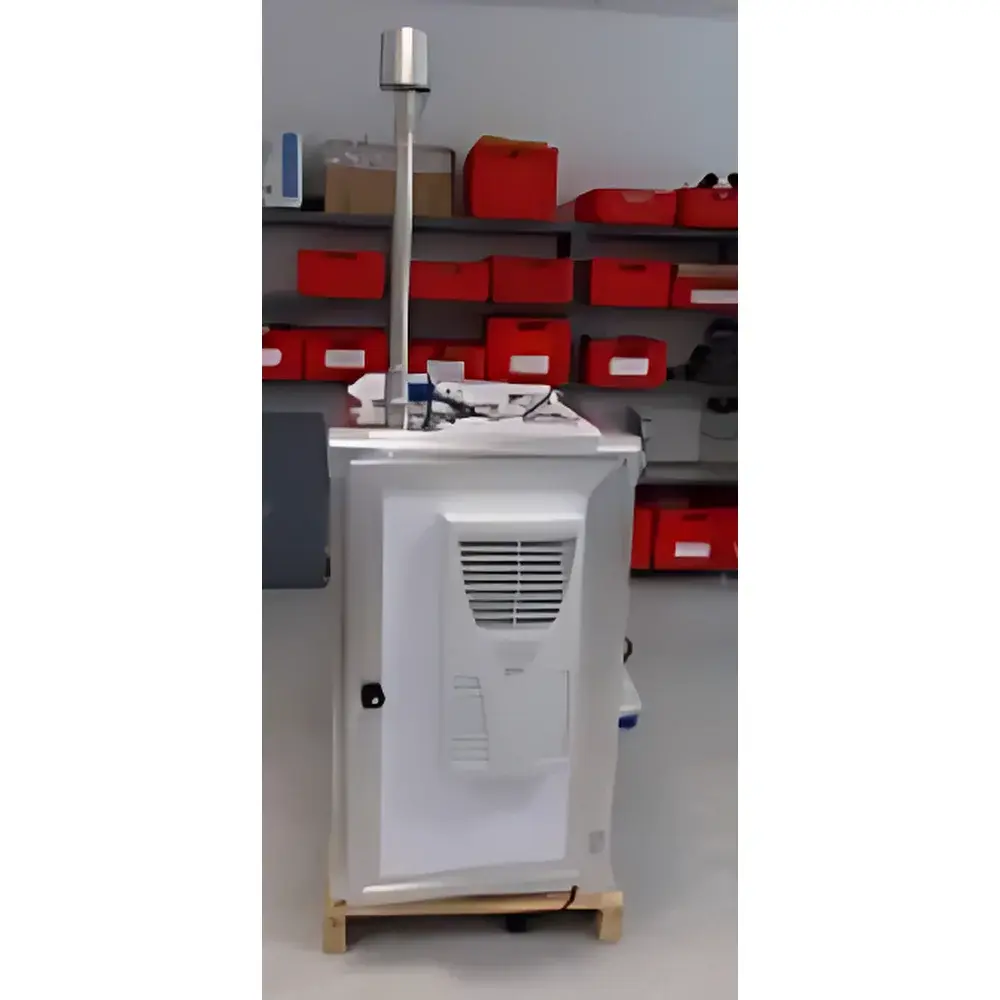
AirScanner Compact Environmental Air Quality Monitoring Station
| Origin | Germany |
|---|---|
| Manufacturer Type | Authorized Distributor |
| Origin Category | Imported |
| Model | AirScanner |
| Price Range | USD 68,000–136,000 (FOB) |
| Pollutants Measured | O₃, NO/NO₂, CO, SO₂, CO₂, VOCs, PM₁₀, PM₂.₅ |
| Measurement Principles | UV Photometry (O₃, SO₂), Chemiluminescence (NO/NO₂), NDIR (CO, CO₂), PID (VOCs), β-Attenuation or Optical Scattering (PM) |
| Environmental Parameters | Temperature, Relative Humidity, Wind Speed & Direction, Ambient Noise, Atmospheric Pressure |
| Data Connectivity | GSM/GPRS, Ethernet (LAN/WLAN), RS-232 |
| Enclosure Rating | IP65 |
| Operating Temperature Range | −20 °C to +50 °C |
| Power Supply | 230 V AC ±10%, 50/60 Hz or Solar/Battery Hybrid Option |
Overview
The AirScanner Compact Environmental Air Quality Monitoring Station is a turnkey, transportable ambient air monitoring system engineered for high-fidelity, real-time measurement of regulated gaseous pollutants and particulate matter in diverse urban and peri-urban environments. Designed and assembled in Germany by MCZ GmbH—a manufacturer with over two decades of expertise in environmental sensor integration—the AirScanner employs validated, reference-grade analytical methods compliant with EU Directive 2008/50/EC and EN 14625 (O₃), EN 14211 (NO₂/NO), EN 14626 (CO), EN 14212 (SO₂), and EN 16450 (PM). Its modular architecture supports simultaneous deployment of UV photometric, chemiluminescent, non-dispersive infrared (NDIR), photoionization (PID), and optical particle detection technologies within a single, climate-controlled enclosure. This enables trace-level quantification across dynamic concentration ranges—from sub-ppb ozone background levels to multi-ppm CO peaks near traffic corridors—while maintaining metrological traceability to national standards (e.g., PTB, NPL).
Key Features
- Multi-pollutant capability: Simultaneous real-time analysis of O₃, NO, NO₂, CO, SO₂, CO₂, total VOCs, PM₂.₅, and PM₁₀ using method-specific detectors per EN and ISO standards
- Climate-stabilized enclosure: Integrated refrigerated air conditioning maintains internal temperature at 20–25 °C ±1 °C across ambient extremes (−20 °C to +50 °C), ensuring analyzer stability and reducing calibration drift
- Robust mechanical design: IP65-rated weatherproof housing with reinforced aluminum frame, vibration-dampened mounting, and lockable access panels for unattended field operation
- Redundant data integrity: Local SD card storage (up to 16 GB) with timestamped, CRC-verified binary logging; automatic fallback to GSM/GPRS upon LAN interruption
- Calibration flexibility: Onboard zero/span gas manifold with programmable auto-calibration cycles (daily, weekly, or event-triggered); compatibility with certified calibration gases (ISO 6141)
- Remote diagnostics & firmware updates: Secure SSH/TLS-enabled access for health monitoring, parameter reconfiguration, and over-the-air software upgrades without site visit
Sample Compatibility & Compliance
The AirScanner is configured for continuous, unattended sampling of ambient outdoor air in accordance with regulatory requirements for official air quality reporting networks. Inlet design follows EN 12341 for PM samplers and EN 13273-1 for gaseous analyzers, including heated sample lines (to prevent condensation), particle filtration (10 µm cyclone + Teflon membrane), and flow-controlled sampling (1.0–1.2 L/min). All gas measurements meet the data quality objectives (DQOs) defined in EU Commission Regulation (EU) 2017/1413, including 90% time coverage, <15% expanded uncertainty (k=2), and <5% missing data per quarter. The system supports full audit trails required under ISO/IEC 17025:2017 and is compatible with national reporting platforms such as AQICN, EEA AirBase, and US EPA AQS via standardized CSV/JSON export or MQTT ingestion.
Software & Data Management
- MCZ AirView™ v4.2: Windows-based configuration and visualization suite with real-time dashboard, spectral overlay, and alarm thresholding (email/SMS notification on exceedance)
- GLP-compliant data handling: Full electronic record retention with user authentication, immutable timestamps, and 21 CFR Part 11–ready audit log (user actions, calibration events, instrument errors)
- API-driven interoperability: RESTful interface for integration into municipal SCADA systems, GIS mapping tools (e.g., QGIS, ArcGIS), and third-party analytics platforms (e.g., Python Pandas, Tableau)
- Automated QA/QC reporting: Daily summary reports include precision checks (duplicate injections), zero/span recovery rates, pressure/temperature compensation logs, and flagging of out-of-spec conditions
Applications
The AirScanner serves mission-critical roles in statutory monitoring, research-grade exposure assessment, and industrial compliance verification. Typical deployments include fixed-site urban background stations, mobile roadside monitoring along arterial roads and tunnels, fence-line monitoring at industrial facilities (e.g., power plants, refineries), and source apportionment studies using spatial gradient analysis. Its compact footprint (<0.8 m² floor area) and low power consumption (0.97 for NO₂ and PM₁₀ under varying RH and temperature conditions.
FAQ
Does the AirScanner meet EU Reference Method equivalency requirements?
Yes—each gas module is type-approved to relevant EN standards (e.g., EN 14211 for NO₂), and the integrated system complies with the performance criteria in Commission Decision 2011/813/EU for indicative monitoring networks.
Can it operate off-grid?
Yes—optional solar panel array (200–400 W) with LiFePO₄ battery bank (2.4 kWh) supports continuous operation for ≥72 hours during grid outage or remote deployment.
Is PM₂.₅ measurement certified to EN 16450?
The optical scattering PM module is factory-calibrated against gravimetric reference and meets EN 16450 Class 3 specifications for indicative monitoring; optional beta-attenuation (BAM) upgrade available for Class 1 compliance.
What cybersecurity protocols are implemented?
All network interfaces support TLS 1.2+, SSH key authentication, VLAN segmentation, and configurable firewall rules; firmware signed with ECDSA-256 to prevent unauthorized modification.







