
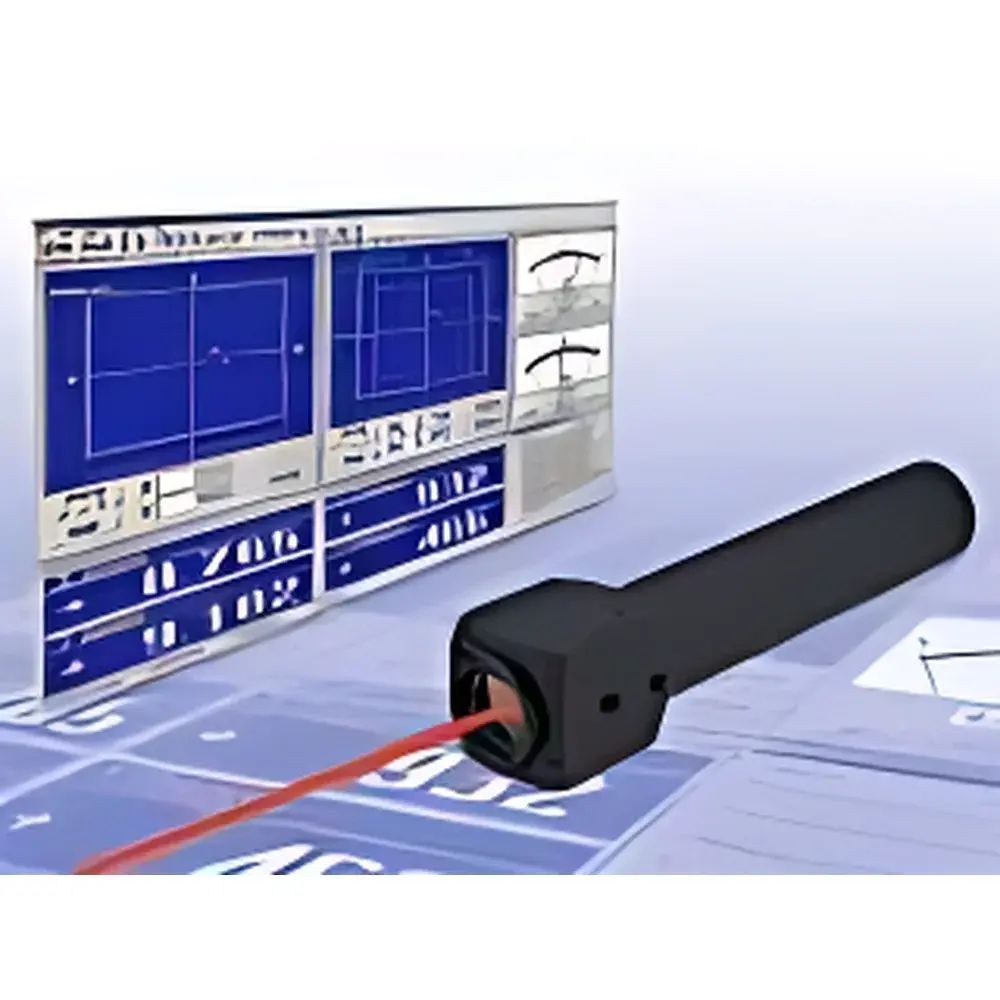
AlignMeter Laser Beam Alignment System by Duma Optronics
| Brand | Duma Optronics |
|---|---|
| Origin | Israel |
| Model | ALIGN series |
| Spectral Range | 350–1100 nm |
| Position Accuracy | ±15 µm |
| Angular Accuracy | ±0.125 mrad |
| Power Accuracy | ±5% |
| Interface | USB 2.0 (standard), RS232, TCP/IP |
| Software | ActiveX-compatible SDK for custom integration |
| Optical Apertures | Standard (f=50 mm / f=100 mm), Large Aperture (22.5 mm × 22.5 mm) |
| Optional Filters | ND4 (1/8), NG9 (10⁻⁹), NG19 (10⁻¹⁰) housed in M37×0.7 thread |
| Ambient Light Suppression | 55 mm extended hood |
Overview
The AlignMeter Laser Beam Alignment System is a precision optical metrology instrument engineered for real-time, non-contact measurement of laser beam position, angular deviation, and power—critical parameters in high-stability optical alignment workflows. Based on quadrant photodiode detection with calibrated centroid calculation algorithms, the system operates across a broad spectral range (350–1100 nm), covering UV-visible-NIR wavelengths typical of diode lasers, solid-state lasers, and fiber-coupled sources. Its core architecture employs a fixed-focal-length imaging lens assembly to project the incident beam onto a high-linearity, low-noise quad-cell sensor. Sub-pixel centroid resolution enables deterministic position tracking at ±15 µm accuracy, while differential signal processing yields angular sensitivity of ±0.125 mrad—sufficient for sub-microradian stability monitoring in interferometric or cavity alignment applications. Designed for integration into automated optical benches and production-grade alignment stations, the AlignMeter meets functional requirements for ISO 10110-7 (laser beam characterization) and supports traceable calibration protocols compliant with ISO/IEC 17025-accredited laboratories.
Key Features
- Triple-parameter simultaneous acquisition: beam centroid (X/Y), divergence angle (θx/θy), and total power—all synchronized within a single exposure cycle.
- Modular optical head configuration: standard focal lengths (f = 50 mm and f = 100 mm) optimized for different working distances and beam diameters; large-aperture variant (22.5 mm × 22.5 mm clear aperture) for collimated or low-divergence beams.
- Dual communication architecture: native USB 2.0 interface for plug-and-play operation; optional RS232 serial and TCP/IP Ethernet ports for industrial PLC integration and remote server-based data logging.
- Optical attenuation suite: threaded ND filters (NG4, NG9, NG19) housed in M37×0.7 mounts enable dynamic range extension from µW to multi-Watt levels without saturation or nonlinear response.
- Ambient light rejection: integrated 55 mm cylindrical hood minimizes stray-light-induced centroid drift under laboratory lighting conditions—validated per IEC 61000-4-3 immunity testing.
- Software development flexibility: native ActiveX control library allows seamless embedding into LabVIEW, MATLAB, Python (via COM wrappers), or custom C#/C++ GUI applications—fully supporting FDA 21 CFR Part 11 audit trail requirements when deployed in regulated environments.
Sample Compatibility & Compliance
The AlignMeter accommodates free-space Gaussian, multimode, and top-hat laser beams with diameters ranging from 100 µm to 20 mm (with appropriate lens selection). It is compatible with continuous-wave (CW) and quasi-CW pulsed lasers (repetition rates >1 kHz), provided average power remains within specified thermal limits of the detector surface. The system conforms to CE marking directives (EMC 2014/30/EU, RoHS 2011/65/EU) and satisfies mechanical safety requirements per IEC 61010-1 for laboratory electrical equipment. Filter options comply with ISO 9001-certified optical coating specifications, and calibration certificates include NIST-traceable reference standards for position and power measurements. When used in pharmaceutical or medical device manufacturing settings, the system supports GLP/GMP documentation workflows through configurable metadata tagging and exportable CSV/ASCII log files with timestamped headers.
Software & Data Management
The included AlignMeter Control Suite provides real-time visualization of X/Y trajectories, angular drift histograms, power stability plots, and statistical summaries (mean, σ, min/max over user-defined intervals). All acquired datasets are stored in structured binary format (.alm) with embedded metadata—including lens ID, filter status, ambient temperature, and firmware revision—for long-term reproducibility. Batch export supports HDF5, MATLAB .mat, and CSV formats. The ActiveX SDK exposes over 40 programmable methods and events, enabling closed-loop feedback control via external motion stages or AOM drivers. Audit trail functionality records operator login, parameter changes, and calibration actions—configurable to meet 21 CFR Part 11 electronic signature and retention mandates. Remote access is supported via secure HTTP API endpoints for integration into MES or SCADA platforms.
Applications
- Laser cavity alignment: iterative optimization of mirror tilt and translation to maximize TEM00 mode coupling efficiency.
- Industrial machine tool calibration: verification of linear axis orthogonality and straightness in CNC gantries and coordinate measuring machines (CMMs).
- Fiber-optic component assembly: active alignment of pump lasers to semiconductor optical amplifiers (SOAs) or wavelength-selective switches (WSS).
- Print-head registration: sub-50 µm positional validation across wide-format inkjet printer arrays during manufacturing QA.
- Free-space optical interconnect alignment: coarse-to-fine beam steering in photonic integrated circuit (PIC) packaging test stations.
- Research-grade beam diagnostics: longitudinal stability analysis of ultrafast amplifier chains and cavity-dumped oscillators.
FAQ
What is the minimum detectable beam diameter?
The system resolves beams down to ~100 µm full-width at half-maximum (FWHM) with f = 100 mm optics; smaller diameters require f = 50 mm configuration and appropriate attenuation.
Can the AlignMeter measure divergent beams directly?
Yes—the built-in lens design accounts for beam divergence within ±5 mrad; beyond this range, an external collimating telescope is recommended prior to measurement.
Is firmware upgrade support available?
Yes—Duma Optronics provides quarterly firmware updates via secure download portal, including enhanced noise filtering algorithms and expanded TCP/IP packet structure options.
Does the system support multi-head synchronization?
Up to four AlignMeter units can be time-synchronized via external TTL trigger input (5 V CMOS) with <100 ns jitter, enabling spatially distributed alignment networks.
How often is recalibration required?
Annual recalibration is recommended under ISO/IEC 17025 guidelines; field verification using certified reference targets (e.g., NIST-traceable reticles) can extend intervals to 18 months in stable environmental conditions.




