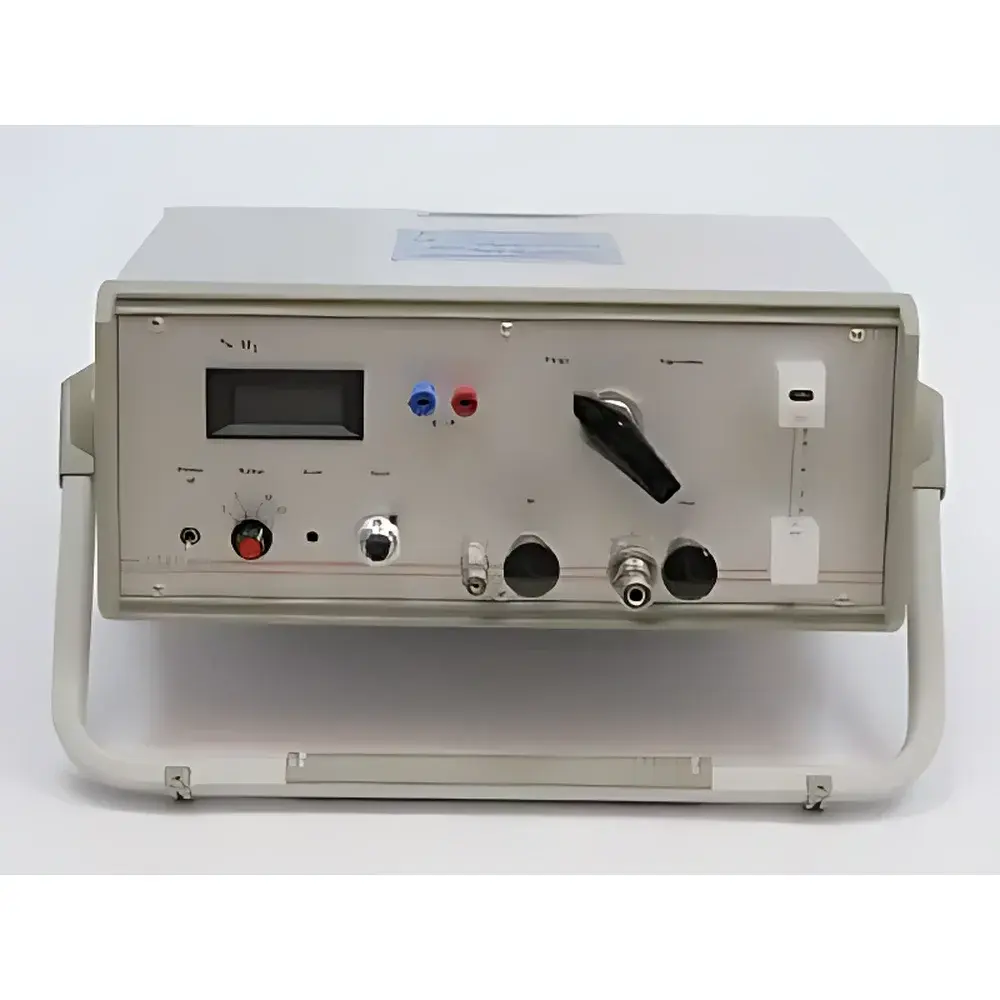
AMS3110 Portable Trace Oxygen Analyzer by AMS (Germany)
| Origin | Germany |
|---|---|
| Manufacturer Type | Authorized Distributor |
| Origin Category | Imported |
| Model | AMS3110 |
| Price | Upon Request |
| Measurement Principle | Electrochemical Sensor |
| Range | 0–10 ppm / 0–100 ppm / 0–1,000 ppm / 0–10,000 ppm (4 selectable ranges) |
| Analog Output | 0–1 V (intrinsically safe) |
| Repeatability | ±2% of reading |
| Resolution | 0.01 ppm (at 0–10 ppm range) |
| Response Time | T90 ≈ 20 s |
| Display | 3.5-digit LCD |
| Gas Inlet | 1/8″ quick-connect fitting |
| Gas Outlet | 6 mm compression fitting |
| Sampling System | Integrated inlet/outlet needle valves, manual purge valve, pressure-reducing valve, and flowmeter |
| Flow Rate | 10–60 L/h |
| Sample Pressure | 1.01–10 bar abs |
| Internal Sensor Pressure Regulation | 50 mbar(g), vented to atmosphere |
| Operating Temperature | –5 °C to +45 °C |
| Sample Humidity | 0–99% RH (non-condensing) |
| Power Supply | Rechargeable lead-acid battery (8 h typical runtime) |
| Dimensions (W×H×D) | 362 × 156 × 320 mm |
| Weight | ~7.5 kg |
| Explosion Protection | ATEX II 3G EEx ib IIC T5 (Zone 2) |
| Optional Accessories | Carrying case, battery charger (for use in safe areas only) |
Overview
The AMS3110 Portable Trace Oxygen Analyzer is an intrinsically safe, field-deployable electrochemical analyzer engineered for high-precision quantification of trace oxygen concentrations in inert, reactive, and process gases. Designed and manufactured under German engineering standards, the instrument employs a diffusion-controlled, amperometric electrochemical cell—comprising an oxygen-selective cathode, lead-based anode, aqueous alkaline electrolyte, hydrophobic polymeric diffusion membrane, and hermetically sealed housing with integrated electrical interface. Oxygen molecules permeate the membrane, undergo reduction at the cathode (O₂ + 2H₂O + 4e⁻ → 4OH⁻), and are subsequently oxidized at the anode (2Pb + 4OH⁻ → 2PbO + 2H₂O + 4e⁻), generating a current linearly proportional to partial pressure of O₂ in the sample stream. This principle ensures stable zero baseline, minimal cross-sensitivity to CO₂, H₂, or hydrocarbons, and long-term signal integrity without catalytic poisoning—critical for high-purity gas certification and process safety monitoring.
Key Features
- Intrinsically safe design certified to ATEX II 3G EEx ib IIC T5 for operation in Zone 2 hazardous areas—enabling direct measurement inside nitrogen blanketing systems, hydrogen purification skids, and semiconductor gas cabinets.
- Four user-selectable measurement ranges (0–10 ppm, 0–100 ppm, 0–1,000 ppm, 0–10,000 ppm) with automatic range switching and auto-zero stabilization, optimized for both ultra-trace (<1 ppm) and low-part-per-million applications.
- Integrated sampling manifold featuring precision needle valves, calibrated flowmeter (10–60 L/h), manual purge valve, and adjustable pressure-reducing regulator—eliminating need for external conditioning hardware.
- Robust portable enclosure (IP65-rated front panel, shock-absorbing rubber bumpers) with ergonomic carry handle, 3.5-digit LCD display, and intuitive push-button interface—designed for repeated field use across shift changes and plant audits.
- Rechargeable lead-acid battery delivering ≥8 hours of continuous operation; charger supplied for safe-area use only, compliant with IEC 60079-11 requirements for energy-limited circuits.
- Real-time analog output (0–1 V, intrinsically safe) compatible with DCS, PLC, and data loggers; supports optional RS-232 or USB interface modules for digital integration (not included).
Sample Compatibility & Compliance
The AMS3110 is validated for continuous analysis of non-corrosive, dry-to-humid (0–99% RH, non-condensing) gas streams—including high-purity N₂, Ar, He, H₂, synthetic air, and dried compressed air—without preconditioning. It exhibits negligible interference from CO₂ (≤5,000 ppm), CH₄, H₂S (<1 ppm), and ambient humidity fluctuations due to its diffusion-barrier architecture and temperature-compensated electronics. The analyzer meets EN 60079-0 and EN 60079-11 for intrinsic safety, carries CE marking per Directive 2014/34/EU, and supports compliance with ISO 8573-1 (compressed air purity), ASTM D6866 (biogenic content verification via O₂ depletion), and internal QA/QC protocols for GMP-regulated environments (e.g., pharmaceutical nitrogen validation per USP ).
Software & Data Management
While the AMS3110 operates as a standalone field instrument, its analog output enables seamless integration into existing SCADA or LIMS infrastructure. When paired with optional serial communication modules (available separately), users can perform remote calibration verification, export timestamped readings (ppm, date/time, range status), and generate audit-ready logs compliant with FDA 21 CFR Part 11 requirements—including electronic signatures, operator ID tagging, and immutable change history. Firmware updates preserve calibration coefficients and sensor lifetime counters, supporting GLP-aligned instrument lifecycle management.
Applications
- Verification of oxygen residuals in inert gas blanketing systems during chemical reactor purging and storage tank inerting.
- In-line monitoring of nitrogen purity in on-site PSA and membrane nitrogen generators (ISO 8573-1 Class 1.2.1).
- Thermal processing atmospheres: real-time O₂ tracking in annealing, brazing, and sintering furnaces to prevent oxidation of stainless steel and titanium components.
- Electronics manufacturing: qualification of ultra-high-purity argon and nitrogen used in CVD/PVD chamber purges and wafer handling environments.
- Hydrogen fuel quality assurance: detection of trace O₂ in PEM electrolyzer output and refueling station supply lines per ISO 14687-2:2019.
- Calibration gas verification: independent validation of certified reference materials (CRMs) prior to use in GC or FTIR systems.
FAQ
What is the expected service life of the electrochemical sensor?
Typical operational lifespan is 18–24 months under continuous use at ambient conditions; performance degrades gradually rather than failing abruptly, allowing scheduled replacement based on drift monitoring.
Can the AMS3110 measure oxygen in hydrogen-rich streams without risk of explosion?
Yes—the intrinsic safety barrier limits energy delivery to the sensor, and the electrochemical cell operates below stoichiometric combustion thresholds; however, H₂ concentration must remain below 100% vol. for full ATEX compliance.
Is routine calibration required, and what standards are recommended?
A two-point calibration (zero gas: high-purity N₂ or Ar; span gas: certified O₂-in-N₂ at 5–10 ppm) is recommended every 30 days or after exposure to >1,000 ppm O₂; calibration certificates traceable to NIST or PTB are advised.
Does the instrument require sample drying or filtration?
No—its diffusion membrane and internal pressure regulation tolerate up to 99% RH (non-condensing); however, particulate filtration (0.1 µm) upstream is recommended for dirty process streams to protect the flowmeter and valves.
How is sensor zero stability maintained during field use?
The unit incorporates automatic zero-tracking logic that periodically samples ambient air through a dedicated bypass path (activated manually or via timed cycle), compensating for baseline drift without interrupting primary measurement.