
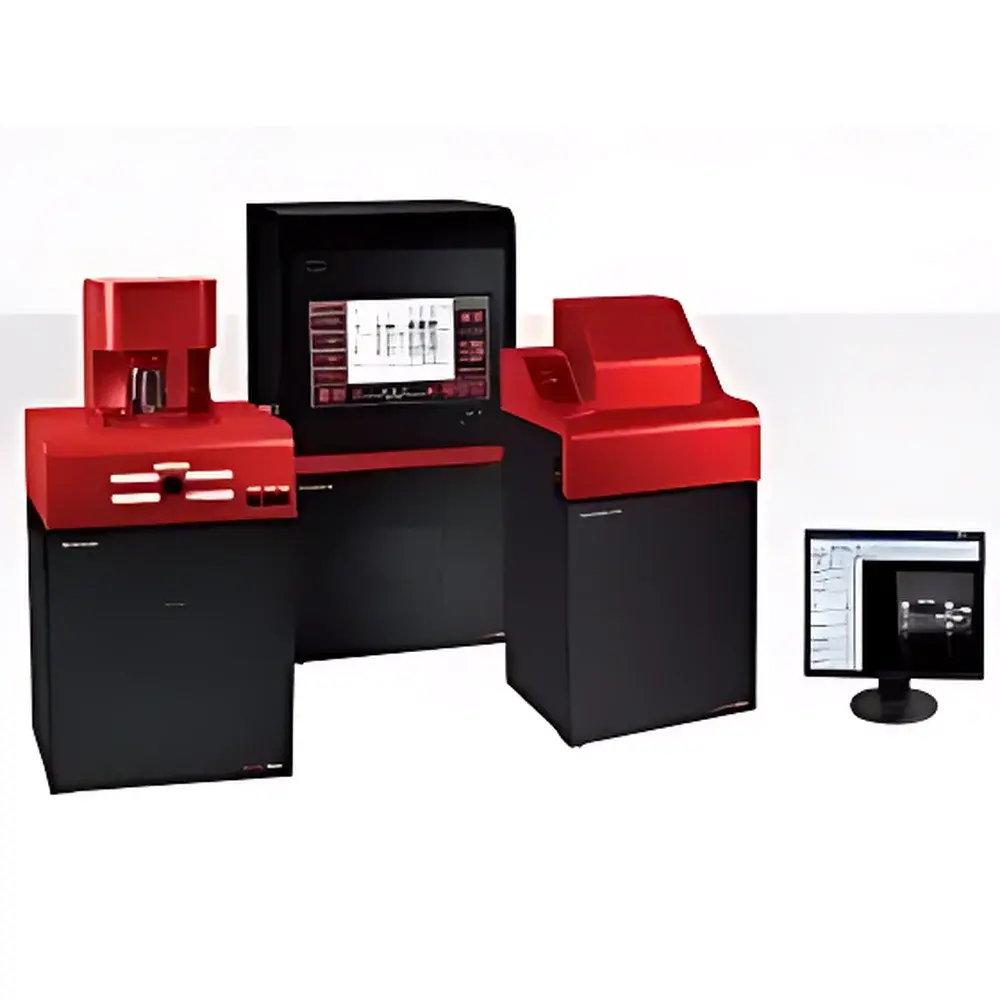
Analytik Jena ChemStudio Chemiluminescence Gel Imaging System
| Brand | Analytik Jena |
|---|---|
| Origin | Germany |
| Model | ChemStudio |
| Instrument Type | Chemiluminescence Gel Imaging System |
| Camera Resolution | Up to 8.1 MP (CCD-Camera 810) |
| Cooling | Peltier-cooled to –35 °C |
| Bit Depth | 16-bit |
| Gray Levels | 65,536 |
| Lens Options | Fixed f/1.2 (30 mm, 50 mm) and motorized zoom (12.5–75 mm f/1.2) |
| Filter Wheel | 4-position (ChemStudio), 5-position (SA/PLUS) |
| Software | VisionWorksLS with 21 CFR Part 11 compliance support |
| Imaging Modes | Chemiluminescence, Fluorescence (UV/blue/NIR), Colorimetry, Multiplex, Transmitted/Reflected White Light, UV Top Illumination |
| Optional Modules | UV Transilluminator (302 nm or multi-wavelength), LED White Light Panel, Blue Light Converter, StudioLite Multi-Spectral Excitation Source |
Overview
The Analytik Jena ChemStudio Chemiluminescence Gel Imaging System is a modular, high-sensitivity digital imaging platform engineered for quantitative detection and analysis of biomolecular signals across electrophoretic gels, blots, membranes, microplates, and colony assays. Based on cooled scientific-grade CCD detection technology and optimized optical path design, the system delivers high signal-to-noise ratio imaging essential for low-abundance chemiluminescent targets—particularly in Western, Northern, and Southern blot applications. Its core architecture integrates a thermoelectrically cooled CCD sensor (down to –35 °C), precision optics, programmable excitation/emission filtering, and a light-tight imaging chamber—all calibrated to meet the reproducibility and traceability requirements of regulated life science laboratories. Unlike film-based detection, ChemStudio enables linear dynamic range quantification over 4–5 orders of magnitude, supporting both publication-grade image acquisition and GLP/GMP-compliant data workflows.
Key Features
- Scientific-grade Peltier-cooled CCD camera options (8.1 MP, 3.2 MP, or 2.1 MP), with quantum efficiency up to 86% and 16-bit digitization (65,536 gray levels)
- Motorized lens systems including fixed-aperture f/1.2 lenses (30 mm, 50 mm) and a high-resolution 12.5–75 mm f/1.2 zoom lens for variable working distances and field-of-view optimization
- Automated 4- or 5-position emission filter wheels compatible with standard fluorophore sets (e.g., GFP, RFP, Cy3/Cy5, IRDye®) and customizable filter configurations
- Integrated dual illumination modes: transmitted white light (LED panel or conversion plate), trans-UV (302 nm or multi-band), top-UV (for TLC plates), and blue light (for SYBR® Safe, GelGreen™)
- StudioLite multi-spectral excitation source—fiber-coupled, wavelength-stabilized LEDs enabling precise, high-intensity excitation across UV–NIR spectra
- Full hardware automation via VisionWorksLS software: synchronized control of exposure time, binning (1×1 to 8×8 or 10×10), focus, filter position, stage height, and illumination source
Sample Compatibility & Compliance
The ChemStudio system accommodates a broad range of sample formats: polyacrylamide and agarose gels (stained with Coomassie, SYPRO Ruby, ethidium bromide or safer alternatives), nitrocellulose/PVDF membranes (chemiluminescent or fluorescent detection), colony plates, tissue sections, and thin-layer chromatography plates. It supports ISO/IEC 17025-aligned validation protocols and meets key regulatory expectations for analytical instrument qualification—including documented IQ/OQ/PQ procedures, audit-trail-enabled software operation, and electronic signature capability per FDA 21 CFR Part 11. VisionWorksLS provides configurable user roles, session logging, metadata embedding (instrument ID, date/time, exposure parameters, filter settings), and export of raw TIFF files with embedded EXIF tags for full data traceability.
Software & Data Management
VisionWorksLS is a validated, multi-language software suite designed specifically for life science imaging workflows. It combines intuitive acquisition controls with rigorous analytical tools compliant with ISO 15197 and CLSI EP17-A2 guidelines for quantitative assay performance. Core capabilities include auto-exposure with overexposure warning, real-time histogram feedback, pixel binning optimization, and dynamic acquisition sequences (time-lapse or exposure series). Analytical modules support 1D gel electrophoresis profiling (band detection, molecular weight estimation, relative quantification), densitometric analysis (background subtraction, lane normalization, % volume/intensity calculation), colony counting with size/threshold customization, fluorescence intensity calibration using reference standards, and multiplex signal deconvolution. All reports are exportable in PDF, PNG, or Excel format—with raw pixel data preserved in TIFF for third-party reanalysis.
Applications
- Quantitative chemiluminescent detection in Western blotting, including low-picogram-level protein targets using HRP- or AP-conjugated secondary antibodies
- Fluorescent nucleic acid visualization (SYBR Gold, GelRed™) and protein staining (Deep Purple™, Krypton™) with spectral separation of co-migrating bands
- Multi-color near-infrared (NIR) imaging for two-plex Westerns using IRDye® 680/800 conjugates
- Colony-forming unit (CFU) enumeration in microbiology and stem cell assays with adjustable segmentation thresholds
- Plant phenotyping and root architecture analysis under white-light transmission
- GFP/RFP expression tracking in live-cell lysates or fixed tissues without photobleaching artifacts
- PCR product verification and qPCR gel documentation with integrated ladder alignment and band intensity correlation
- TLC plate documentation with top-UV illumination and post-run derivatization compatibility
FAQ
What is the minimum detectable signal level for chemiluminescence imaging?
Detection sensitivity is dependent on substrate kinetics and antibody affinity; however, under optimized conditions with ECL substrates and high-QE CCD-Camera 610, the system reliably detects ≤1 pg of horseradish peroxidase (HRP) on nitrocellulose.
Can VisionWorksLS be validated for use in GxP environments?
Yes—VisionWorksLS includes 21 CFR Part 11-compliant features: electronic signatures, audit trail configuration, role-based access control, and secure data export. Full validation documentation (IQ/OQ templates, test scripts) is available upon request.
Is NIR imaging supported natively, or does it require additional hardware?
NIR imaging requires the optional StudioLite NIR excitation module and matched long-pass emission filters (e.g., 700/750 nm); the CCD-Camera 610 offers highest QE in the 700–900 nm range.
How is focus consistency maintained across multiple samples or time-series experiments?
Auto-focus algorithms use edge-detection contrast metrics at user-defined ROI; manual focus lock and Z-stage memory positions ensure repeatability between runs.
Are third-party analysis tools compatible with exported ChemStudio data?
All images are saved in uncompressed 16-bit TIFF format with embedded EXIF metadata (exposure time, binning, filter ID, lens focal length), ensuring interoperability with ImageJ/Fiji, MATLAB, Python (OpenCV/scikit-image), and commercial platforms such as ImageLab or Quantity One.





