
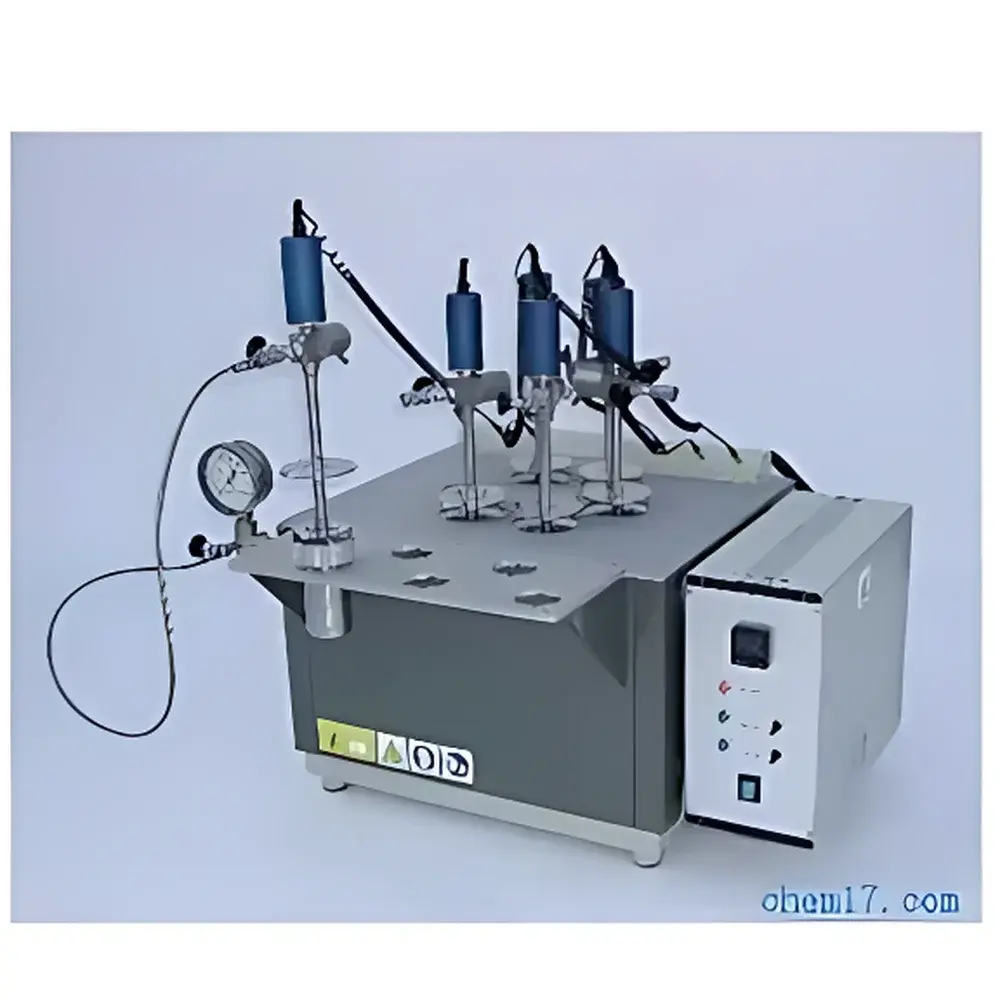
Anton Paar D525 Gasoline Oxidation Stability Tester
| Origin | France |
|---|---|
| Supplier Type | Authorized Distributor |
| Origin Category | Imported |
| Model | D525 |
| Pricing | Upon Request |
Overview
The Anton Paar D525 Gasoline Oxidation Stability Tester is a precision-engineered benchtop instrument designed to evaluate the oxidative resistance of gasoline, aviation turbine fuels, and other light distillate petroleum products under accelerated aging conditions. It operates on the principle of oxygen pressure drop measurement in sealed stainless-steel bomb vessels immersed in a precisely controlled thermal environment—either a water bath or dry-block heater—per ASTM D525 (for gasoline), ASTM D873 (for aviation fuels), IP 40, and IP 138 test methods. The system quantifies oxidation stability by monitoring real-time pressure decay over time at elevated temperatures (up to 150 °C), enabling automated determination of the induction period—the critical time interval before rapid pressure decline indicates onset of autoxidation. This parameter serves as a key indicator of fuel shelf life, storage integrity, and additive package effectiveness in commercial and military fuel specifications.
Key Features
- Compliant with internationally recognized standards: ASTM D525, ASTM D873, IP 40, and IP 138 for reproducible, auditable test execution.
- Benchtop architecture with dual thermal options: programmable water bath (with auto-leveling, low-water alarm, and electronic heating) or aluminum dry-block heater—both supporting 2-, 4-, or 6-position sample configurations.
- Pt100 RTD temperature sensor with PID-controlled thermal regulation; temperature range: ambient to 150 °C, resolution ±0.1 °C, stability ±0.2 °C over 60 min.
- Ceramic-coated stainless-steel housing and bomb-compatible components ensure long-term corrosion resistance and mechanical robustness in laboratory environments.
- Dedicated Windows-based software with real-time pressure acquisition via RS232 interface; automatically detects inflection points, calculates induction periods, generates pressure–time curves, and exports data in CSV/PDF formats.
- Integrated oxygen distribution manifold with calibrated pressure gauge and flexible tubing for rapid, leak-tight pressurization of oxygen bombs to specified initial pressures (typically 700 kPa).
- Comprehensive safety architecture: overtemperature cut-off, low-water level alert (water bath models), SSR-driven heating control, and CE-marked electrical design compliant with IEC 61010-1.
Sample Compatibility & Compliance
The D525 accommodates standard ASTM/ISO-compliant oxygen bombs (sold separately) for testing gasoline, jet fuel (JP-4, JP-8, Jet A/A-1), and related hydrocarbon blends. Its thermal uniformity and pressure measurement fidelity meet the stringent repeatability requirements of ASTM D525 (RSD ≤ 5% for duplicate runs) and support GLP/GMP-aligned workflows. The instrument’s design facilitates integration into quality control laboratories subject to regulatory audits—including those referencing FDA 21 CFR Part 11 for electronic records and signatures when paired with validated software configurations. All hardware interfaces, calibration traceability paths (via optional PT100 simulators CAL001/CAL002), and documentation align with ISO/IEC 17025 competence requirements for testing laboratories.
Software & Data Management
The proprietary Windows application provides full instrument control, real-time visualization of pressure vs. time profiles, and automated induction period calculation using first-derivative threshold detection. Data files include metadata (operator ID, sample ID, test date/time, temperature setpoint, initial pressure), audit trail logs, and digital signatures where enabled. Export functions support LIMS integration via CSV, while PDF reports include graphical plots, numerical results, and pass/fail status against specification limits. Software validation packages—including IQ/OQ documentation templates—are available upon request to support regulated environments requiring compliance with USP , ASTM E2500, or EU Annex 11.
Applications
- Quality assurance of finished gasoline formulations during refinery off-gas blending and terminal distribution.
- Evaluation of antioxidant efficacy (e.g., hindered phenols, amine derivatives) in fuel stabilization programs.
- Stability screening of bio-blended fuels (e.g., ethanol-gasoline, GTL-derived components) under accelerated oxidative stress.
- Research and development of next-generation fuel additives and synthetic hydrocarbon pathways.
- Contract testing services accredited to ISO/IEC 17025 for third-party certification of oxidation resistance claims.
FAQ
Does the D525 include oxygen bombs?
No—oxygen bombs (model AD0525-A00) are optional accessories and must be ordered separately.
Can the instrument operate without a connected PC?
Yes; standalone operation is supported via front-panel controls and digital display, though full data logging, curve analysis, and reporting require the Windows software.
What power supply is required?
220 V AC, 50 Hz, 3000 W; single-phase input with dedicated circuit breaker recommended.
Is the software compliant with 21 CFR Part 11?
The base software supports ALCOA+ principles; full 21 CFR Part 11 compliance (including electronic signatures and audit trails) requires implementation of validated configuration and administrative controls per site-specific SOPs.
What maintenance is required for long-term reliability?
Routine verification of Pt100 probe calibration (using CAL001/CAL002), periodic inspection of O-rings and bomb gaskets (AD0525-C00), and cleaning of water bath reservoirs per manufacturer guidelines.




