
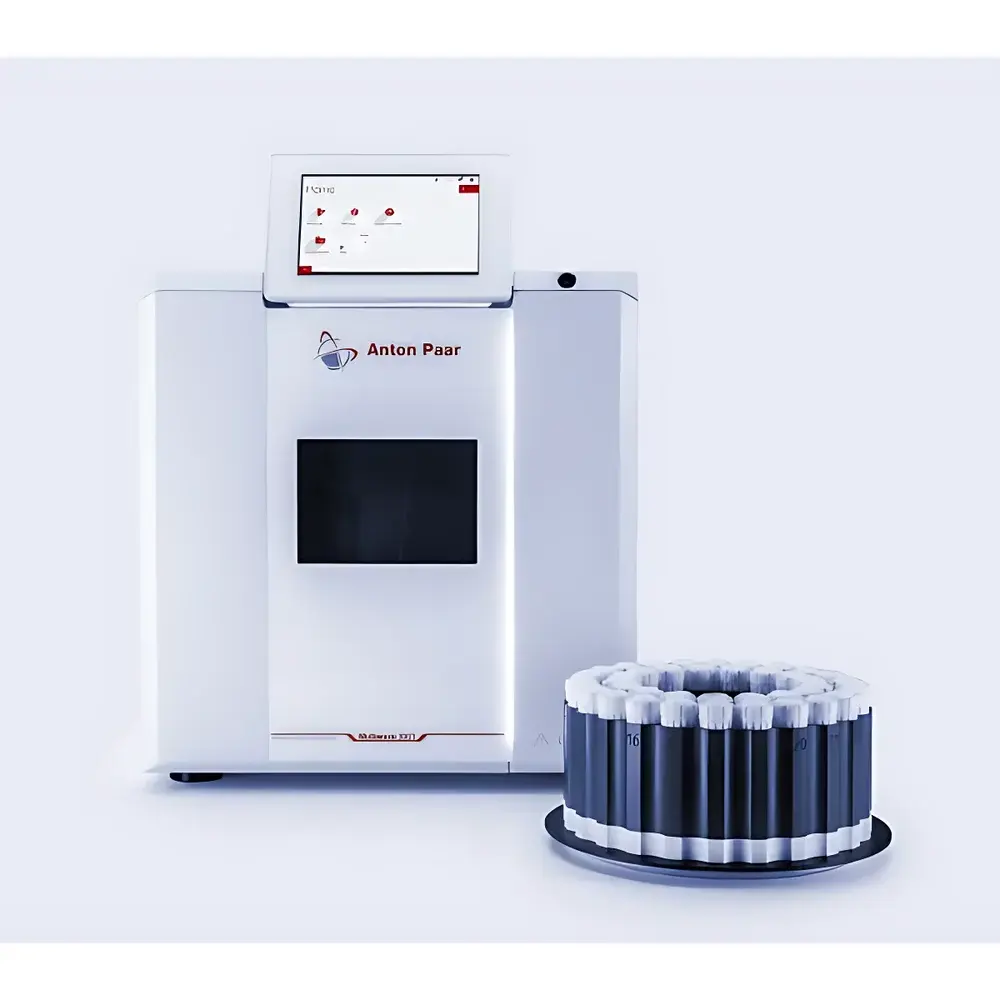
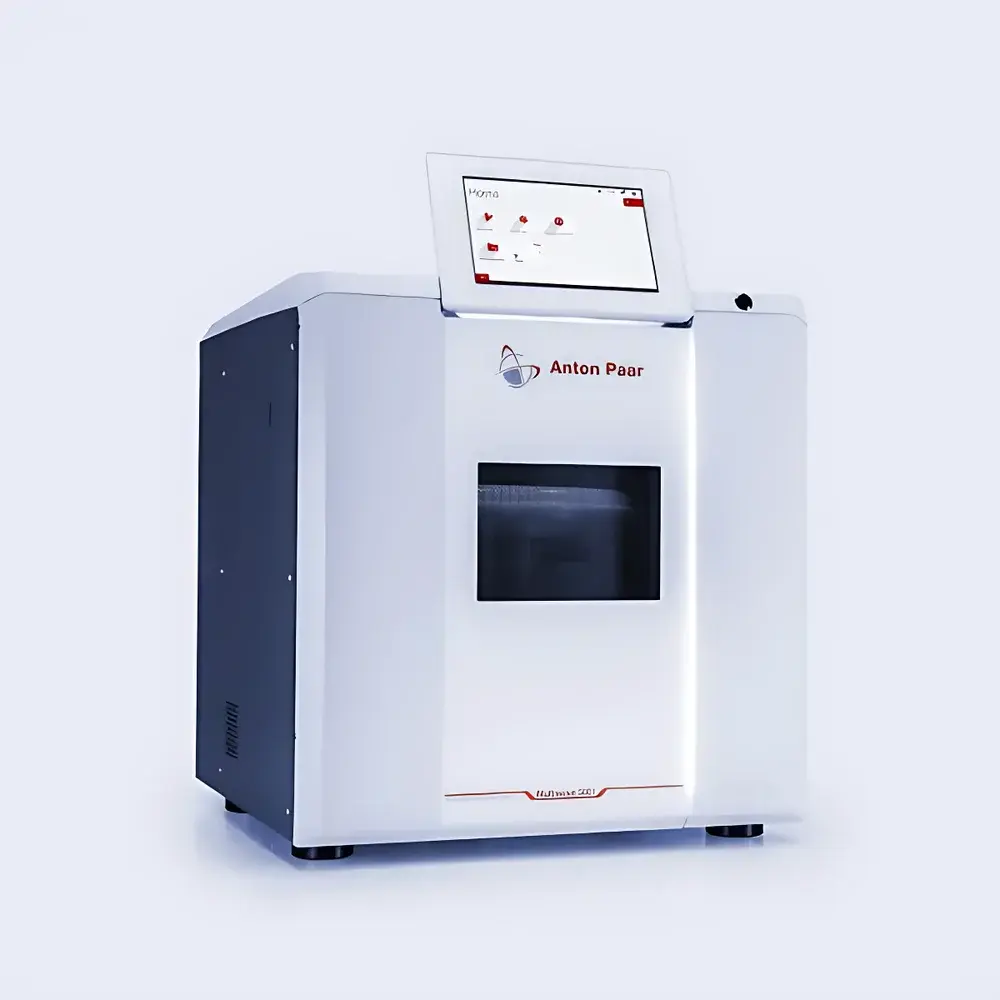
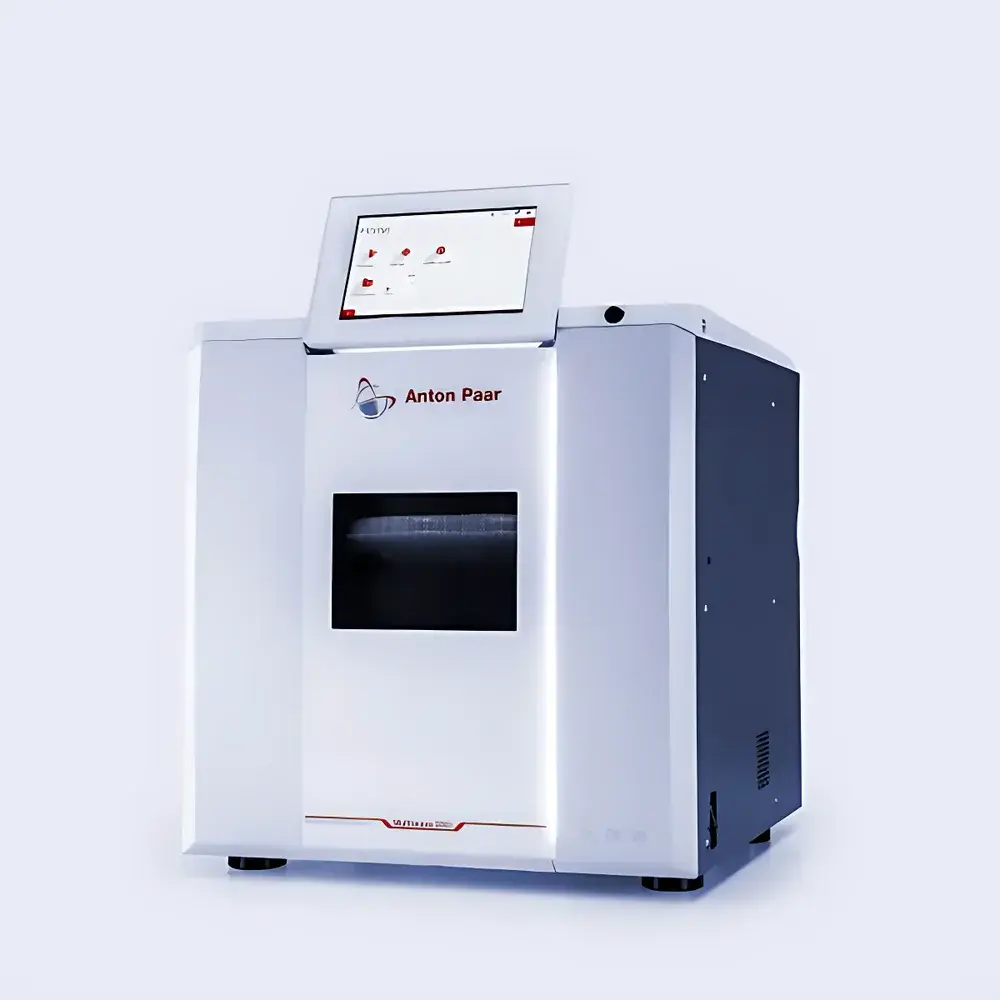
Anton Paar Multiwave 5001/3001 Microwave Chemical Reaction Platform
| Brand | Anton Paar |
|---|---|
| Origin | Austria |
| Manufacturer Type | Original Equipment Manufacturer (OEM) |
| Product Origin | Imported |
| Model | Multiwave 5001/3001 |
| Cavity Class | Industrial-Grade |
| Sample Capacity | 96 samples/batch |
| Microwave Source | Dual Magnetron |
| Max Temperature | 300 °C |
| Temp Measurement Accuracy | ±0.1 °C |
| Temp Control Stability | ±1 °C |
| Temp Uniformity | ±1 °C |
| Max Pressure | 200 bar / 100 bar |
Overview
The Anton Paar Multiwave 5001/3001 Microwave Chemical Reaction Platform is an industrial-grade, high-throughput sample preparation system engineered for precision-controlled microwave-assisted digestion, extraction, evaporation, drying, and parallel synthesis. Leveraging over five decades of expertise in thermal sample preparation—dating back to the world’s first automated wet digestion system introduced by Anton Paar in 1973—the platform integrates advanced microwave energy delivery, real-time multimodal process monitoring, and fail-safe engineering to meet stringent laboratory requirements across environmental, pharmaceutical, food, geochemical, and materials science applications. Its core operating principle relies on controlled microwave irradiation (2.45 GHz) within a pressurized, temperature-regulated cavity, enabling rapid, homogeneous heating of reaction vessels via dielectric loss mechanisms. Unlike conventional hotplate or oven-based methods, this platform achieves reproducible thermal profiles under closed-vessel conditions, minimizing analyte loss, contamination risk, and reagent consumption while complying with international method standards including EPA 3050B, 3051A, 3052, ISO 15587-1, and ASTM D5511.
Key Features
- Industrial-grade stainless-steel cavity with dual magnetron power delivery (up to 1900 W total), ensuring uniform field distribution and extended component lifetime.
- SmartTemp 2.02 non-contact internal temperature sensing technology: measures actual reaction mixture temperature inside each vessel using fiber-optic–enhanced IR detection—critical for exothermic or refractory matrices.
- Intelligent pressure control system with NOx-sensitive vent detection, enabling dynamic pressure regulation and corrosion-resistant exhaust management during controlled venting events.
- Patented forced-air cooling architecture (US Patent No. US5435066): reduces post-digestion cooling time to <5 minutes per batch without external chillers, preserving rotor integrity and throughput efficiency.
- Automated door actuation mechanism—hands-free opening via light push or elbow contact—eliminates workflow interruption during high-volume processing.
- Dual-certified safety compliance: ETL-listed (UL 61010-1) and GS-marked (EN 61010-1), incorporating hardware interlocks, pressure rupture discs, real-time cavity leakage monitoring, and automatic microwave cutoff upon door breach.
Sample Compatibility & Compliance
The Multiwave 5001/3001 supports a modular rotor ecosystem accommodating 8–96 samples per run, including HVT (high-volume TFM), SVT (standard-volume TFM), NXF/NXQ (HF-resistant quartz-lined), and MG5 (micro-volume glass) configurations. Vessels are constructed from PTFE-TFM or quartz-composite materials rated for sustained exposure to concentrated HF, HNO3, HCl, and aqua regia at temperatures up to 300 °C and pressures up to 200 bar. The system validates method transfer across diverse matrices—from routine biological tissues and soil extracts per EPA SW-846 protocols, to challenging polymers, ceramics, alloys, and carbonaceous materials requiring aggressive oxidative digestion. All operational parameters—including ramp rate, hold time, temperature setpoint, and pressure limit—are fully traceable and audit-ready, supporting GLP/GMP workflows compliant with FDA 21 CFR Part 11 when paired with optional electronic signature modules.
Software & Data Management
Equipped with the intuitive Multiwave Touch OS, the platform enables full method customization, touchscreen-driven workflow navigation, and embedded video-guided operation. Users define primary screens with shortcuts to frequently used methods, regulatory templates (e.g., ISO 17025-compliant reporting), or SOP-linked video manuals. All process data—including real-time temperature/pressure curves per vessel, microwave power output, cooling dynamics, and event logs—are timestamped, digitally signed, and exportable in CSV or PDF formats. Optional software packages provide automated report generation aligned with ISO/IEC 17025 documentation requirements, raw data archiving with SHA-256 checksum validation, and integration with LIMS via standard OPC UA or RESTful API interfaces.
Applications
- Regulatory-compliant acid digestion of environmental solids (sediments, sludges, fly ash) per EPA Methods 3051A and 3052.
- Pharmaceutical residual metal analysis (ICH Q2(R2)) in APIs and excipients using USP <232>/<233>-validated protocols.
- High-temperature, high-pressure decomposition of refractory materials (e.g., graphite, borosilicate glass, tungsten carbide) for elemental profiling by ICP-MS/OES.
- Accelerated solvent extraction (ASE) of pesticides and PAHs from food and feed matrices.
- Parallel microwave-assisted organic synthesis under inert atmosphere (N2/Ar), supporting catalyst screening and green chemistry development.
- Low-volume (<20 mg) trace metal analysis in clinical and forensic specimens using micro-vessel configurations.
FAQ
Is the Multiwave 5001 backward-compatible with legacy rotors and accessories?
Yes—the Multiwave 5001 maintains full mechanical and software compatibility with 16-position rotors and consumables from prior Multiwave generations (e.g., Multiwave PRO, UltraWave). The Multiwave 3001 is a dedicated entry-tier variant optimized for routine digestion tasks and does not support all high-end rotor types.
What safety certifications apply to the Multiwave 5001/3001 platform?
The system carries both ETL certification (UL 61010-1, North America) and GS mark (EN 61010-1, EU), confirming conformance with electrical safety, electromagnetic compatibility (EMC), and mechanical integrity requirements for Class II laboratory equipment.
How does SmartTemp 2.02 differ from conventional IR or fiber-optic temperature sensors?
SmartTemp 2.02 combines the speed and accuracy of direct internal fiber-optic probes with the non-invasive convenience of IR sensing—achieving ±0.1 °C measurement accuracy without physical probe insertion, eliminating cross-contamination risk and calibration drift associated with immersed thermocouples.
Can the system be integrated into a regulated quality management system (QMS)?
Yes—when configured with optional audit-trail logging, electronic signatures, and secure user role management, the platform meets ALCOA+ data integrity principles and supports FDA 21 CFR Part 11, EU Annex 11, and ISO 17025 compliance for accredited testing laboratories.



