
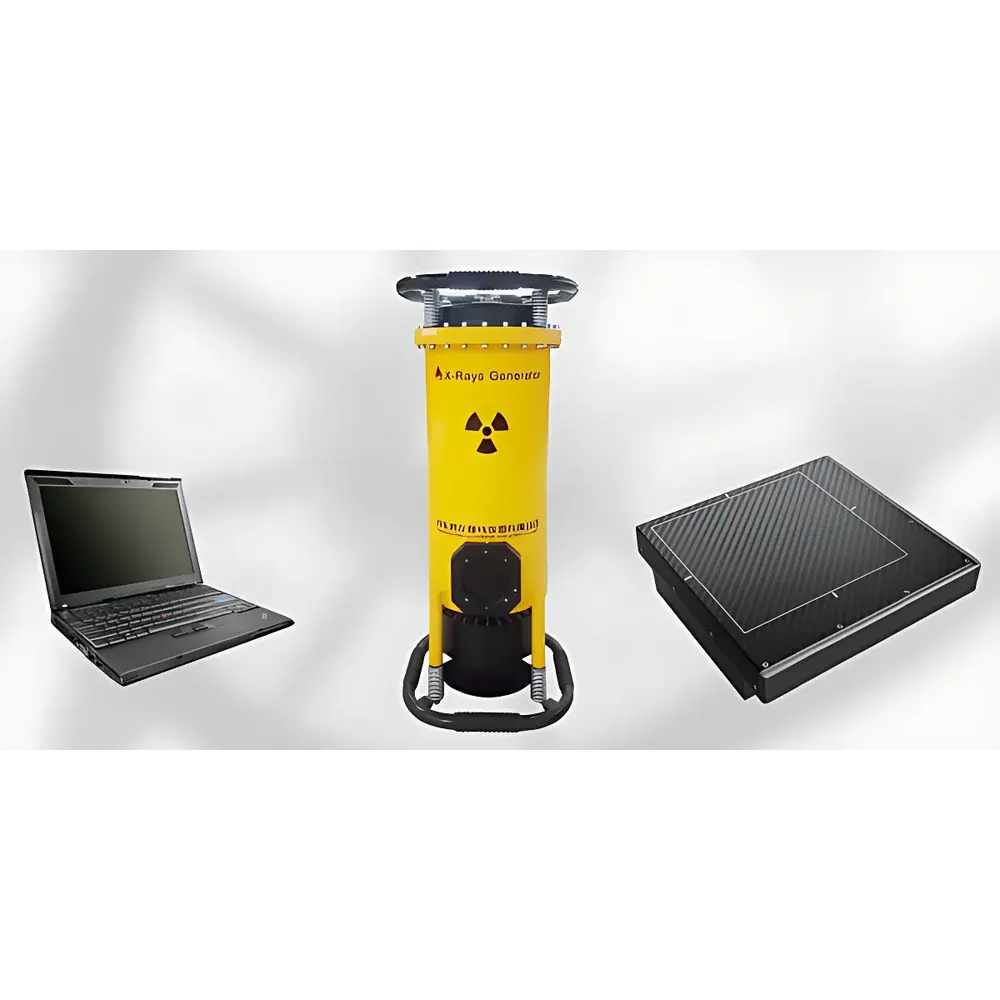
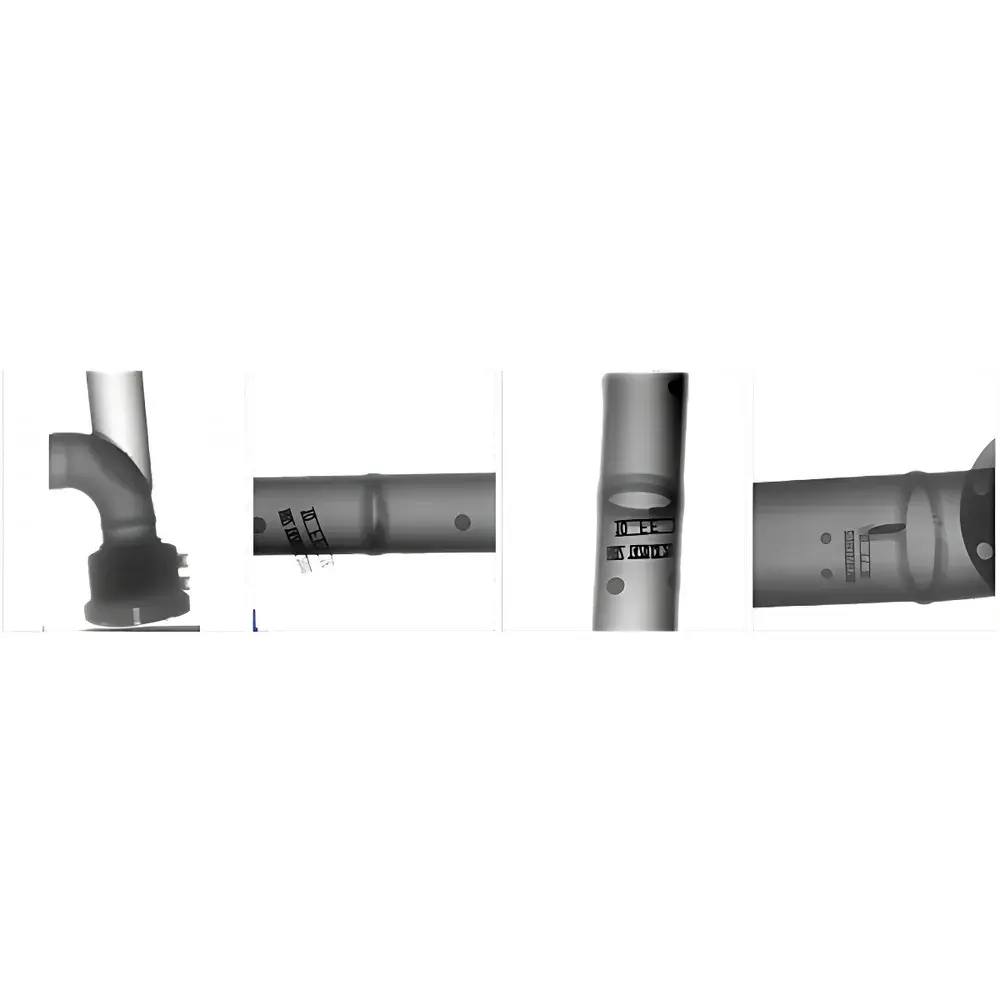
Aolong AL-DR-300C Variable-Frequency Portable X-ray Digital Radiography (DR) System
| Brand | Aolong |
|---|---|
| Origin | Liaoning, China |
| Manufacturer Type | Manufacturer |
| Country of Origin | China |
| Model | AL-DR-300C |
| Configuration | Portable |
| Beam Directionality | Directional |
| Focal Spot Size | 2.5 mm |
| Radiation Angle | 40° + 5° (Total Coverage: 45°) |
| Maximum Penetration | 60 mm Fe-equivalent |
| Max. Tube Voltage | 320 kV |
| Tube Current | 5 mA |
| Detector Type | Amorphous Silicon (a-Si) Flat Panel Detector (Custom-optimized for Variable-Frequency X-ray Source) |
| Active Detector Area | 13 cm × 13 cm |
| Pixel Pitch | 85 µm |
| Spatial Resolution | 4 LP/mm |
| A/D Conversion | 16-bit |
| Sensitivity | ≤1.5% (EN 13297:2011 compliant) |
Overview
The Aolong AL-DR-300C is a variable-frequency portable X-ray digital radiography (DR) system engineered for high-fidelity, field-deployable non-destructive testing (NDT) of metallic and composite structures. Unlike fixed-frequency or pulsed X-ray sources, its variable-frequency generator enables precise control over tube voltage (up to 320 kV) and real-time optimization of beam spectrum—enhancing contrast sensitivity across heterogeneous material thicknesses while minimizing dose exposure. The system operates on the principle of digital radiographic imaging: X-rays generated from a directional tungsten-target tube pass through the test object and are captured by a custom amorphous silicon (a-Si) flat-panel detector with 16-bit analog-to-digital conversion. This architecture ensures linear dynamic range (>80 dB), low electronic noise, and high detective quantum efficiency (DQE) at clinically and industrially relevant dose levels. Designed for compliance with ISO 17636-2:2020 (radiographic testing of welds) and ASTM E2737-21 (digital radiography system qualification), the AL-DR-300C delivers reproducible image quality suitable for Level II NDT personnel certification and third-party inspection audits.
Key Features
- Variable-frequency X-ray generator enabling continuous kV adjustment from 40–320 kV—optimized for multi-material inspection without hardware reconfiguration
- Directional X-ray tube with nominal focal spot size of 2.5 mm (IEC 60336 compliant), ensuring geometric unsharpness <0.3 mm at standard source-to-detector distances
- Compact, ruggedized chassis with integrated shock-absorbing transport case; certified to MIL-STD-810G for vibration, drop, and thermal cycling during field deployment
- Amorphous silicon flat-panel detector (13 cm × 13 cm active area, 85 µm pixel pitch) with 4 line pairs per millimeter (LP/mm) limiting resolution—validated per EN 13297:2011 Annex B
- Real-time image acquisition latency <150 ms; supports up to 12 frames per second in fluoroscopic mode for dynamic defect tracking
- Zero-hazard transport configuration: no radioactive isotopes, no lead shielding required for air freight (UN 2919 exempt under IATA DGR 5.5.2.2)
Sample Compatibility & Compliance
The AL-DR-300C accommodates ferrous and non-ferrous components up to 60 mm steel-equivalent thickness—including castings, weldments, pressure vessels, aerospace fasteners, and railway axle assemblies. Its directional beam geometry (40° nominal radiation angle ±5° tolerance) allows targeted irradiation with minimal scatter—critical for confined-space inspections (e.g., pipeline girth welds, turbine blade roots). The system meets essential requirements of ISO 9712:2021 for NDT personnel qualification, and its image quality indicators (IQIs) satisfy IQI sensitivity class ≤1.5% per EN 462-1. All firmware and calibration protocols are traceable to NIST-traceable X-ray reference standards. Optional factory calibration certificates include uncertainty budgets aligned with ISO/IEC 17025:2017.
Software & Data Management
The embedded Windows 7–based DR acquisition and analysis suite provides full DICOM 3.0 compatibility and supports FDA 21 CFR Part 11-compliant audit trails when deployed in regulated environments (e.g., ASME BPVC Section V, API RP 1104). Core functions include dual-window window/level adjustment, edge enhancement via Sobel convolution kernels, negative inversion, pseudo-color LUT mapping, and quantitative geometric measurement tools with sub-pixel interpolation accuracy (±0.05 mm). Image metadata (kV, mA, exposure time, detector temperature, calibration timestamp) is embedded in EXIF and DICOM headers. Batch export supports TIFF (uncompressed), JPEG2000 (lossless), and PDF/A-2b archival formats. User role management enforces three-tier access (Operator, Supervisor, Administrator) with password-protected parameter locking.
Applications
- Field inspection of offshore wind turbine tower welds and foundation anchor bolts
- In-service examination of railcar couplers and brake system castings under ASTM E2903-22
- QA/QC of additive-manufactured titanium aerospace brackets (ASTM F3122-21)
- Corrosion mapping of buried gas transmission pipelines using tandem DR imaging
- Educational use in university NDT laboratories for ISO 9712 Level I/II training modules
FAQ
What regulatory standards does the AL-DR-300C comply with for industrial radiography?
It conforms to ISO 17636-2:2020, EN 13297:2011, ASTM E2737-21, and IEC 61331-1 for radiation safety and image quality evaluation.
Can the system be integrated into an existing PACS or CMMS infrastructure?
Yes—via DICOM SCU/SCP interface or configurable FTP/SFTP push/pull protocols with TLS 1.2 encryption.
Is detector calibration performed in-field or only at the factory?
Factory calibration includes flat-field and dark-current correction matrices; optional annual on-site recalibration kits with NIST-traceable step wedges are available.
Does the software support automated defect recognition (ADR) algorithms?
The base platform includes threshold-based blob detection; ADR modules (e.g., CNN-based porosity classification) are available as validated add-ons compliant with ISO/IEC 17065.
What is the typical warm-up time before achieving stable kV/mA output?
Less than 90 seconds from cold start, verified per IEC 61223-3-5 stability protocol.
Related Products



