
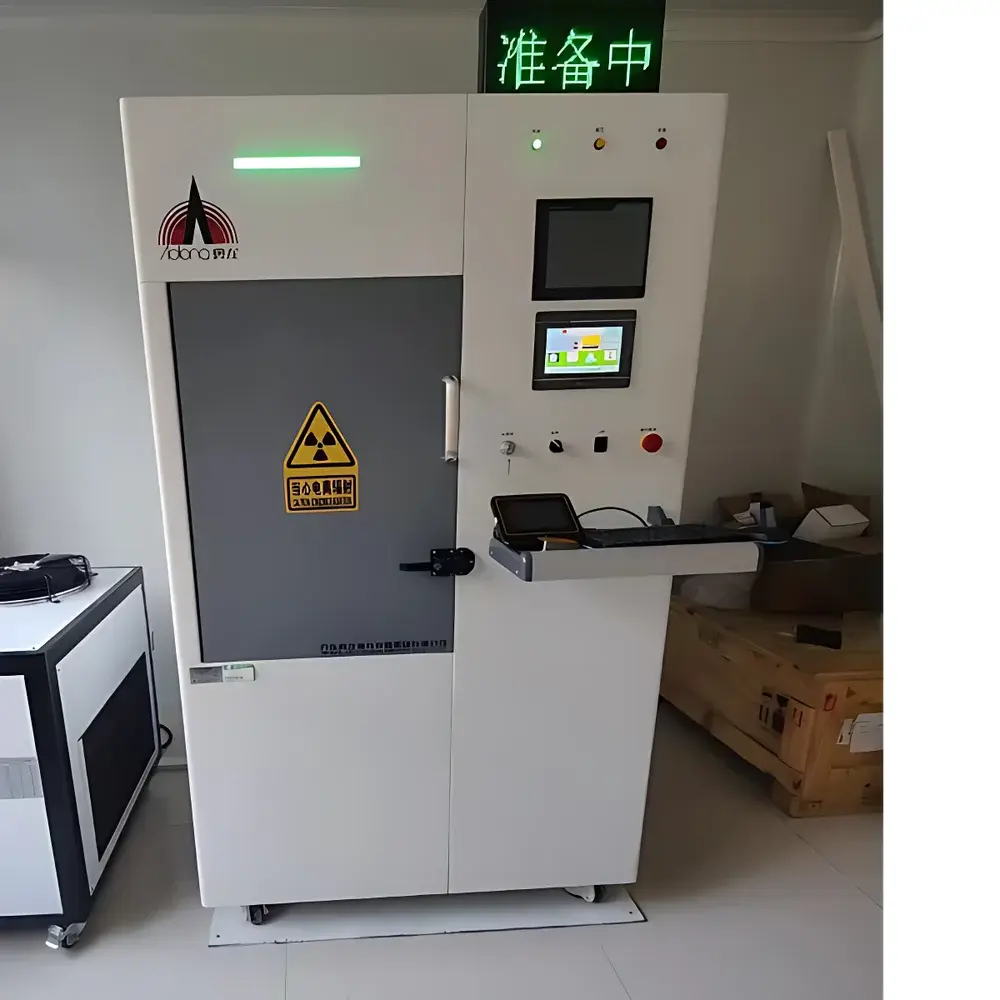
Aolong CHIRAD 160 kV Biological X-ray Irradiator
| Brand | Aolong |
|---|---|
| Origin | Liaoning, China |
| Manufacturer Type | Direct Manufacturer |
| Model | CHIRAD |
| Max. Operating Voltage | 160 kV |
| Max. Power Output | 4000 W |
| SSD Range | 20–70 cm (customizable chamber) |
| Filter Configuration | Standard 2 mm Al + 0.3 mm Cu drawer-type filter set |
| Dose Uniformity | ≥95% |
| Exposure Time Range | 1–9999 s |
| Ambient Dose Rate (5 cm from housing) | <20 µR/h |
| Sample Compatibility | Cells, tissues, organs, bacteria, mice, rats, nanomaterials, food, seeds, insects |
| Environmental Control Option | Integrated biological incubator module |
| Safety Compliance | Meets GBZ 125–2022 and GB 18871–2002 radiation safety standards |
| Data Export | Excel-compatible CSV output |
| Touch Interface | 15.6″ industrial capacitive touchscreen with real-time ionization chamber dose monitoring |
| Shielding | Self-shielded irradiation chamber with dual-redundant interlock system (door, beam gate, emergency stop) and audible/visual fault alerts |
Overview
The Aolong CHIRAD 160 kV Biological X-ray Irradiator is a purpose-engineered, self-shielded irradiation platform designed for precision radiobiological research in academic, pharmaceutical, and preclinical laboratories. Unlike gamma-based systems, this instrument utilizes a high-stability, industrial-grade X-ray tube operating at up to 160 kV with selectable filtration (standard 2 mm Al + 0.3 mm Cu), enabling tunable beam quality optimized for soft-tissue penetration and low-energy absorption profiling. The system operates on the principle of bremsstrahlung radiation generation, where accelerated electrons impinge on a tungsten target to produce a polychromatic X-ray spectrum. Its calibrated ionization chamber provides real-time, traceable dose measurement (in Gy or rad) with NIST-traceable calibration protocols—ensuring metrological integrity across longitudinal experiments. Engineered for reproducibility, the CHIRAD delivers ≥95% dose uniformity over a defined horizontal irradiation plane and maintains consistent depth-dose profiles across small animal and cellular samples—critical for studies requiring quantitative dose–response relationships in DNA damage repair, cell cycle arrest, hematopoietic stem cell conditioning, or immunomodulation.
Key Features
- Self-shielded irradiation chamber (880 × 108 × 188 cm W×D×H) compliant with GB 18871–2002 and GBZ 125–2022 radiation protection standards
- Dual-redundant safety interlock architecture: electromechanical door switch, beam gate actuator, and emergency stop circuit—all independently monitored and logged
- Adjustable source-to-sample distance (SSD) from 20 to 70 cm, with optional custom chamber configurations for specialized sample geometries
- Real-time dose monitoring via integrated, temperature-compensated air-filled ionization chamber with ±2% linearity across 0.01–20 Gy/min range
- 15.6″ industrial-grade capacitive touchscreen interface supporting multi-user access control, protocol scheduling, and audit trail generation
- Optional integrated biological incubator module (37°C ±0.3°C, 5% CO₂, <±0.5% RH stability) for in situ irradiation of adherent cultures or live-animal procedures
- High-throughput modular mouse irradiation cage with individual compartmentalization and restraint-free positioning—eliminating motion-induced dose variability
Sample Compatibility & Compliance
The CHIRAD accommodates diverse biological and material specimens without modification: suspension or adherent mammalian cells (including primary isolates), excised tissues, whole organs (e.g., thymus, spleen), bacterial cultures (Gram±), murine models (C57BL/6, BALB/c, NSG), rat strains, insect larvae (Drosophila, Galleria), plant seeds, food matrices (meat, grain), and engineered nanomaterials (metal oxides, quantum dots). All irradiation protocols adhere to GLP-aligned documentation practices. Dose reporting conforms to ISO/IEC 17025 requirements for testing laboratories; raw dose logs include timestamp, operator ID, chamber temperature, SSD, kV/mA settings, filter configuration, and cumulative exposure—exportable as CSV files readable in Excel or MATLAB. System validation supports FDA 21 CFR Part 11 compliance when deployed with optional electronic signature and audit trail modules.
Software & Data Management
The embedded firmware implements a deterministic real-time operating system (RTOS) with deterministic I/O latency (<10 ms) for synchronized dose delivery and sensor feedback. Each irradiation session generates an immutable metadata record—including pre-irradiation chamber purge status, tube warm-up duration, beam-on time, and ion chamber charge integral—stored locally on encrypted industrial SSD. Data export includes both summary reports (PDF) and granular time-series dose rate logs (CSV), compatible with LIMS integration via RESTful API. Software architecture supports role-based access control (RBAC) with three permission tiers: Operator, Supervisor, and Administrator—each with configurable password policies and session timeout enforcement. Firmware updates are digitally signed and verified prior to installation, ensuring chain-of-custody integrity.
Applications
- Pre-transplant conditioning of hematopoietic stem cells and feeder layer inactivation for iPSC culture
- Controlled induction of double-strand breaks in CRISPR/Cas9 off-target assessment workflows
- Radiosensitizer screening in 3D tumor spheroids under physiologically relevant oxygen tension
- Blood product irradiation (RBCs, platelets) per AABB and EU Directive 2002/98/EC requirements
- Food safety validation: pathogen load reduction (Salmonella, Listeria) and shelf-life extension studies
- Nanoparticle radiosensitization kinetics using synchrotron-calibrated dosimetry cross-checks
- In vivo radioimmunotherapy biodistribution modeling via matched small-animal irradiation and PET tracer co-administration
FAQ
Is the CHIRAD certified for use in GLP-regulated environments?
Yes—the system’s firmware, data logging, and user access controls support full GLP compliance when configured with audit trail and electronic signature options per OECD Principles of GLP (1998).
Can dose calibration be performed in-house, or does it require third-party service?
Initial factory calibration is NIST-traceable; annual verification may be conducted using accredited secondary standard dosimeters (e.g., PTW TN30013) following ISO/IEC 17025 procedures. Aolong provides calibration SOP templates and traceability documentation.
What regulatory documentation is provided for radiation safety licensing?
The shipment includes a complete Radiation Safety File: shielding evaluation report, dose mapping certificates, interlock test records, and compliance statements aligned with national regulations (GB 18871–2002, GBZ 125–2022) and IAEA SSG-46 guidance.




