
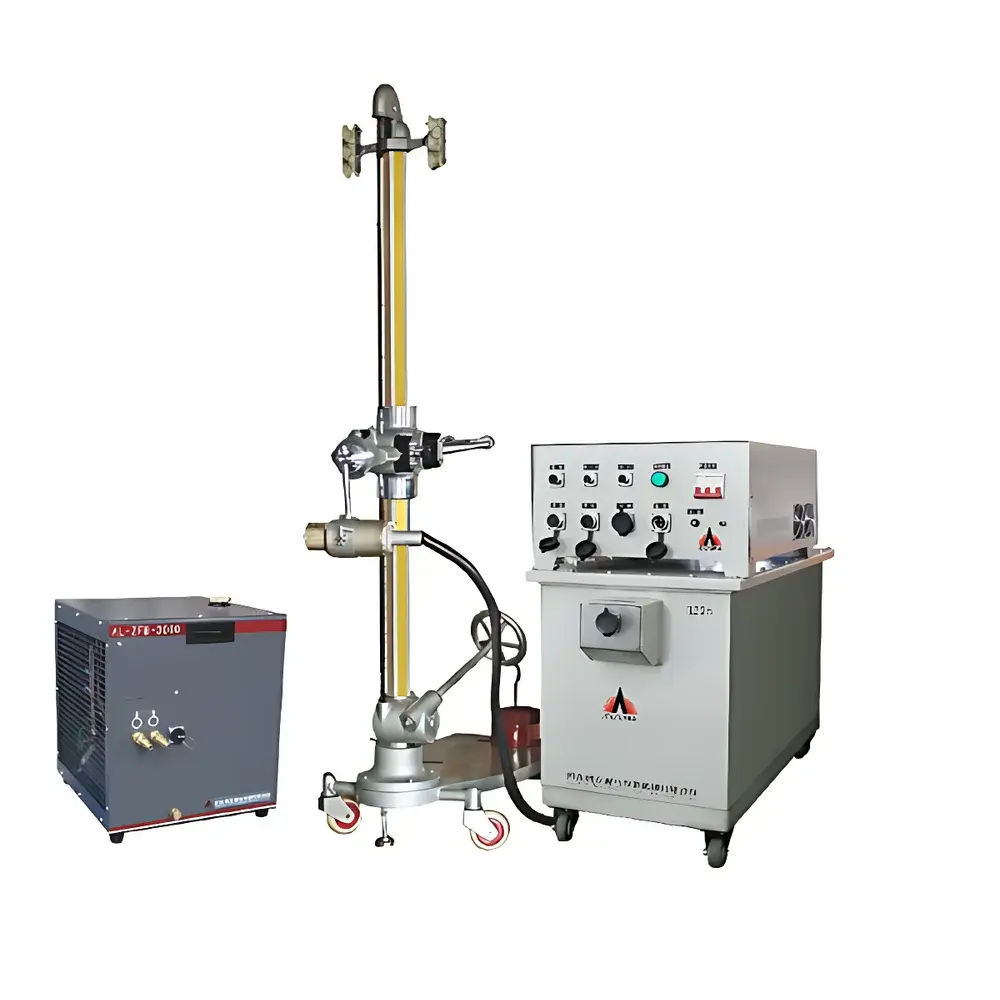
Aolong Mobile High-Frequency Constant-Voltage X-ray Radiographic Inspection System
| Brand | Aolong |
|---|---|
| Origin | Liaoning, China |
| Manufacturer Type | OEM Manufacturer |
| Origin Category | Domestic (China-made) |
| Model | Single-Polarity |
| Price Range | USD 28,000 – 70,000 |
| Weight | Controller — 12 kg |
| Dimensions (L×W×H) | Controller — 410 × 500 × 250 mm |
| Input Voltage | 220 VAC ±10% |
| Frequency | 50 Hz ±2% |
| Input Power | ≥5 kW |
| Output Voltage Range | 20–225 kV |
| Output Current | 30 mA |
| kV Adjustment Resolution | 1 kV |
| mA Adjustment Resolution | 0.1 mA |
| Operating Duty Cycle | Continuous |
| Generator Frequency | 40 Hz |
| Max. HV Generator Output | −225 kV (cathode), 30 mA, 3 kW |
| Insulation Method | Oil-immersed |
| Cooling | Forced water cooling (AL-ZFB-3000 cooler) |
| Control Interface | T7000 color touchscreen controller with Chinese GUI, EMI-hardened design, programmable exposure parameters, automatic tube conditioning, real-time exposure logging, and interlocked lead-shielded door safety system |
| Exposure Timer Range | 0.1–99.8 min (99.9 min = continuous mode) |
Overview
The Aolong Mobile High-Frequency Constant-Voltage X-ray Radiographic Inspection System is an industrial-grade, portable NDT solution engineered for high-fidelity radiographic imaging of metallic and composite components in field or workshop environments. Based on high-frequency inverter technology, the system delivers stable, ripple-free DC high voltage—critical for minimizing beam hardening artifacts and ensuring consistent X-ray photon energy distribution across exposures. Unlike conventional 50/60 Hz transformer-based systems, its 40 Hz high-frequency generator enables precise control over kV and mA, resulting in superior image contrast, reduced scatter, and enhanced detection sensitivity for fine discontinuities such as micro-cracks, porosity, and inclusions. Designed for compliance with ISO 5579:2019 (Non-destructive testing — Radiographic testing of metallic materials using X- and gamma-rays — Basic rules), the system supports both film-based and digital detector array (DDA) workflows, and integrates seamlessly into ASME BPVC Section V and ASTM E94/E1742-compliant inspection protocols.
Key Features
- Stable constant-voltage output with <1.5% voltage ripple—ensures repeatable exposure conditions essential for quantitative density analysis and comparative defect assessment.
- Mobile architecture: Modular design with independently transportable controller, oil-insulated high-voltage generator, and compact water-cooling unit—enables rapid deployment at remote sites without permanent installation requirements.
- T7000 intelligent controller featuring a 7-inch color touchscreen interface, Chinese-language UI, EMI-resistant signal processing, and built-in exposure parameter memory for up to 99 user-defined inspection programs.
- Automated tube conditioning sequence (pre-heating and gradual voltage ramp-up) extends X-ray tube life and maintains focal spot stability over extended operational cycles.
- Integrated safety architecture: Dual-channel interlock monitoring of lead-shielded cabinet doors, emergency stop circuitry compliant with IEC 61508 SIL2, and real-time radiation dose rate feedback via optional external ionization chamber interface.
- Precise exposure control: Timer resolution of 0.1 second; selectable continuous or timed exposure modes; programmable kV/mA/timer sequences with audit-trail logging for GLP/GMP traceability.
Sample Compatibility & Compliance
The system accommodates a broad range of industrial specimens—including weldments, castings, forgings, aerospace turbine blades, pressure vessels, and railway axle assemblies—with maximum penetrable thickness up to 85 mm steel equivalent (at 225 kV, 30 mA, 10 min exposure). Its high-voltage stability and low spectral drift ensure consistent image quality across varying material densities and geometries. The unit conforms to national type-approval standards per GB/T 26837–2011 (Non-destructive testing — Equipment for industrial X-ray radiography — General requirements) and meets electromagnetic compatibility (EMC) Class B limits under GB 4824–2019. Optional accessories include collimators, alignment lasers, and certified reference step wedges traceable to NIM (National Institute of Metrology, China).
Software & Data Management
While hardware-centric, the T7000 controller provides native support for DICOM SR (Structured Reporting) export when interfaced with third-party PACS or radiographic image analysis platforms. All exposure logs—including date/time stamp, operator ID (via optional RFID badge reader), kV/mA/timer settings, and cumulative tube-on time—are stored in non-volatile memory with timestamped CSV export capability. Audit trails comply with FDA 21 CFR Part 11 requirements when paired with validated networked data acquisition software (e.g., Aolong RIS-Link v3.2, sold separately). Firmware updates are performed via USB 2.0 port with cryptographic signature verification to prevent unauthorized modification.
Applications
This system serves critical roles in manufacturing QA/QC (e.g., automotive casting validation), infrastructure integrity management (e.g., pipeline girth weld inspection), defense component certification (per MIL-STD-45662A), and academic research involving dynamic radiography setup. Its portability and rapid setup time make it especially suitable for in-service inspection of offshore platforms, wind turbine towers, and rail freight bogies where fixed radiography bays are unavailable. Field technicians routinely deploy it for root-cause failure analysis following fracture mechanics evaluation or fatigue crack growth monitoring.
FAQ
Is the system certified for use in hazardous locations (e.g., Zone 1 or ATEX)?
No—this model is rated for general industrial indoor/outdoor use only (IP54 enclosure rating). Explosion-proof variants require custom engineering and third-party certification.
Can the system be integrated with computed radiography (CR) or digital radiography (DR) detectors?
Yes—standard DIN 54110-compatible detector interfaces and trigger synchronization ports support all major CR phosphor plate readers and flat-panel DR detectors (including CsI-based and amorphous selenium panels).
What is the recommended maintenance interval for the oil-insulated HV generator?
Annual dielectric strength testing and oil analysis per IEC 60156 are advised; full oil replacement every 3 years or after 5,000 operating hours, whichever occurs first.
Does the controller support multi-language firmware beyond Chinese?
English and Russian language packs are available as optional firmware upgrades; Spanish and Arabic localization is under development and scheduled for Q4 2025 release.
Is remote diagnostics supported?
Yes—via optional Ethernet module (IEEE 802.3, TCP/IP stack), enabling secure SSH-based remote access for firmware update, log retrieval, and parameter diagnostics under IT-managed VLAN segmentation.



