
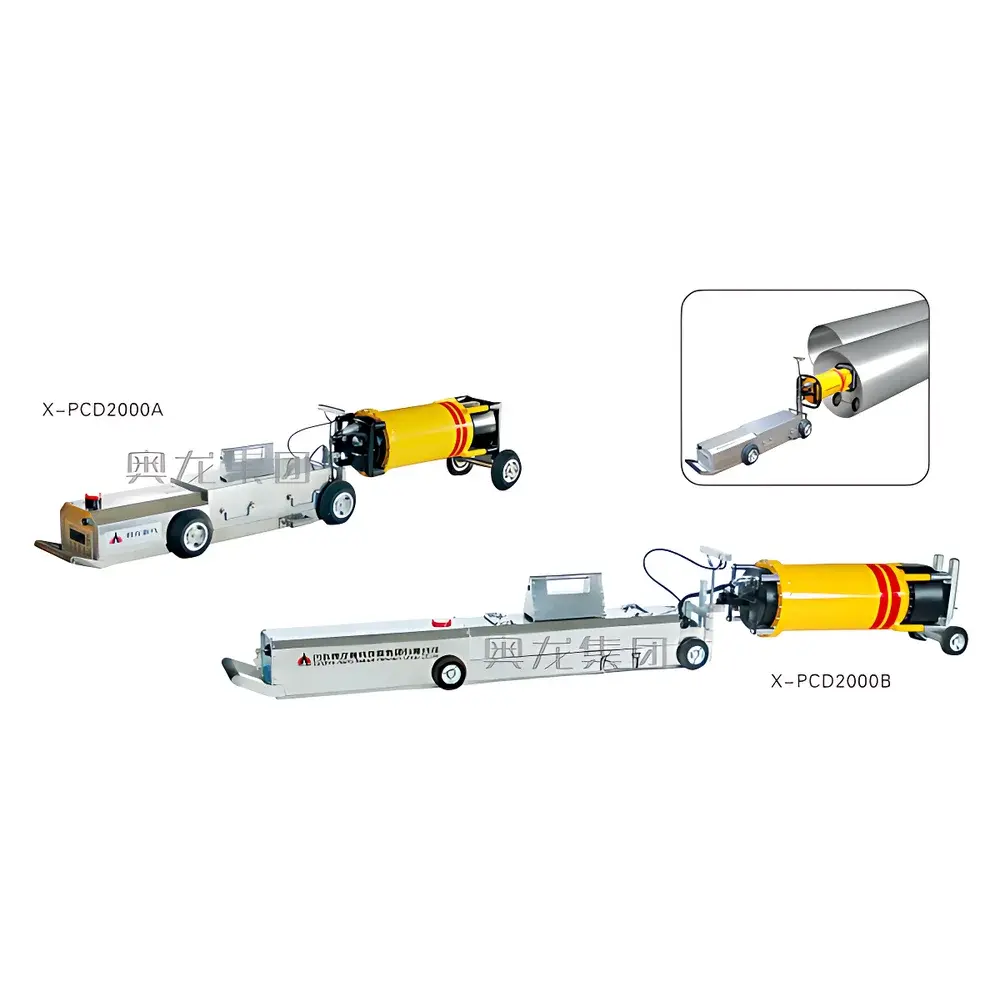
Aolong X-Ray Pipeline Crawler
| Brand | Aolong |
|---|---|
| Origin | Liaoning, China |
| Manufacturer Type | OEM/ODM Manufacturer |
| Country of Origin | China |
| Model | X-Ray Pipeline Crawler |
| Price Range | USD 28,000 – 70,000 |
Overview
The Aolong X-Ray Pipeline Crawler is an autonomous, remotely operated radiographic inspection system engineered for non-destructive testing (NDT) of buried, elevated, or inaccessible pipeline segments in oil & gas transmission, petrochemical infrastructure, and municipal water/sewer networks. It operates on the principle of industrial X-ray radiography—emitting controlled bremsstrahlung radiation from a compact, shielded X-ray generator mounted onboard, which penetrates pipe walls and welds to produce high-fidelity film or digital detector array (DDA) images. Unlike tethered or manually positioned sources, this crawler integrates motion control, real-time telemetry, and closed-loop exposure regulation into a single ruggedized platform capable of navigating curved, inclined, and diameter-variable pipelines (typically DN100–DN600). Its core innovation lies in the proprietary constant tube current control system—a feedback-regulated high-voltage power supply architecture that maintains stable X-ray output regardless of battery discharge state, directly addressing a longstanding source of radiographic density inconsistency in field-deployed crawlers.
Key Features
- Constant tube current control system: Dynamically compensates for declining battery voltage to ensure consistent X-ray photon flux and radiographic contrast across full mission duration.
- Siemens S7-200 programmable logic controller (PLC): Provides deterministic real-time control of motor sequencing, sensor polling, safety interlocks, and communication protocols with external ground station.
- Magnetic positioning system: Enables centimeter-level positional accuracy without reliance on GPS (infeasible underground) or optical encoders susceptible to slippage; calibrated against pipe wall ferromagnetism and integrated with encoder redundancy.
- Comprehensive fault protection suite: Includes dual-threshold battery voltage monitoring, over/zero-voltage detection, over/zero-current cutoff, IP68-rated ingress protection, thermal shutdown for X-ray generator (≥85°C), motor torque limiting, antenna and generator detachment sensors, and DDA communication handshake validation.
- Optimized firmware architecture: Implements adaptive speed profiling based on pipe curvature, incline angle, and surface friction coefficient; prevents mechanical stress accumulation during start/stop cycles and minimizes geartrain wear.
Sample Compatibility & Compliance
The crawler is designed for seamless operation inside carbon steel, stainless steel, and ductile iron pipelines with nominal diameters from 100 mm to 600 mm and wall thicknesses up to 35 mm (for ASTM E94/E1032-compliant weld inspection). It complies with IEC 61331-1 (radiation protection for X-ray equipment), ISO 17636-2 (radiographic testing of welds), and EN 1435 (radiographic examination of welded joints in metallic materials). All safety-critical logic—including emergency stop initiation, radiation shutter actuation, and automatic return-on-failure—is certified per IEC 61508 SIL2 functional safety requirements. The system supports traceable audit logs required under ASME BPVC Section V and API RP 1163 for integrity management programs.
Software & Data Management
The ground control station runs Windows-based Aolong Crawler Control Suite v3.x, supporting bidirectional encrypted telemetry (AES-128) via 2.4 GHz FHSS radio or optional fiber-optic tether. Real-time telemetry includes position (m), battery SOC (%), tube kV/mA setpoints and actuals, generator temperature (°C), motor current (A), and DDA acquisition status. Exposed radiographs are tagged with embedded metadata (time, location, exposure parameters, operator ID) and exported in DICOM 3.0 or ASTM E2737-compliant .rpd format. Audit trails record all parameter changes, manual overrides, and safety events with timestamps—fully compliant with FDA 21 CFR Part 11 electronic record requirements when deployed in regulated utility environments.
Applications
- Automated girth weld inspection in cross-country natural gas transmission lines.
- In-service corrosion mapping of aging municipal water mains using double-wall single-image (DWSI) technique.
- Post-hydrotest verification of pipeline integrity in offshore platform tie-ins.
- Quality assurance of field welds during refinery turnaround projects under confined-space constraints.
- Regulatory compliance audits requiring full radiographic coverage documentation per CSA Z662 or AS 2885.1.
FAQ
What pipeline diameters and materials is the crawler rated for?
It is validated for carbon steel, stainless steel, and ductile iron pipes with nominal diameters between 100 mm and 600 mm and wall thicknesses up to 35 mm.
Does the system support digital radiography (DR) or only film-based imaging?
Both: it interfaces with industry-standard flat-panel detectors (e.g., PerkinElmer XRD 1611, Varex 4343CT) and conventional lead foil–enhanced film cassettes.
How is radiation safety ensured during autonomous operation?
Radiation emission is strictly gated by dual-redundant hardware interlocks: mechanical shutter closure is mandatory before movement resumes, and exposure is disabled if positional drift exceeds ±5 cm from programmed target.
Can the crawler navigate tees, reducers, or valves?
It is rated for straight runs and gentle bends (radius ≥ 20× pipe diameter); complex fittings require manual repositioning or use of auxiliary guide tools.
Is remote firmware update capability available?
Yes—secure OTA updates are supported via authenticated SSH session with rollback functionality and SHA-256 image verification.



