
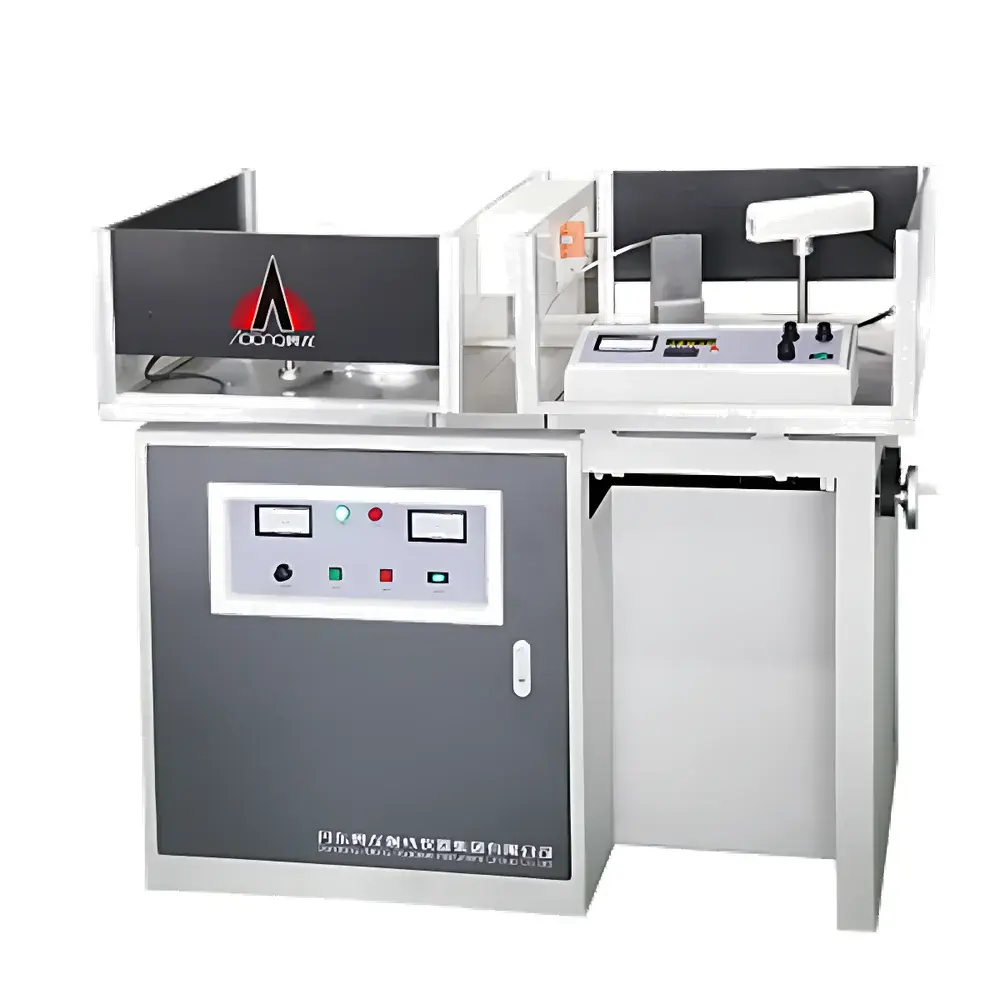
Aolong YX-2C Embedded X-ray Crystal Orientation Analyzer
| Brand | Aolong |
|---|---|
| Origin | Liaoning, China |
| Manufacturer Type | Manufacturer |
| Country of Origin | China |
| Model | YX-2C |
| Price Range | USD 140,000 – 280,000 |
| Input Power | AC 220 V, 50 Hz, 0.5 kW |
| X-ray Tube | Cu anode, air-cooled, 30 kV, 0–5 mA |
| Detector | Geiger–Müller counter |
| Time Constants | 0.1 s, 0.4 s, 3 s |
| Angular Range | θ = −5° to +55°, 2θ = −10° to +110° |
| Mechanical Angular Resolution | 1° (on scale ring for both θ and 2θ) |
| Digital Display Resolution | 10 arcseconds |
| Angular Accuracy | ±30 arcseconds |
| Slit Apertures | 4′, 5′, 6′ |
| Beam Shutter | Manual |
| Display Format | Degrees, Minutes, Seconds |
| Angle Setting | Programmable digital angle preset |
| Dimensions (L×W×H) | 1140 × 650 × 1030 mm |
| Weight | 150 kg |
Overview
The Aolong YX-2C Embedded X-ray Crystal Orientation Analyzer is a benchtop Bragg-angle diffractometer engineered for precise crystallographic orientation determination in single-crystal materials. It operates on the principle of monochromatic X-ray diffraction using Cu-Kα radiation (λ = 1.5418 Å), enabling angular alignment via the Bragg condition (nλ = 2d sinθ). Designed for routine quality control and R&D environments in piezoelectric, optical, and semiconductor crystal manufacturing, the instrument delivers repeatable angular positioning with a certified accuracy of ±30 arcseconds — sufficient for wafer slicing, boule orientation marking, and seed crystal alignment prior to Czochralski or Bridgman growth. Its embedded mechanical architecture integrates the goniometer, X-ray source, and detector into a rigid, vibration-damped frame, minimizing thermal drift and mechanical hysteresis during manual or semi-automated angular scans.
Key Features
- Fixed-copper-anode X-ray tube (30 kV, 0–5 mA) with forced-air cooling, optimized for stable Cu-Kα output without water circulation infrastructure
- Dual-axis goniometric stage with independent θ and 2θ motion, calibrated mechanical scale rings (1° graduation) supplemented by high-resolution digital angular readout (10″ resolution)
- Geiger–Müller counter detector with selectable time constants (0.1 s / 0.4 s / 3 s) to balance signal-to-noise ratio and measurement throughput
- Manually actuated beam shutter and interchangeable collimating slits (4′, 5′, 6′) for controlled irradiation footprint and background suppression
- Digital angle preset function allowing direct entry and recall of target orientations — essential for batch processing of identically oriented crystals
- Compact footprint (1140 × 650 × 1030 mm) and self-contained design requiring only standard single-phase AC power (220 V, 50 Hz, 0.5 kW)
- Robust steel chassis (150 kg total mass) with shock-absorbing feet, suitable for installation in shared lab spaces without dedicated concrete foundations
Sample Compatibility & Compliance
The YX-2C accommodates cylindrical, rectangular, or irregularly shaped single crystals up to Ø150 mm × 100 mm height, including quartz (SiO₂), lithium niobate (LiNbO₃), potassium dihydrogen phosphate (KDP), silicon carbide (SiC), and sapphire (Al₂O₃). Sample mounting uses adjustable kinematic clamps compatible with standard crystal holders (e.g., brass or aluminum chucks with vacuum or mechanical grip). While not certified to IEC 61000-6-3 (EMC) or ISO 13485, the system complies with general electrical safety requirements per GB 4793.1–2007 (Chinese equivalent of IEC 61010-1) and incorporates interlocked shielding to meet national radiation safety standards (GBZ 138–2002). Users are required to implement local radiation monitoring protocols and maintain operational logs per national regulatory guidelines.
Software & Data Management
The YX-2C operates in standalone mode with embedded firmware; no external PC is required for basic operation. All angular data — including θ/2θ positions, count rates, time-constant settings, and slit configuration — are stored internally and displayed in real time on the integrated LCD panel. For traceability, users may manually record measurements in laboratory notebooks or export values via RS-232 serial interface (optional adapter) to third-party spreadsheet or LIMS software. Though lacking native GLP-compliant audit trails or FDA 21 CFR Part 11 electronic signature support, the instrument’s deterministic digital readout and mechanical repeatability enable full manual compliance with ISO/IEC 17025 calibration documentation requirements when paired with accredited external angular verification standards.
Applications
- Orientation verification of quartz wafers prior to AT-cut or SC-cut fabrication
- Angular alignment of LiTaO₃ and LiNbO₃ substrates for SAW device production
- Boule end-face indexing in optical crystal growth facilities (e.g., YAG, BBO, LBO)
- Seed crystal orientation validation in industrial crystal pullers
- Educational use in solid-state physics and materials science laboratories for teaching Bragg diffraction fundamentals
- Pre-machining orientation checks for anisotropic etching or cleaving of nonlinear optical crystals
FAQ
What crystal systems can the YX-2C analyze?
It supports all centrosymmetric and non-centrosymmetric single crystals that produce measurable Bragg reflections under Cu-Kα irradiation — including trigonal (quartz), tetragonal (KTaO₃), orthorhombic (KDP), and cubic (diamond, Si) lattices.
Is radiation shielding included?
Yes — the instrument features lead-lined housing with interlocked front panel and shutter mechanism; leakage dose rate is <1 μSv/h at 5 cm from any surface during operation.
Can the digital angle display be calibrated externally?
Yes — calibration is performed using NIST-traceable optical encoder standards or certified crystal reference samples (e.g., Si(111) at 2θ = 28.438°); procedure is documented in the operator manual.
Does it support automated scanning or motorized stages?
No — the YX-2C is manually operated; motorization and programmable scan sequences require upgrade to the YX-3 series or integration with third-party motion controllers.
What maintenance is required for the X-ray tube?
Annual inspection of cooling fins and voltage regulation is recommended; tube lifetime exceeds 5,000 hours under typical usage (≤3 mA, intermittent duty cycle).



