
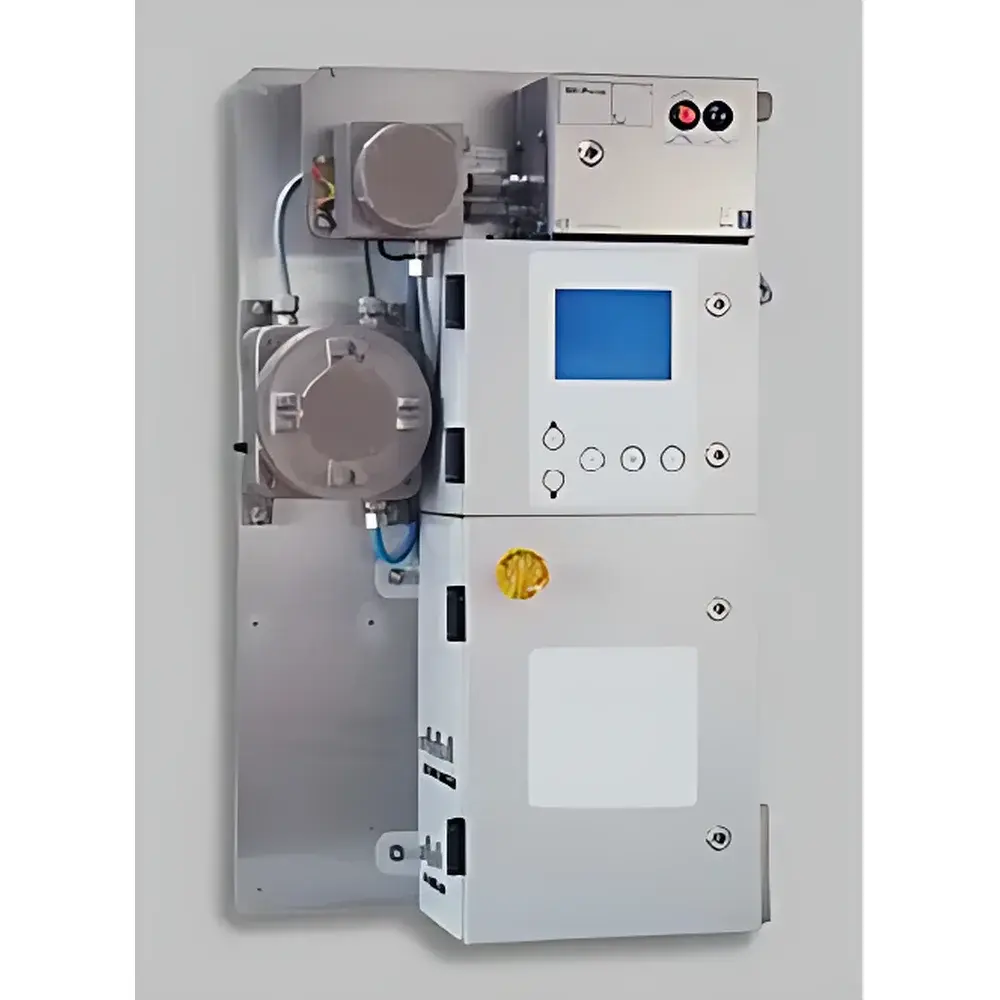
ASTM-Compliant 780 Online Reid Vapor Pressure (RVP) and VL20 Analyzer
| Origin | USA |
|---|---|
| Type | Imported |
| Model | 780 |
| Compliance | ASTM D323, D4953, D5482, D5181, D5188 |
| RVP Range | 0–35 psi (0–250 kPa) |
| VL20 Temperature Range | 25–65 °C |
| Cycle Time | ≤5 min per mode |
| Repeatability | ±0.05 psi (±3.5 mbar) for RVP |
| Operating Environment | NEMA 4X / IP65 |
| Sample Flow Rate | 0.04–0.1 L/min |
| Sample Particle Size | ≤10 µm |
| Purge Gas | Dry nitrogen ≥98% purity, 40–100 psi |
Overview
The ASTM-Compliant 780 Online Reid Vapor Pressure (RVP) and VL20 Analyzer is a fully automated, process-integrated instrument engineered for continuous, real-time vapor pressure measurement of petroleum liquids—primarily gasoline, reformulated blends, and oxygenated fuels—in refinery, terminal, and blending facility environments. It implements the standardized physical principles defined in ASTM D323 (RVP) and ASTM D5188 (VL20), utilizing controlled vapor-liquid equilibrium (VLE) thermodynamics in a precisely regulated 4:1 gas-to-liquid volume ratio chamber. Unlike offline laboratory methods requiring manual sample transfer and conditioning, the 780 performs direct in-line analysis with minimal sample disturbance, eliminating time delays, phase separation risks, and operator-induced variability. Its core architecture integrates a digitally actuated micro-syringe sampling system, high-stability magnetic stirring, temperature-controlled measurement cell (maintained at 37.8 °C for RVP), and a high-resolution absolute pressure transducer calibrated to ±0.01% of full scale. Designed for 24/7 operation in hazardous locations, it delivers traceable, auditable data compliant with regulatory frameworks governing fuel volatility—including U.S. EPA Tier 2 Clean Air Act requirements and seasonal VL20 specifications for summer-grade gasoline.
Key Features
- True dual-mode operation: independent or sequential RVP (ASTM D323/D4953/D5482) and VL20 (ASTM D5188) measurement on a single platform
- Automated vacuum purge and zero-baseline verification prior to each analysis cycle, ensuring sensor drift compensation and long-term baseline stability
- Optimized fluidic path with stainless-steel wetted components, NEMA 4X/IP65-rated enclosure, and intrinsic safety certification for Class I Div 1 Group C+D or ATEX Zone 1 II B+H2 T4 environments
- Integrated diagnostic engine (VisioGraph™) continuously monitors pressure signal integrity, leak detection, thermal equilibration status, and valve actuation performance—with actionable fault diagnostics logged to system memory
- Modular sampling interface supports optional configurations: single-stream bypass, dual-stream auto-switching (P/N 700171), certified reference material injection (P/N 700170), and high-pressure sample return (up to 120 psi, P/N 700172)
- Robust mechanical design with no moving parts in the measurement chamber; maintenance intervals extended by >20,000 cycles based on field service history
Sample Compatibility & Compliance
The 780 accepts homogeneous, anhydrous liquid hydrocarbon streams meeting ASTM D4057 sampling protocol criteria. It requires stable sample flow (0.04–0.1 L/min), particle-free condition (≤10 µm filtration recommended), and temperature within 2–50 °C. The analyzer complies with all referenced ASTM standards for method equivalence and metrological traceability. Data outputs are structured to support GLP/GMP audit trails, including timestamped raw pressure curves, equilibrium detection flags, and environmental parameter logs. When configured with optional firmware modules, it meets FDA 21 CFR Part 11 requirements for electronic records and signatures—including user authentication, audit logging, and data immutability controls. All calibration certificates are issued with NIST-traceable references and uncertainty budgets per ISO/IEC 17025.
Software & Data Management
The embedded control system runs deterministic real-time firmware with dual redundant watchdog timers. Local HMI provides intuitive mode selection, diagnostic visualization, and alarm acknowledgment. Remote access is enabled via secure Modbus TCP or OPC UA over Ethernet, supporting integration into DCS, MES, and LIMS platforms. Historical data—including RVP, VL20, chamber temperature, pressure ramp profiles, and system health metrics—is stored onboard for ≥30 days and exportable as CSV or XML. Optional cloud-based analytics (via API-enabled gateway) enable predictive maintenance alerts, statistical process control (SPC) charting, and cross-unit fleet performance benchmarking. All software updates undergo rigorous regression testing against ASTM-defined test cases prior to release.
Applications
This analyzer is deployed at critical control points where volatility directly impacts compliance, safety, and economics: crude distillation unit overheads, gasoline blendstock headers, pipeline receipt points, marine loading terminals, and retail distribution terminals. In refineries, it enables closed-loop RVP adjustment during summer-blend production, reducing rework and tank turnover costs. At blending facilities, real-time VL20 feedback allows dynamic ethanol or butane dosing to meet regional specifications without over-treatment. Regulatory enforcement agencies use its certified output for spot-check validation against batch certificates. Its reliability (>99% uptime in 5-year field deployments) and repeatability (±0.05 psi) make it suitable for custody transfer verification where contractual RVP tolerances are specified at ±0.1 psi.
FAQ
What ASTM standards does the 780 fully satisfy?
It is validated for ASTM D323 (RVP), D4953 (RVP for oxygenated fuels), D5482 (RVP by digital manometer), D5181 (RVP by portable apparatus), and D5188 (VL20). Full conformance documentation is provided with each unit.
Can the 780 operate in explosive atmospheres?
Yes—models P-780-1100 (NEC Class I Div 1 Group C+D) and P-780-1200 (ATEX Zone 1 II B+H2 T4) are certified for installation in classified hazardous areas per IEC 60079 and NFPA 70.
Is manual calibration required between analyses?
No—each cycle includes automated vacuum purge, zero-point verification, and internal pressure sensor self-diagnostics. Annual verification using NIST-traceable reference standards is recommended.
How does the system handle water-contaminated samples?
Water presence violates ASTM D323 preconditioning requirements. The analyzer will detect abnormal pressure decay signatures and flag non-compliant samples via diagnostic alerts—but does not perform water quantification.
What maintenance is required for sustained accuracy?
Routine tasks include quarterly inspection of sample filters and purge gas regulators; annual replacement of consumables (P/N 700175/700176); and biennial full-system verification per manufacturer’s SOP-780-VERIF.





