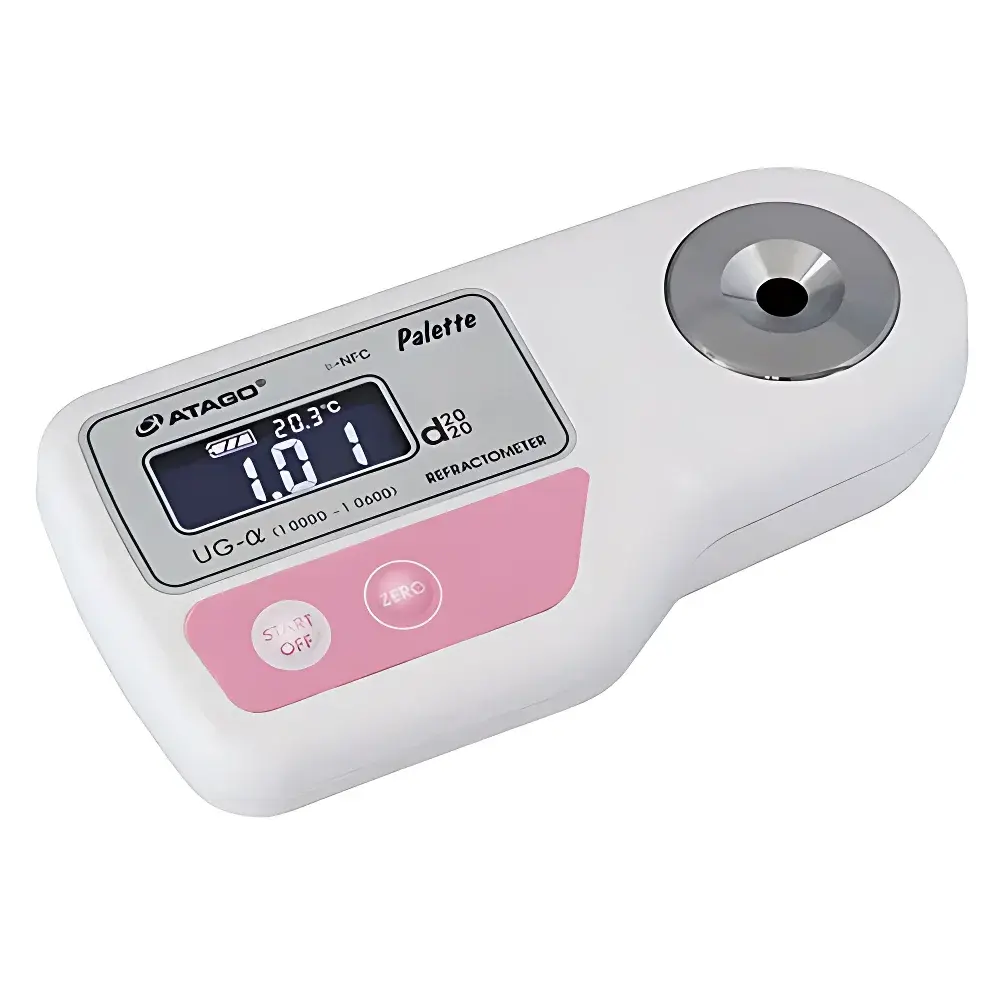
ATAGO US-α High-Resolution Urine Specific Gravity Refractometer
| Brand | ATAGO |
|---|---|
| Origin | Japan |
| Model | 3464 |
| Resolution | 0.0001 |
| Accuracy | ±0.0010 |
| Measurement Range | 1.000–1.060 S.G. |
| Automatic Temperature Compensation (ATC) | 10–35°C |
| IP Rating | IP65 |
| Measurement Time | <3 seconds |
| Sample Volume | ~0.3 mL |
Overview
The ATAGO US-α High-Resolution Urine Specific Gravity Refractometer is a precision optical instrument engineered for clinical and research laboratories requiring rapid, repeatable, and temperature-compensated measurement of urine specific gravity (S.G.). It operates on the fundamental principle of critical-angle refractometry: incident light undergoes total internal reflection at the prism–urine interface, with the critical angle directly correlated to the solution’s refractive index—and thus its solute concentration. Since urine specific gravity reflects total dissolved solids (e.g., urea, creatinine, glucose, electrolytes), this refractometric method provides a robust, non-destructive proxy for renal concentrating capacity without requiring calibration curves or reagents. Designed specifically for point-of-care and benchtop use in nephrology, sports medicine, and biomedical education, the US-α delivers traceable, operator-independent results compliant with CLIA-waived testing requirements under U.S. regulatory frameworks.
Key Features
- High-resolution digital display: 0.0001 resolution across the clinically relevant S.G. range (1.000–1.060), enabling detection of subtle shifts associated with early-stage renal dysfunction or acute hydration changes.
- Automated temperature compensation (ATC): Integrated thermistor continuously monitors sample temperature between 10°C and 35°C, applying real-time correction based on the validated refractive index–temperature relationship for human urine—eliminating manual correction tables and reducing inter-laboratory variability.
- Rugged, field-ready construction: Sealed optical path and IP65-rated prism housing resist splashes, humidity, and routine disinfectant exposure; meets IEC 60529 standards for dust and water ingress protection.
- Minimal sample requirement: Requires only 0.3 mL of uncentrifuged, room-temperature urine—compatible with pediatric, geriatric, and catheterized specimens where volume is limited.
- Single-button operation: No warm-up time, no zeroing, no consumables; measurement completes in under three seconds with audible confirmation and stable-value hold function.
- Ergonomic handheld design: Weighs less than 200 g with textured grip and low-profile prism stage—optimized for repeated use in mobile clinics, athletic training rooms, and teaching labs.
Sample Compatibility & Compliance
The US-α is validated for use with fresh, refrigerated, or frozen-thawed human urine samples—including those containing moderate levels of protein (≤100 mg/dL), glucose (≤2 g/dL), or bilirubin. It is not intended for use with highly viscous, turbid, or heavily hemolyzed specimens without prior centrifugation. The instrument conforms to ISO 15197:2013 (in vitro diagnostic devices — Requirements for blood-glucose monitoring systems) for metrological traceability of optical measurements and supports GLP-compliant documentation when paired with ATAGO’s optional RS-232 data logging interface. While classified as a Class I exempt device per FDA 21 CFR §862.2250 (urine specific gravity analyzers), it satisfies essential performance criteria referenced in CLSI EP15-A3 and ASTM D1218–21 for refractometric density determination.
Software & Data Management
The US-α operates as a standalone optical instrument with no embedded firmware or software dependencies. For audit-trail compliance in regulated environments (e.g., CAP-accredited labs or GCP trials), optional RS-232 output enables direct connection to LIMS or electronic health record (EHR) systems via standard serial-to-USB adapters. Output format is ASCII-encoded, including timestamp (if external clock source provided), S.G. value, and ATC status flag. No proprietary drivers or cloud services are required. Data export supports CSV formatting for statistical analysis in JMP, GraphPad Prism, or Excel—facilitating longitudinal tracking of hydration status or renal response to diuretic therapy.
Applications
- Nephrology & primary care: Rapid assessment of urinary concentrating ability in suspected acute kidney injury (AKI), chronic kidney disease (CKD) staging, and post-transplant monitoring.
- Sports medicine & military physiology: Objective hydration screening pre-/post-exercise; correlation with plasma osmolality and serum sodium in heat-stress protocols.
- Clinical research: Endpoint measurement in trials evaluating diuretics, vasopressin analogs, or fluid-resuscitation strategies.
- Medical & biomedical education: Hands-on demonstration of renal physiology principles, including countercurrent multiplication and tubular solute handling—integrated into USMLE Step 1 curricula and undergraduate physiology labs.
- Veterinary diagnostics: Cross-species application validated for canine and feline urine (with species-specific reference intervals).
FAQ
Does the US-α require recalibration between samples?
No. The optical system is factory-calibrated using NIST-traceable sucrose standards and maintains stability over time; only periodic verification with distilled water (S.G. = 1.000) and 5% NaCl solution (S.G. ≈ 1.034) is recommended per CLSI GP28-A3 guidelines.
Can the US-α measure urine from patients with glycosuria or proteinuria?
Yes—within clinically typical concentrations (glucose ≤2 g/dL; protein ≤100 mg/dL). Elevated solutes contribute additively to refractive index; no correction factor is applied, as the device reports total dissolved solids as S.G., consistent with clinical interpretation standards.
Is the prism surface resistant to corrosion from urine or cleaning agents?
Yes. The sapphire-coated BK7 glass prism resists etching from uric acid crystals and common quaternary ammonium disinfectants; cleaning is performed with lint-free tissue and deionized water per ATAGO Technical Bulletin TB-USα-02.
What regulatory documentation is supplied with the instrument?
Each unit ships with an ISO/IEC 17025-accredited calibration certificate (traceable to NMIJ/AIST, Japan), Declaration of Conformity (CE, RoHS, REACH), and IFU compliant with IEC 62304 Class B software safety requirements (for embedded microcontroller firmware).