
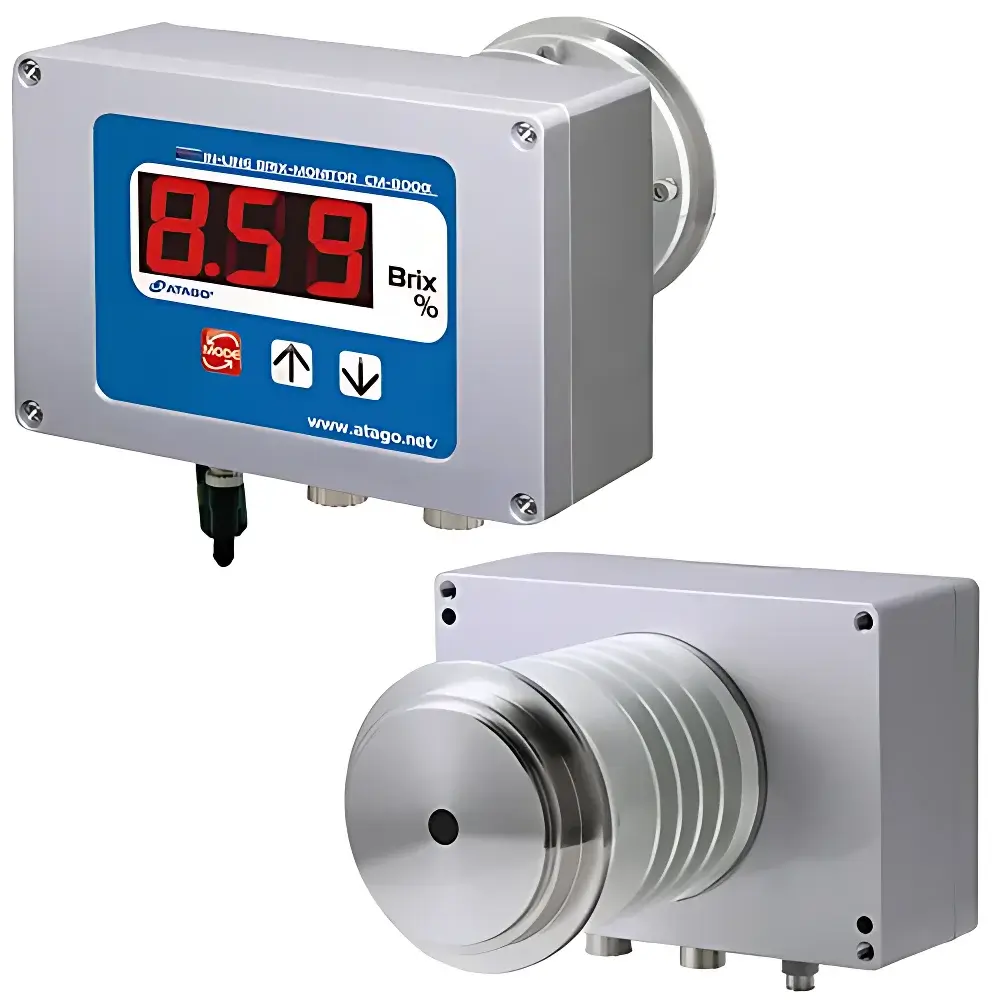
ATAGO CM-800α Online Refractometer
| Brand | ATAGO |
|---|---|
| Origin | Japan |
| Model | CM-800α |
| Measurement Scale | Brix |
| Range | 0.0–80.0% Brix |
| Resolution | 0.1% Brix |
| Accuracy | ±0.1% Brix |
| Temperature Range (Sample) | −15°C to +160°C |
| Ambient Operating Temperature | 5°C to 40°C |
| Auto-Temperature Compensation Range | 5°C to 100°C |
| Output Options | DC 4–20 mA or RS-232C |
| Power Supply | DC 24 V |
| Prism Material | Synthetic Sapphire |
| Flow Cell Material | SUS316L |
| Ingress Protection Rating | IP67 |
| Dimensions (H×W×D) | 160 × 167 × 110 mm |
| Weight | Not specified |
Overview
The ATAGO CM-800α Online Refractometer is an industrial-grade, in-line process analyzer engineered for continuous, real-time measurement of soluble solids concentration—expressed as Brix—in liquid streams across food processing, fermentation, cleaning-in-place (CIP), and chemical manufacturing applications. Based on the principle of critical-angle refractometry, the instrument measures the refractive index of a flowing sample in direct contact with a synthetic sapphire prism, converting it into a precise Brix value using factory-calibrated algorithms traceable to NIST-standard sucrose solutions. Its robust design enables uninterrupted operation under high-temperature, high-pressure, and chemically aggressive conditions typical of industrial pipelines and mixing vessels. Unlike laboratory-based handheld refractometers, the CM-800α integrates seamlessly into distributed control systems (DCS) and programmable logic controllers (PLC) via analog 4–20 mA output or digital RS-232C interface, supporting closed-loop feedback control without manual sampling or operator intervention.
Key Features
- Synthetic sapphire prism—chemically inert, scratch-resistant, and thermally stable up to 160°C—ensures long-term optical integrity and minimal drift in harsh process environments.
- SUS316L wetted flow cell compatible with acidic, alkaline, and saline media; suitable for CIP and SIP (sterilization-in-place) cycles.
- Automatic temperature compensation (ATC) across 5–100°C eliminates manual correction and maintains accuracy during dynamic thermal transitions.
- IP67-rated enclosure provides protection against dust ingress and temporary immersion, enabling installation in humid or washdown-prone areas.
- Wide operating sample temperature range (−15°C to +160°C) supports applications from cryogenic juice concentration to hot alkaline detergent monitoring.
- High-resolution display (0.1% Brix) and ±0.1% Brix accuracy meet requirements for QC-critical processes governed by ISO 21527-1, AOAC 932.12, and USP .
Sample Compatibility & Compliance
The CM-800α is validated for use with aqueous solutions containing sugars (e.g., sucrose, glucose, fructose), organic acids, alcohols, glycols, and caustic cleaning agents (e.g., NaOH, sodium metasilicate). It is not intended for opaque, highly viscous (>1000 mPa·s), or particulate-laden fluids unless paired with inline filtration or flow conditioning. The device complies with IEC 61000-6-2 (EMC immunity) and IEC 61000-6-4 (EMC emission) standards. Its analog output meets HART Foundation specifications for interoperability in industrial automation networks. For regulated environments—including FDA-regulated food facilities and pharmaceutical water systems—the unit supports audit-ready data logging when integrated with compliant SCADA platforms adhering to 21 CFR Part 11 requirements for electronic records and signatures.
Software & Data Management
While the CM-800α operates as a standalone sensor, its RS-232C interface enables bidirectional communication with host systems running proprietary or third-party process monitoring software (e.g., Ignition SCADA, Siemens Desigo CC, or custom LabVIEW-based dashboards). Configuration parameters—including Brix calibration offset, damping time, alarm thresholds, and temperature compensation coefficients—can be modified remotely. All measurement events, diagnostic status flags (e.g., prism fouling warning, temperature out-of-range), and timestamped readings are exportable in CSV or Modbus TCP format. When deployed alongside ATAGO’s optional data acquisition module (CM-DAS), the system generates GLP-compliant reports with full traceability, including operator ID, calibration history, and environmental logs—essential for internal audits and regulatory inspections.
Applications
- Fermentation process control: Real-time Brix tracking in soy sauce, miso, sake, and ethanol production to optimize yeast activity and endpoint determination.
- Food & beverage concentration: Inline monitoring of fruit juice, dairy whey, and syrup evaporation to maintain consistent final product solids content.
- Cleaning validation: Quantitative verification of alkaline cleaner concentration during CIP cycles to ensure microbiological efficacy while minimizing chemical overuse.
- Chemical dosing control: Feedback regulation of sugar-based antifreeze or humectant injection in HVAC and coating lines.
- Wastewater pretreatment: Estimation of organic loading (as Brix-equivalent COD proxy) in pre-screening stages of municipal or industrial effluent streams.
FAQ
What is the maximum allowable pressure rating for the CM-800α flow cell?
The standard CM-800α is rated for continuous operation at ≤1.0 MPa (10 bar) at 25°C; derating applies above 80°C per ASME B31.3 guidelines.
Can the CM-800α measure non-sugar solutes such as sodium chloride or ethanol?
No—it is calibrated exclusively for sucrose-based Brix; alternative solutes require custom refractive index correlation curves and are outside factory warranty scope.
Is field recalibration possible without returning the unit to ATAGO?
Yes—using certified sucrose reference standards (e.g., 10.00% and 40.00% w/w), users may perform two-point span adjustment via the front-panel menu or RS-232 command set.
Does the instrument support explosion-proof certification for hazardous area installation?
Not natively; however, it may be installed in Zone 2/Class I Div 2 environments when housed in an approved purge cabinet meeting NEC 500/IEC 60079-13 requirements.
How often should the sapphire prism surface be cleaned during continuous operation?
Cleaning frequency depends on fouling potential; ATAGO recommends visual inspection every 72 hours and ultrasonic cleaning with deionized water every 2–4 weeks for high-solids applications.
Related Products







