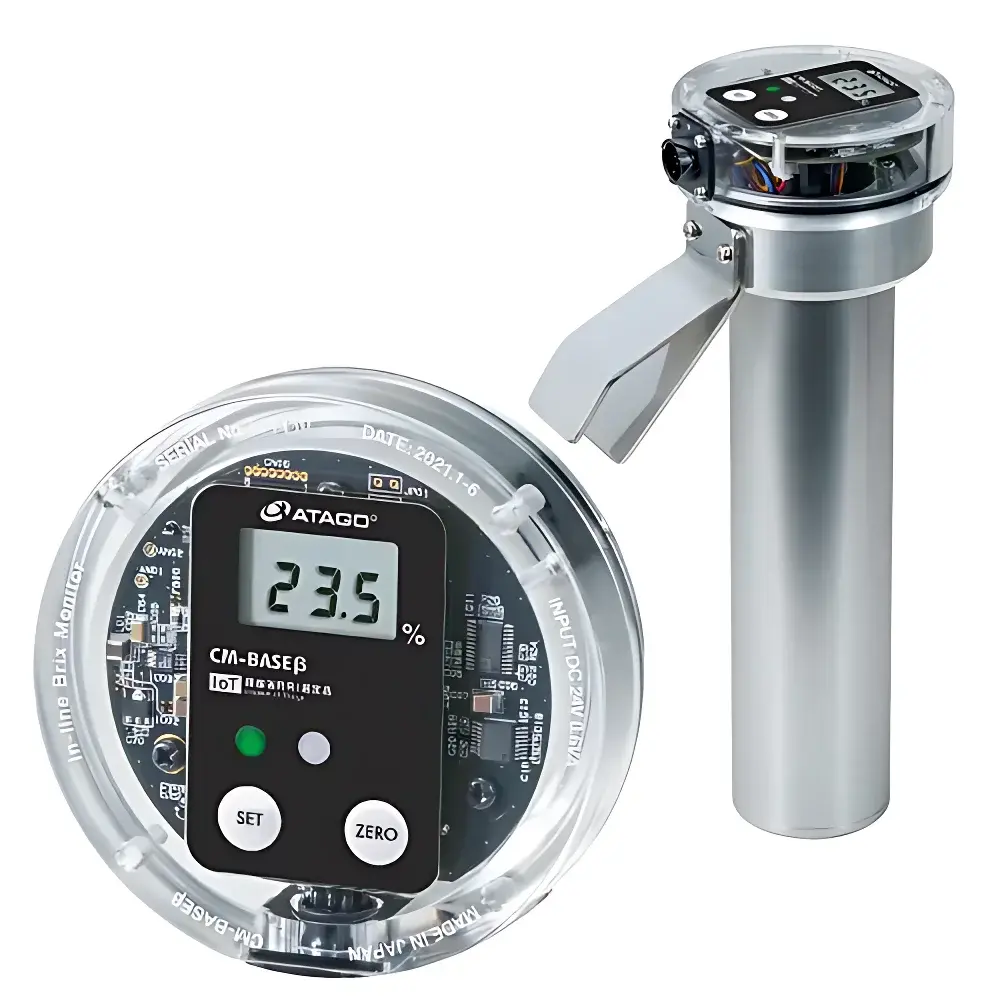
ATAGO CM-BASEβ Online Refractometer (Easy-Mount Version)
| Brand | ATAGO |
|---|---|
| Origin | Japan |
| Model | CM-BASEβ |
| Measurement Range | 0.0–93.0% Brix (ATC) |
| Temperature Range | 10–95°C (ATC) |
| Accuracy | ±0.2% Brix |
| Resolution | 0.1% Brix |
| Output | DC 4–20 mA / RS-232C |
| Prism Housing Material | Aluminum |
| IP Rating | IP67 |
| Dimensions (H×W×D) | 90×90×58 mm + probe length (200/300/500 mm) |
| Weight | 873 g (main unit only) |
| Power Supply | DC 24 V |
Overview
The ATAGO CM-BASEβ Online Refractometer (Easy-Mount Version) is a robust, industrial-grade inline process analyzer engineered for continuous, real-time measurement of refractive index-derived concentration in flowing or static liquid streams. Based on the fundamental optical principle of total internal reflection at the prism–sample interface, the instrument determines Brix concentration by measuring the critical angle shift induced by changes in sample refractive index—automatically compensated for temperature variations between 10 °C and 95 °C (ATC). Designed specifically for integration into metalworking fluid systems, cleaning solution lines, beverage production loops, and chemical dosing circuits, the CM-BASEβ delivers stable, drift-resistant readings without requiring flow cells, bypass loops, or external calibration standards during routine operation. Its solid-state optical architecture—featuring an aluminum prism housing and sealed optical path—ensures long-term stability in harsh manufacturing environments, including high-humidity, oil-mist, and washdown conditions.
Key Features
- Tool-free, clamp-style mounting directly onto tank walls or pipe surfaces—no drilling, welding, or process interruption required.
- Three standardized probe lengths (200 mm, 300 mm, 500 mm) to accommodate varying vessel wall thicknesses and immersion depths; part numbers 5851, 5852, and 5853 respectively.
- Integrated automatic temperature compensation (ATC) with high-stability NTC sensor embedded in the prism block, ensuring ±0.2% Brix accuracy across the full 10–95 °C operating range.
- Dual analog and digital output: isolated 4–20 mA current loop for PLC/DCS integration and RS-232C serial interface for local configuration, diagnostics, and firmware updates.
- IP67-rated main unit housing—dust-tight and protected against immersion up to 1 m for 30 minutes—enabling deployment in wet or outdoor industrial zones.
- On-device data correction function allows user-defined offset adjustment for system-level calibration alignment with reference laboratory measurements (e.g., digital handheld refractometers traceable to NIST standards).
- Configurable alarm thresholds with visual LED indicators and relay-triggered dry-contact outputs for concentration deviation alerts (e.g., low coolant concentration or over-diluted cleaning agent).
Sample Compatibility & Compliance
The CM-BASEβ is validated for use with aqueous-based industrial fluids exhibiting low-to-moderate turbidity and non-abrasive particulate content—including water-soluble metalworking emulsions, alkaline and acidic cleaning solutions, glycol-based coolants, fruit juice concentrates, syrup blends, and pharmaceutical excipient solutions. It is not intended for highly viscous, opaque, or suspended-solid-laden media that impede optical transmission at the prism interface. While the device itself does not carry CE, UKCA, or ATEX certifications, its electrical design complies with IEC 61000-6-2 (immunity) and IEC 61000-6-4 (emission) standards. When integrated into GMP or GLP-regulated processes, users may configure audit-trail-capable SCADA systems to log all concentration readings, alarm events, and parameter modifications—supporting compliance with FDA 21 CFR Part 11 requirements for electronic records and signatures when paired with appropriate validation protocols.
Software & Data Management
The CM-BASEβ operates as a stand-alone sensor node and does not require proprietary PC software for basic operation. Configuration—including Brix offset, alarm setpoints, output scaling, and RS-232 communication parameters—is performed via ASCII command protocol over the serial interface using standard terminal emulation tools (e.g., PuTTY, Tera Term). For centralized monitoring, the 4–20 mA output integrates seamlessly with industry-standard control platforms (Siemens SIMATIC, Rockwell ControlLogix, Yokogawa CENTUM VP) and SCADA historians (OSIsoft PI System, GE iFIX). Optional Modbus RTU firmware upgrade (available upon request) enables direct register mapping for enhanced interoperability in IIoT architectures. All configuration changes are retained in non-volatile memory and survive power cycling.
Applications
- Metalworking fluid concentration control in CNC machining centers to maintain optimal lubricity, corrosion inhibition, and bacterial suppression.
- Real-time monitoring of alkaline cleaning bath strength in automotive parts washing lines to ensure consistent soil removal and prevent residue formation.
- In-line sugar concentration verification during juice blending, syrup dilution, and soft drink formulation to meet batch consistency targets per ISO 21527 or AOAC 932.12.
- Process validation support for cleaning-in-place (CIP) cycle endpoints in food and beverage facilities, aligning with 3-A Sanitary Standards and EHEDG guidelines.
- Quality assurance of aqueous polymer solutions in coating and adhesive manufacturing where viscosity correlates strongly with refractive index.
FAQ
Is the CM-BASEβ suitable for pressurized pipelines?
No—the sensor is designed for open-tank or atmospheric-pressure vessel wall mounting. It is not rated for direct insertion into pressurized process lines.
Can it measure ethanol–water mixtures?
Yes, provided the mixture remains optically clear and falls within the 0.0–93.0% Brix range; however, note that Brix scale assumes sucrose-equivalent refractive behavior—calibration correlation must be established empirically for non-sucrose solutes.
Does it require periodic prism cleaning?
Yes—while the aluminum prism resists corrosion, buildup of oils, proteins, or mineral deposits will degrade optical performance. Routine inspection and gentle wiping with lint-free cloth and deionized water are recommended per maintenance schedule.
What is the warranty period?
ATAGO provides a standard 12-month limited warranty covering defects in materials and workmanship under normal industrial use conditions.
Is NIST-traceable calibration documentation available?
Factory calibration certificates (not NIST-traceable by default) are included. Traceable calibration services with accredited third-party labs can be arranged separately upon order.
Related Products