
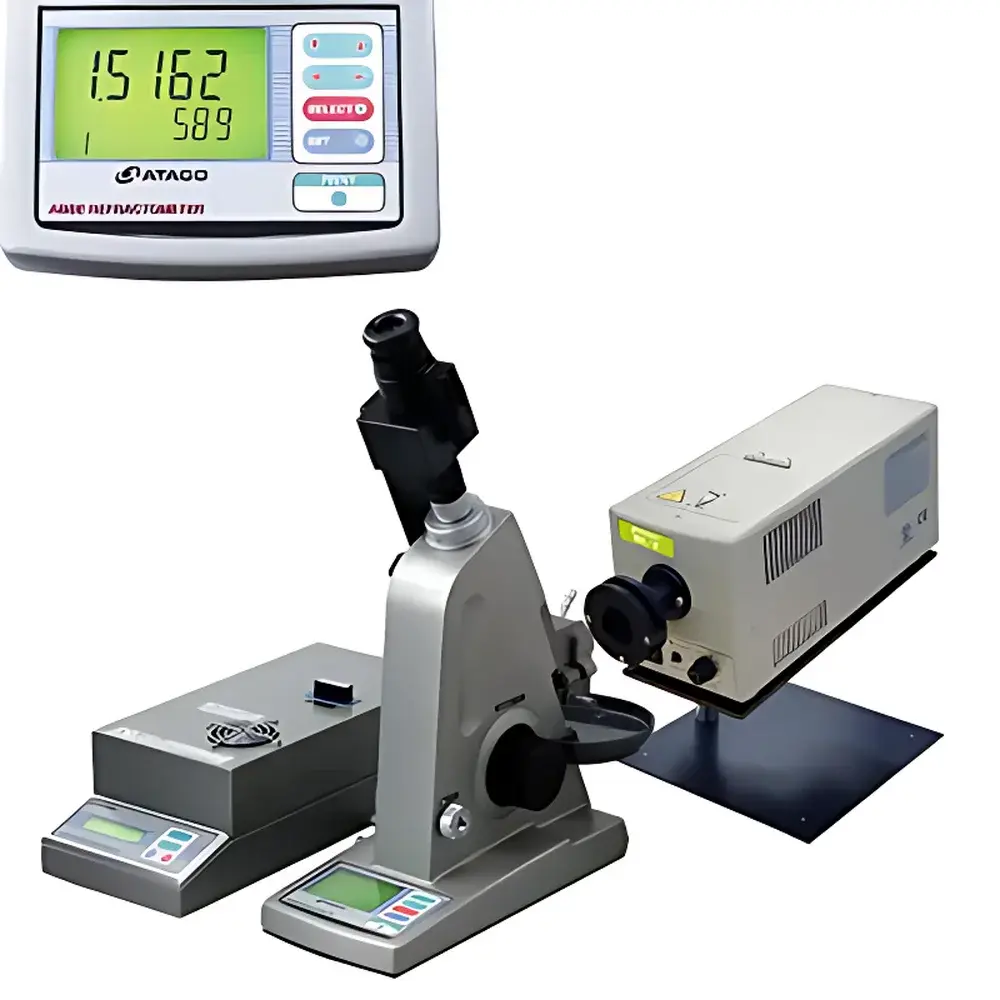
ATAGO DR-M2/1550(A) Multi-Wavelength Abbe Refractometer
| Origin | Japan |
|---|---|
| Manufacturer Type | Authorized Distributor |
| Origin Category | Imported |
| Model | DR-M2/1550(A) |
| Price | Upon Request |
| Wavelength Range | 450–1550 nm |
| Refractive Index Range (at 450 nm) | 1.3278–1.7379 |
| Refractive Index Range (at 589 nm) | 1.3000–1.7100 |
| Refractive Index Range (at 680 nm) | 1.2912–1.7011 |
| Refractive Index Range (at 1100 nm) | 1.2743–1.6840 |
| Refractive Index Range (at 1550 nm) | 1.2662–1.6759 |
| Minimum Display Resolution | RI ±0.0001, Abbe Number ±0.1 |
| Accuracy (RI at 589 nm) | ±0.0002 (with certified calibration plate) |
| Temperature Control Range | 5–50 °C |
| Light Source | Monochromatic LED-based source with interference filters |
| Dimensions (Refractometer Unit) | 23 × 35 × 21–31 cm |
| Weight (Refractometer Unit) | 5.9 kg |
| Power Supply | AC 100–240 V, 50/60 Hz |
| Power Consumption | 100 VA (main unit + power supply) |
Overview
The ATAGO DR-M2/1550(A) is a high-precision, multi-wavelength Abbe refractometer engineered for quantitative optical characterization of transparent and semi-transparent materials across the visible to near-infrared (NIR) spectrum. Unlike conventional single-wavelength refractometers, this instrument employs a tunable monochromatic light source combined with interchangeable interference filters to enable spectral dispersion analysis—supporting direct measurement of refractive index (nD, nF, nC, ne, nv) and Abbe number (vd, ve) at user-selectable wavelengths from 450 nm to 1550 nm. Its optical design follows classical Abbe principle: critical angle detection via boundary line intersection in a double-prism configuration (main and auxiliary prisms), ensuring traceable, repeatable measurements compliant with ISO 21147:2022 and ASTM D1218 standards for refractive index determination. The integrated temperature-controlled sample stage (5–50 °C) mitigates thermal drift, while the high-resolution LCD display presents real-time digital readouts of both refractive index and Abbe number—eliminating parallax error associated with analog scale interpretation.
Key Features
- Multi-wavelength capability across four NIR/visible bands: 450–539 nm, 540–680 nm, 681–799 nm, and 800–1550 nm—enabling full dispersion curve generation
- High-resolution digital display: 0.0001 RI resolution and 0.1 Abbe number resolution, calibrated against NIST-traceable reference plates
- Interchangeable interference filter set (standard 589 nm; optional 486 nm, 656 nm, 546 nm, 480 nm, 644 nm, and custom-band filters) for wavelength-specific metrology
- Near-infrared observation eyepiece (RE-9119) and polarized viewing attachment (RE-1146) for enhanced contrast in low-reflectivity or birefringent samples
- Modular architecture: separate refractometer head (5.9 kg), power supply unit (3.0 kg), and monochromatic source module—facilitating maintenance and recalibration
- Compliant electrical design: dual-voltage input (AC 100–240 V, 50/60 Hz), CE-marked, and RoHS-conformant
Sample Compatibility & Compliance
The DR-M2/1550(A) accommodates liquid, paste, gel, and solid transparent media—including optical adhesives (e.g., LED encapsulants), lens coatings, polymer resins, specialty glasses, and semiconductor-grade immersion fluids. Its adjustable prism pressure mechanism ensures uniform contact without sample deformation, critical for soft-cure epoxies and silicone gels used in optoelectronic packaging. All measurements adhere to GLP documentation requirements when paired with optional DP-22(B) digital printer (model 3125), which logs timestamped RI/Abbe values with operator ID and calibration status. The system supports audit-ready data integrity per FDA 21 CFR Part 11 when integrated into validated laboratory informatics environments. Calibration verification follows ISO/IEC 17025 guidelines using certified reference materials (e.g., ATAGO RE-1195 calibration standard).
Software & Data Management
While the DR-M2/1550(A) operates as a standalone benchtop instrument, its RS-232C interface enables bidirectional communication with external PCs or LIMS platforms. Raw measurement data—including wavelength setting, temperature reading, RI value, Abbe number, and pass/fail flags—can be exported in ASCII format for post-processing in MATLAB, Python (NumPy/Pandas), or Excel. Optional DP-22(B) printer provides hard-copy output with embedded calibration certificate ID and environmental metadata. Firmware updates are delivered via USB memory stick, ensuring long-term compliance with evolving IEC 61000-4 electromagnetic compatibility standards.
Applications
- Quality control of LED die-attach adhesives and underfill materials—verifying refractive index match between encapsulant and chip substrate to minimize Fresnel losses
- R&D of gradient-index (GRIN) optical polymers and sol-gel-derived coatings for AR/HR filter stacks
- Characterization of telecom-grade optical fibers and planar lightwave circuits (PLCs) operating at 1310 nm and 1550 nm windows
- Validation of immersion oils for high-NA microscopy objectives (e.g., oil immersion at 546 nm or 633 nm)
- Material certification for ISO 10110-2 surface specification of optical components
- Academic research in photonic crystal fabrication, where precise n(λ) dispersion modeling informs bandgap tuning
FAQ
Does the DR-M2/1550(A) support automatic wavelength switching?
No—wavelength selection requires manual insertion of the corresponding interference filter; however, the modular filter holder allows rapid exchange with minimal alignment recalibration.
Can this refractometer measure turbid or opaque samples?
No—it is designed exclusively for optically transparent or translucent media; scattering or absorption above 10% at the selected wavelength will compromise boundary line detection.
Is temperature compensation applied automatically during measurement?
Yes—the built-in Peltier-controlled stage maintains setpoint temperature within ±0.1 °C, and the firmware applies real-time correction based on material-specific dn/dT coefficients stored in internal lookup tables.
What is the recommended recalibration interval?
ATAGO recommends annual verification using certified reference standards (e.g., RE-1195); more frequent checks are advised in regulated QC environments operating under ISO 9001 or IATF 16949.
Are replacement prisms available as service parts?
Yes—main and auxiliary prisms (part no. RE-16500) are field-replaceable and supplied with factory certification of surface flatness (λ/10) and refractive homogeneity.



