
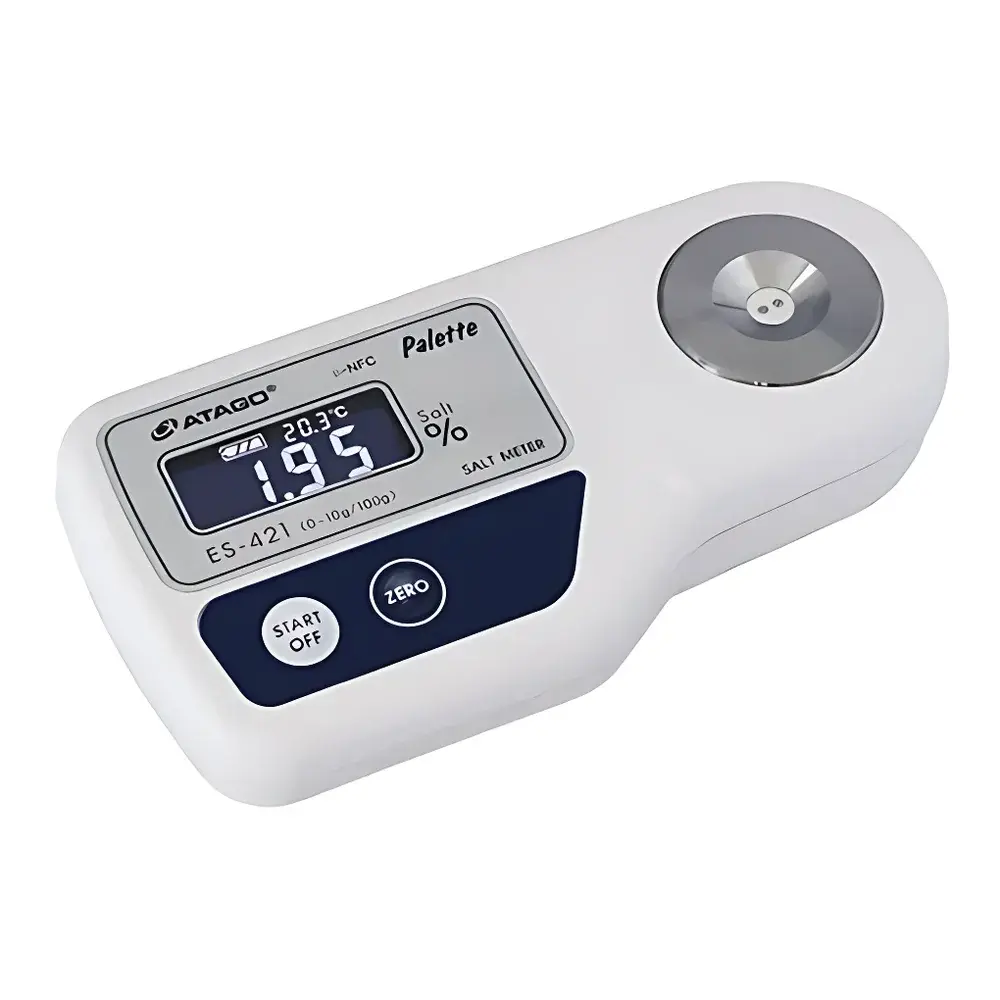
ATAGO ES-421 Conductivity-Based Salinometer
| Brand | ATAGO |
|---|---|
| Origin | Japan |
| Model | ES-421 |
| Measurement Principle | Conductivity Method |
| Salt Range | 0.00–10.0% (g/100g) |
| Resolution | 0.01% (0.00–2.99%), 0.1% (3.0–10.0%) |
| Accuracy | ±0.05% (0.00–0.99%), ±5% rel. (1.00–10.0%) |
| ATC Range | 10–40°C |
| Operating Temp. | 10–40°C |
| Power | 9V alkaline battery (006P) |
| Dimensions | 170 × 90 × 40 mm |
| Weight | 220 g (host only) |
| IP Rating | IP64 |
Overview
The ATAGO ES-421 Conductivity-Based Salinometer is a compact, benchtop-ready instrument engineered for rapid, reagent-free quantification of salt concentration in viscous and heterogeneous food matrices. Unlike optical refractometers or titration-based methods, the ES-421 employs calibrated electrical conductivity measurement—a principle grounded in the linear relationship between ionic strength and conductance in aqueous electrolyte solutions. This method delivers direct salt mass fraction (g/100g) output without requiring calibration curves for individual product types, provided samples fall within defined viscosity and temperature constraints. Designed specifically for food quality control laboratories, R&D kitchens, and production line QA stations, the ES-421 meets routine requirements for process consistency, regulatory labeling compliance (e.g., FDA Nutrition Facts, EU Regulation No. 1169/2011), and HACCP critical limit monitoring. Its fixed geometry, integrated temperature sensor, and factory-traceable calibration ensure measurement reproducibility across shifts and operators.
Key Features
- Conductivity-based measurement eliminates need for chemical reagents, reducing operational cost, waste disposal burden, and analyst exposure risk—fully aligned with ISO 14001 environmental management principles.
- Funnel-shaped sample chamber enables reliable filling with minimal volume (≈10 mL), accommodating high-viscosity liquids such as soy sauce, miso paste, brines, and fermented condiments without air entrapment or meniscus error.
- Automatic Temperature Compensation (ATC) operates continuously across 10–40°C, referencing a built-in thermistor to correct for thermal drift in conductivity response—critical for ambient-uncontrolled environments like pilot plants or shared lab spaces.
- Rugged housing rated IP64 ensures resistance to dust ingress and water splashing during routine cleaning; compact footprint (170 × 90 × 40 mm) and low mass (220 g) support flexible deployment on laminar flow hoods, QC benches, or mobile carts.
- Single-button operation (START/OFF) initiates measurement sequence with visual feedback (three LED flashes), minimizing training time and procedural variability—particularly advantageous in multilingual or high-turnover production settings.
Sample Compatibility & Compliance
The ES-421 is validated for use with aqueous food systems where sodium chloride dominates ionic contribution, including but not limited to: soy sauce (shoyu, tamari), dashi broth, kimchi brine, pickling solutions, teriyaki marinades, tomato-based sauces, cured meats (surface extracts), and cheese whey. It is not intended for non-aqueous solvents, highly carbonated beverages, or samples containing significant concentrations of non-NaCl electrolytes (e.g., potassium lactate, calcium chloride) without empirical correction. While not certified under FDA 21 CFR Part 11 or ISO/IEC 17025, its measurement traceability aligns with internal laboratory validation protocols per ISO/IEC 17025:2017 Clause 7.7. The device complies with IEC 61010-1 for electrical safety and carries CE marking for conformity with EU electromagnetic compatibility (EMC) Directive 2014/30/EU.
Software & Data Management
The ES-421 operates as a standalone, embedded-system instrument with no onboard data logging, Bluetooth, or USB interface. All measurements are displayed in real time on a high-contrast LCD screen. For traceable recordkeeping, users must manually transcribe results into LIMS, Excel, or paper-based batch logs. To satisfy GLP/GMP documentation requirements, laboratories commonly pair the ES-421 with standardized SOPs specifying: operator ID, sample ID, ambient temperature, instrument serial number, and verification against NIST-traceable NaCl reference standards (e.g., 1.00%, 5.00%, and 8.00% w/w). Periodic performance verification—per ASTM D1125 or internal QC checklists—is recommended at start-of-shift and after every 20 measurements.
Applications
- Batch release testing of fermented condiments to verify compliance with declared salt content on nutrition labels.
- In-process monitoring of brining tanks during vegetable fermentation (e.g., sauerkraut, olives) to prevent over- or under-salting.
- Supplier qualification of soy sauce concentrate deliveries prior to blending into finished products.
- R&D formulation development for low-sodium alternatives, enabling rapid iteration of salt-reduction strategies while maintaining sensory thresholds.
- Audit-ready verification during third-party food safety inspections (BRCGS, SQF, FSSC 22000) where salt concentration serves as a critical control point.
FAQ
Does the ES-421 require calibration before each use?
No—factory calibration is stable for typical usage conditions. However, daily verification using a certified 3.0% NaCl standard is strongly recommended per ISO 8655-7 and internal QA protocols.
Can it measure salt in solid or semi-solid foods like cheese or cured ham?
Not directly. These require homogenization into an aqueous extract (e.g., 1:10 w/v in distilled water), followed by filtration and temperature equilibration prior to measurement.
Is the instrument compliant with FDA or EU food safety regulations?
It is not a regulated medical device nor subject to premarket approval, but its measurement methodology supports compliance with FDA 21 CFR 101.9 (nutrition labeling) and EU Regulation (EU) No 1169/2011 when used within validated procedures.
What maintenance is required?
Rinse the sample chamber with deionized water after each use; dry with lint-free cloth. Avoid abrasive cleaners. Replace 9V battery when display contrast diminishes or measurement delay exceeds 2 seconds.
Why does accuracy degrade above 1.00% salt?
Conductivity response becomes increasingly non-linear at higher ionic strengths due to inter-ion interactions (Debye-Hückel effects); the ±5% relative tolerance reflects this physical limitation—not instrument defect.




