
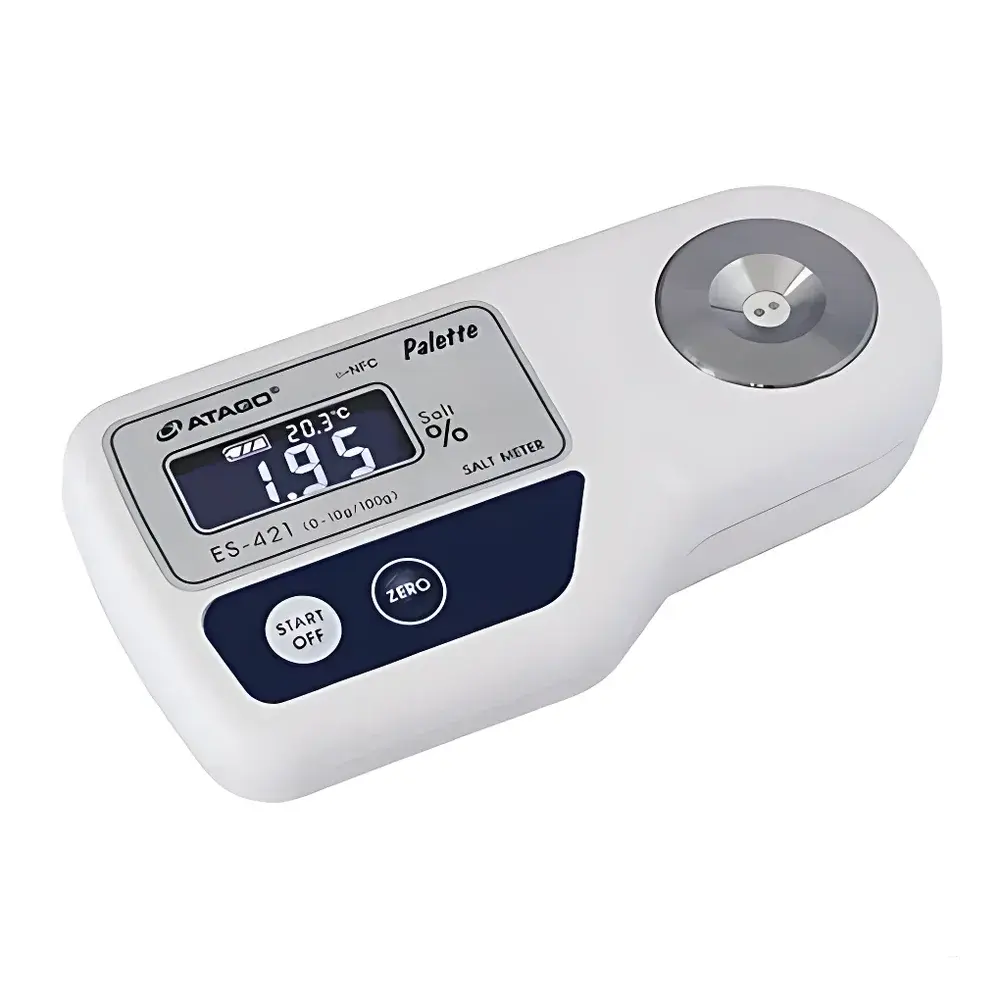
ATAGO ES-421 Digital Salinometer (Conductivity-Based)
| Brand | ATAGO |
|---|---|
| Origin | Japan |
| Model | ES-421 |
| Measurement Principle | Conductivity Method |
| Salt Concentration Range | 0.00–10.0% (g/100g) |
| Resolution | 0.01% (0.00–2.99%), 0.1% (3.0–10.0%) |
| Accuracy | ±0.05% (0.00–0.99%), ±5% relative (1.00–10.0%) |
| Automatic Temperature Compensation (ATC) | 10–40°C |
| Operating Ambient Temperature | 10–40°C |
| Power Supply | 9V alkaline battery (006P) |
| Dimensions & Weight | 17 × 9 × 4 cm, 220 g (instrument only) |
| Ingress Protection Rating | IP64 |
Overview
The ATAGO ES-421 Digital Salinometer is a compact, handheld conductivity-based instrument engineered for rapid, reagent-free quantification of salt concentration in liquid and semi-liquid food matrices. Unlike optical refractometers or titration-based methods, the ES-421 employs electrical conductivity measurement — a technique grounded in the linear correlation between ionic strength and conductance in aqueous sodium chloride solutions — to deliver direct % (w/w) salt readings calibrated against standardized NaCl reference solutions. Its design prioritizes operational robustness in high-humidity or splash-prone environments (IP64-rated enclosure), making it suitable for QC labs, production floors, and R&D kitchens where routine salt verification is critical for formulation consistency, regulatory compliance (e.g., FDA nutrition labeling, EU Regulation No. 1169/2011), and shelf-life optimization. The instrument does not require calibration fluids or consumables beyond standard NaCl reference standards; its ATC function ensures traceable results across ambient lab conditions (10–40°C), eliminating manual correction tables.
Key Features
- Conductivity-based measurement principle enabling direct % (g/100g) salt output without chemical reagents or titrants
- Optimized sample chamber with funnel-shaped prism slot accommodating viscous or particulate-laden samples (e.g., soy sauce, miso broth, brined vegetables, tomato paste dilutions)
- Low sample volume requirement (~10 mL), minimizing waste and enabling high-throughput screening
- Automatic temperature compensation (ATC) across 10–40°C, compliant with ISO 2173:2003 guidelines for temperature-dependent conductivity assays
- IP64-rated housing for dust resistance and protection against water splashes during routine handling
- Battery-powered operation (9V alkaline, 006P) ensuring portability and independence from mains supply — ideal for field use or mobile QA stations
- High-contrast LCD display with intuitive single-button interface; no software installation or PC dependency required
Sample Compatibility & Compliance
The ES-421 is validated for use with aqueous food extracts and diluted preparations where NaCl dominates ionic contribution. Typical applications include quality control of fermented condiments (soy sauce, fish sauce), cured meats, pickled vegetables, dairy-based dressings, and ready-to-eat meal sauces. While not intended for seawater or high-mineral groundwater analysis (where K⁺, Ca²⁺, and Mg²⁺ interfere), its calibration aligns with AOAC Official Method 971.25 for salt determination in processed foods. Instrument performance meets general requirements for laboratory-grade portable salinometers under ISO/IEC 17025:2017 — particularly regarding repeatability (RSD < 1.5% at 5.0% NaCl), stability over 8-hour shifts, and documented traceability to NIST-traceable NaCl reference materials.
Software & Data Management
The ES-421 operates as a standalone, firmware-controlled device with no embedded data logging or USB/Bluetooth connectivity. All measurements are displayed in real time and must be manually recorded. This architecture intentionally avoids electronic record requirements under FDA 21 CFR Part 11, simplifying audit readiness for facilities operating under GLP or GMP frameworks where paper-based logbooks remain standard practice. For laboratories requiring digital traceability, ATAGO recommends pairing the ES-421 with external LIMS-integrated barcode scanners or dedicated data capture tablets using standardized SOP templates aligned with ISO 15197:2013 documentation protocols.
Applications
- Routine verification of salt content in pre-blended seasoning powders prior to packaging
- In-process monitoring of brine concentration during vegetable fermentation (e.g., kimchi, sauerkraut)
- Final product release testing for compliance with national sodium labeling thresholds (e.g., WHO ≤2g Na/day guidance)
- Batch-to-batch consistency checks in sauce manufacturing (e.g., teriyaki, hoisin, Worcestershire)
- Raw material acceptance testing for salted fish, cheese curds, or cured pork belly
- Educational use in food science laboratories demonstrating fundamental principles of electrolytic conductivity and colligative properties
FAQ
Does the ES-421 require daily calibration?
No — calibration is performed only when initiating use, after battery replacement, or if measurement drift exceeds ±0.1% against a certified 5.0% NaCl reference standard.
Can it measure undiluted soy sauce directly?
Yes; the funnel-shaped sample chamber accommodates high-viscosity liquids without clogging, though users should rinse thoroughly with deionized water between samples to prevent cross-contamination.
Is the accuracy specification valid across the full 0.00–10.0% range?
Accuracy is specified as ±0.05% absolute for low-concentration ranges (0.00–0.99%) and ±5% relative error above 1.00%, consistent with IUPAC recommendations for conductivity-based salt analyzers in complex food matrices.
What maintenance is required beyond cleaning?
No scheduled maintenance is needed; periodic inspection of electrode contacts and battery compartment corrosion is recommended per ISO 13485:2016 preventive maintenance guidelines.
Is the IP64 rating sufficient for washdown environments?
IP64 protects against dust ingress and water splashes from any direction, but does not permit immersion or high-pressure cleaning — instruments used in wet processing zones should be housed in protective enclosures or wiped with damp cloths only.





