
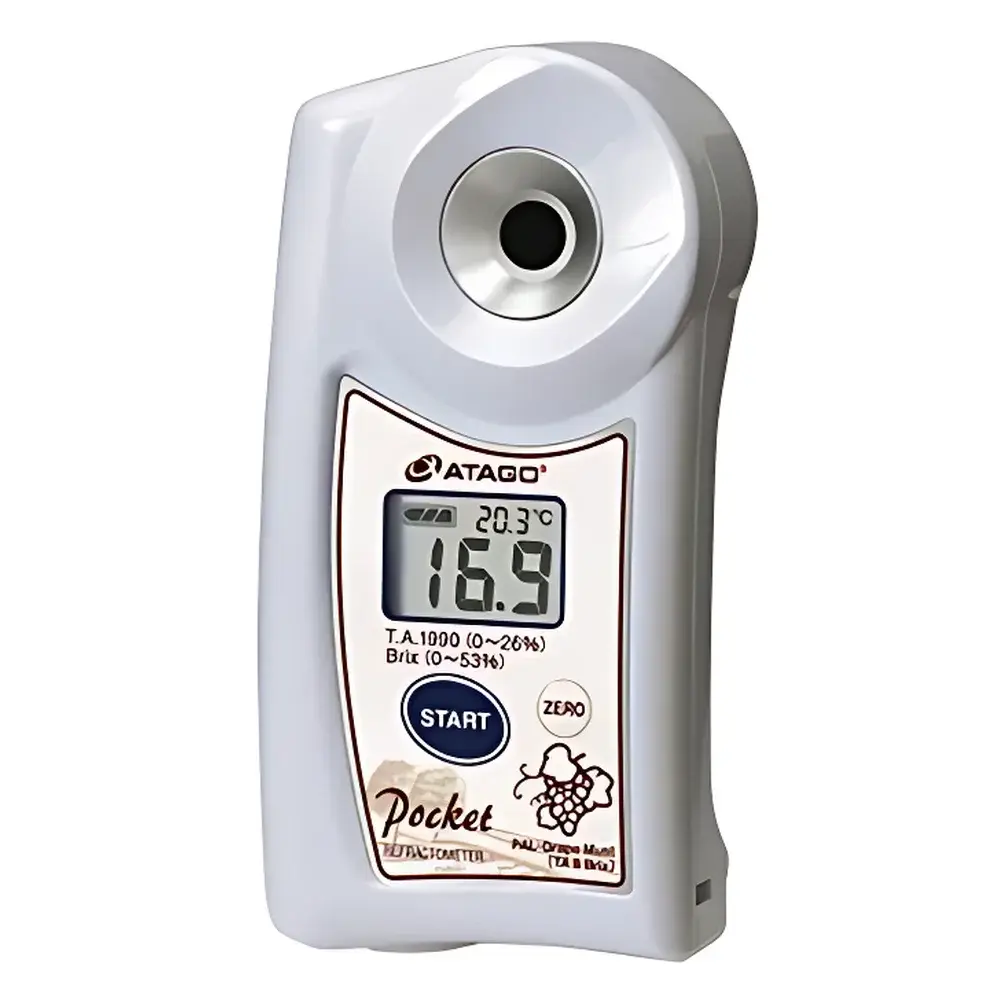
ATAGO PAL-Grape Must Digital Refractometer (Brix)
| Brand | ATAGO |
|---|---|
| Origin | Japan |
| Model | PAL-Grape Must (Brix) |
| Product Type | Handheld Digital Refractometer |
| Temperature Compensation | Automatic (ATC, 10–100°C) |
| Display | Digital LCD |
| Measurement Range | 0.0–33.0% Brix |
| Accuracy | ±0.2% Brix |
| Resolution | 0.1% Brix |
| Operating Ambient Temperature | 10–40°C |
| Power Supply | Two AAA batteries |
| IP Rating | IP65 |
| Dimensions | 5.5 × 3.1 × 10.9 cm |
| Weight | 100 g (instrument only) |
Overview
The ATAGO PAL-Grape Must Digital Refractometer is a precision handheld optical instrument engineered specifically for rapid, on-site measurement of soluble solids content—expressed as Brix (% w/w)—in grape must, freshly crushed grape juice, and other high-sugar fruit liquids. Based on the principle of critical-angle refractometry, the device determines Brix by measuring the refractive index of a small sample (typically 0.3 mL) placed on the sapphire prism surface. Light refraction at the prism-sample interface is converted into a digital Brix reading via embedded optics and temperature-compensated algorithms. Unlike generic refractometers, the PAL-Grape Must incorporates ATAGO’s proprietary Grape-Specific ATC (Automatic Temperature Compensation) curve, calibrated to match the density–refractive index relationship of grape-derived must across 10–100°C. This ensures metrological traceability and minimizes systematic deviation when measuring warm or chilled must directly from press or fermentation tank—critical during harvest decision-making and juice procurement.
Key Features
- Grape-optimized ATC algorithm: Compensates for temperature-induced refractive index shifts using a grape-must-specific calibration profile—not generic sucrose-based curves.
- High-precision sapphire prism: Chemically inert, scratch-resistant, and thermally stable for consistent optical performance under field or winery conditions.
- IP65-rated enclosure: Dust-tight and protected against low-pressure water jets—enabling reliable use in humid cellars, outdoor vineyards, and wet processing areas.
- One-touch measurement: Sample application, auto-zeroing, and result display completed in <3 seconds; no manual scale reading or external light source required.
- Low-power design: Operates continuously for up to 10,000 measurements on two standard AAA batteries; auto-power-off after 3 minutes of inactivity.
- Ergonomic form factor: Compact dimensions (5.5 × 3.1 × 10.9 cm) and 100 g weight enable single-hand operation during prolonged field sampling.
Sample Compatibility & Compliance
The PAL-Grape Must is validated for direct measurement of unfiltered grape must—including varieties with high pulp content, skin fragments, or suspended solids—without centrifugation or filtration. Its optical system tolerates moderate turbidity due to optimized LED wavelength (589 nm) and prism geometry. The instrument complies with ISO 2173:2003 (fruit and vegetable products — determination of soluble solids content — refractometric method) and supports GLP-aligned documentation workflows when paired with ATAGO’s optional data logging accessories. While not FDA 21 CFR Part 11 certified as a standalone unit, its measurement repeatability (≤±0.1% Brix intra-unit, ≤±0.2% Brix inter-unit per ATAGO factory calibration report) meets routine QC requirements for grape maturity assessment in commercial viticulture and juice sourcing operations.
Software & Data Management
The PAL-Grape Must operates as a stand-alone instrument with no onboard memory or Bluetooth connectivity. However, it is fully compatible with ATAGO’s PAL-Log software (Windows/macOS) when used with the optional RS-232 interface cable (Model: PAL-CABLE). This enables timestamped batch export of measurement records—including Brix value, ambient temperature, and operator ID—for integration into LIMS or Excel-based harvest tracking systems. Calibration verification logs (per ISO/IEC 17025 traceable standards) can be generated and archived to satisfy internal audit requirements. Firmware updates are performed via PC connection, ensuring long-term alignment with evolving industry reference methods.
Applications
- Vineyard harvest timing: Real-time Brix monitoring to determine optimal picking windows based on varietal-specific maturity thresholds (e.g., 22–26% Brix for red wine grapes; 18–20% for early-harvest white must).
- Juice procurement QA: Rapid screening of incoming grape lots at crushing facilities to enforce contractual sugar specifications before payment or processing.
- Ice wine production: Critical assessment of frozen must concentration prior to pressing—where Brix values >32% indicate sufficient cryo-concentration for premium ice wine designation.
- Fermentation management: Tracking initial must sugar load to estimate potential alcohol yield (using standard conversion: 1° Brix ≈ 0.55% v/v ethanol at full fermentation).
- Research & extension services: Field-deployable tool for viticultural trials evaluating rootstock/scion effects on sugar accumulation kinetics.
FAQ
Does the PAL-Grape Must require recalibration before each use?
No—factory calibration is stable for 12 months under normal operating conditions. Users should verify calibration daily using ATAGO-certified 10.00% and 25.00% Brix standard solutions.
Can it measure frozen must directly?
Yes—its extended ATC range (10–100°C) accommodates samples thawed to ≥10°C. For true ice wine must, allow partial thawing until liquid phase dominates; avoid measuring solid ice.
Is cleaning the prism necessary between samples?
Yes—residual must contains organic acids and sugars that crystallize upon drying. Wipe gently with lens tissue and distilled water after each measurement.
How does its accuracy compare to laboratory Abbe refractometers?
While lab-grade Abbe instruments offer marginally higher resolution (±0.05% Brix), the PAL-Grape Must delivers equivalent functional accuracy for field decisions where ±0.2% Brix meets OIV and regional wine authority tolerances.
Does it meet regulatory requirements for certified wine labeling?
It provides legally defensible Brix data for internal process control and contract enforcement. For official appellation certification, refer to jurisdiction-specific protocols (e.g., EU Regulation No 1308/2013 Annex VII, Part II).





