
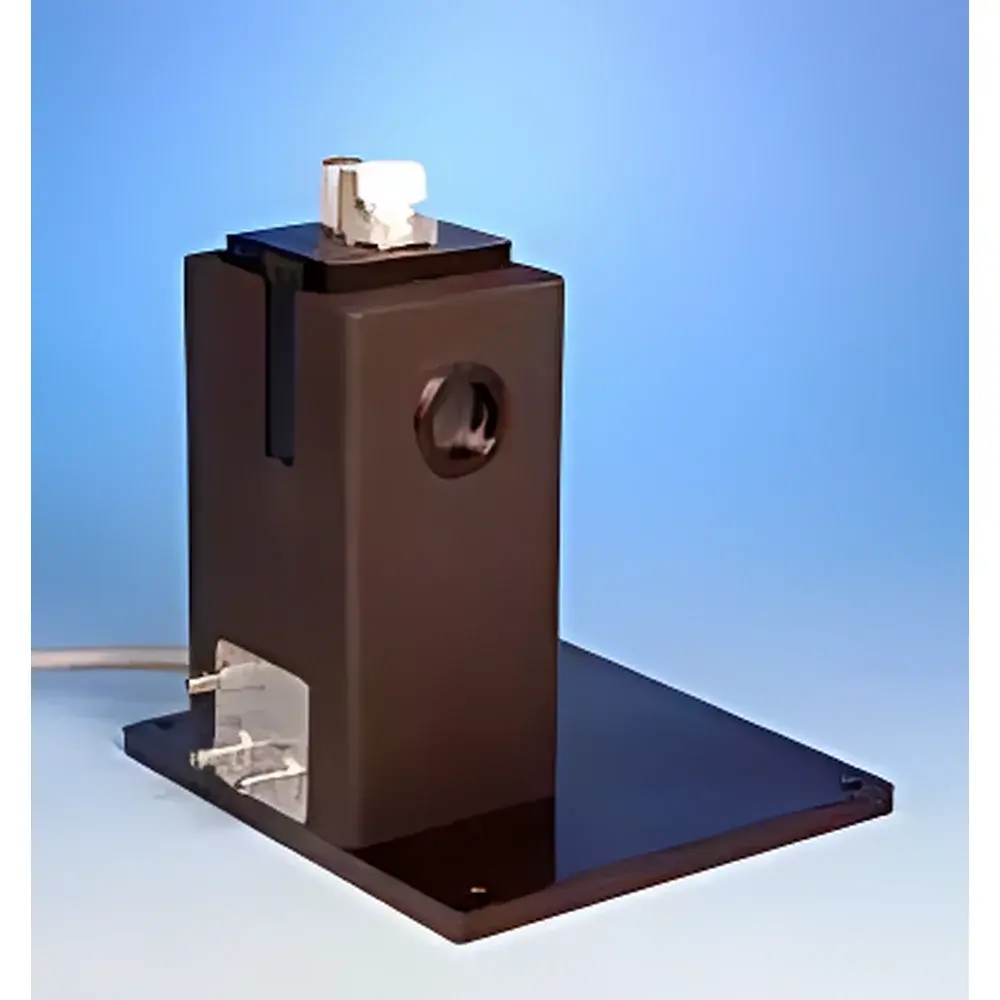
Quantum Northwest CD250 Precision Temperature-Controlled Cuvette Holder
| Brand | Quantum Northwest |
|---|---|
| Origin | South Korea |
| Model | CD250 Cuvette Holder |
| Temperature Range | −10.00 to +105.00 °C (±0.02 °C accuracy) |
| Extended Range Option | −55.00 to +150.00 °C |
| Control Method | Peltier-based thermoelectric control |
| Temperature Monitoring | Integrated Pt100 or thermistor sensor |
| Sample Agitation | Magnetic stirring with adjustable speed |
| Optical Window | Stress-free fused silica |
| Compatibility | UV-Vis, Fluorescence, CD, Raman, NIR, Transient Absorption, Fiber-optic, Circular Dichroism, and Neutron Scattering spectrometers |
| Compliance | Designed for GLP/GMP-aligned lab environments |
Overview
The Quantum Northwest CD250 Precision Temperature-Controlled Cuvette Holder is an engineered optical component designed for high-fidelity thermal regulation of spectroscopic samples in demanding research and quality control applications. Built upon a solid-state Peltier thermoelectric architecture, the CD250 delivers rapid, bidirectional temperature control across a standard range of −10.00 °C to +105.00 °C with exceptional stability (±0.02 °C) and minimal thermal gradient across the sample volume. Its core function is to maintain precise, reproducible thermal conditions during optical measurements—critical for studies where spectral shifts, conformational transitions, or kinetic behavior are temperature-dependent. The device is not a standalone instrument but a modular, application-integrated subsystem, intended for seamless integration into UV-Vis absorption, fluorescence emission, circular dichroism (CD), transient absorption, Raman scattering, near-infrared (NIR), and fiber-coupled spectroscopy platforms. Its mechanical design accommodates standardized cuvette geometries while preserving optical access along orthogonal axes—enabling simultaneous excitation and detection paths without beam obstruction.
Key Features
- Peltier-driven thermoelectric control enables fast heating and cooling rates (typical <60 s to stabilize ±0.05 °C within 2 °C of setpoint), minimizing experiment downtime.
- High-resolution temperature monitoring via integrated calibrated thermistor or Pt100 sensor, providing real-time feedback with traceable NIST-traceable calibration options.
- Programmable magnetic stirrer (0–1200 rpm, adjustable) ensures homogeneous thermal distribution and mitigates convective stratification—especially essential for viscous or low-conductivity samples.
- Stress-free fused silica optical windows minimize birefringence and wavefront distortion, supporting polarized-light techniques including CD and Mueller matrix spectroscopy.
- Dual-port optical access: primary cuvette path aligned with spectrometer beam axis; secondary 90° port optimized for right-angle fluorescence detection or auxiliary probe beams.
- Modular mounting interface compatible with standard optical breadboards (M4/M6 tapped holes) and common spectrometer sample compartments (e.g., JASCO, Olis, Aviv, Applied Photophysics).
Sample Compatibility & Compliance
The CD250 supports standard rectangular cuvettes (10 mm pathlength, 3.5–5.0 mL volume) and optional custom inserts for micro-volume cells (down to 50 µL), capillary cells, or flow-through configurations. It is routinely deployed in laboratories adhering to ISO/IEC 17025, ASTM E2877 (for temperature-controlled spectroscopy), and USP (spectrophotometric system suitability). When paired with Quantum Northwest’s QCLab software or third-party LabVIEW/Python APIs, temperature profiles—including ramp, hold, and step sequences—can be logged with time-stamped metadata, fulfilling FDA 21 CFR Part 11 requirements for electronic records and signatures. All units undergo factory thermal mapping and long-term drift validation (≤0.01 °C/h at 25 °C ambient) prior to shipment.
Software & Data Management
The CD250 operates via RS-232 or USB virtual COM port, enabling direct integration with spectrometer control suites (e.g., OceanInsight OceanView, Thorlabs ThorImage, or custom MATLAB/Python acquisition scripts). Quantum Northwest provides open-command-set documentation and Python SDK examples for automated temperature scripting—including synchronized acquisition triggers for kinetic experiments. Temperature history is recorded at user-defined intervals (100 ms to 10 s resolution) and exported in CSV or HDF5 format. Optional firmware upgrades support TTL-triggered temperature jumps synchronized to laser pulses or detector gate signals—essential for pump-probe transient absorption workflows.
Applications
- Circular dichroism (CD) studies of protein folding/unfolding thermodynamics and ligand-binding enthalpy determination.
- Temperature-dependent fluorescence quantum yield and lifetime analysis in molecular probes and quantum dots.
- Thermal stability screening of biopharmaceuticals (monoclonal antibodies, mRNA-LNPs) using UV-Vis thermal melt assays.
- In situ monitoring of polymer phase transitions (LCST/UCST) via NIR absorbance shifts.
- Raman band intensity ratio analysis (e.g., ν(C≡C)/ν(C=C)) as a function of temperature in catalytic intermediates.
- Calibration reference for temperature-sensitive photodetectors and radiometric standards.
FAQ
What cuvette sizes does the CD250 support natively?
Standard configuration accepts 10 × 10 × 45 mm quartz or fused silica cuvettes; optional inserts accommodate 1 × 1 cm, 2 × 2 cm, and micro-volume (100 µL) cells.
Can the CD250 be used under vacuum or inert gas purge?
Yes—the housing includes sealed gas inlet/outlet ports (¼”-28 UNF) for controlled atmosphere operation; optional O-ring-sealed lid kits are available.
Is the magnetic stirrer compatible with all solvent types?
Stir bars are chemically inert PTFE-coated; stainless steel cores are omitted for corrosive or reducing environments—custom ceramic or glass-coated stir elements can be specified.
Does the CD250 require external chiller or coolant circulation?
No—fully self-contained Peltier operation requires only 24 V DC power (5 A max); passive heatsinking suffices for ≤+60 °C operation; active air or water cooling is recommended above that threshold.
How is temperature uniformity verified across the sample volume?
Each unit undergoes spatial thermal profiling using calibrated micro-thermocouples at ≥9 points within the cuvette chamber; full validation report is supplied with every system.





