
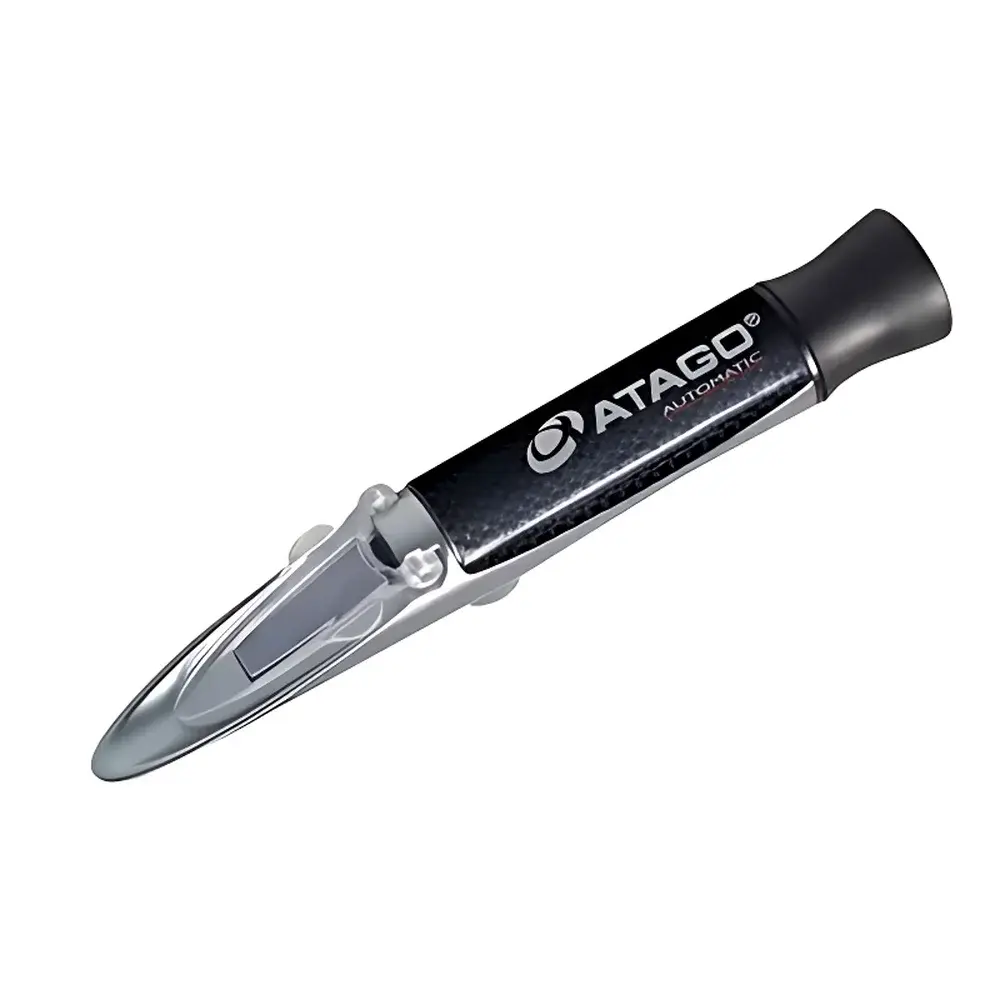
ATAGO MASTER-20T Automatic Temperature Compensation (ATC) Handheld Analog Refractometer
| Brand | ATAGO |
|---|---|
| Origin | Japan |
| Model | MASTER-20T (ATC) |
| Type | Analog Handheld Refractometer |
| Temperature Compensation | Automatic (ATC) |
| Display | Analog scale (no digital readout) |
| Measurement Range | 0.0–20.0% Brix |
| Scale Division | 0.1% Brix |
| Accuracy | ±0.2% Brix (10–30°C) |
| Repeatability | ±0.1% Brix |
| Dimensions | 3.2 × 3.4 × 20.7 cm |
| Weight | 165 g |
| Prism Housing Material | Metal |
| Compliance | Designed per JIS Z 8806 and ISO 2173 for refractometric determination of soluble solids in beverages and food extracts |
Overview
The ATAGO MASTER-20T is a precision analog handheld refractometer engineered for rapid, field-deployable measurement of soluble solids concentration—expressed as Brix (% w/w)—in low-concentration aqueous solutions. Based on the optical principle of critical angle refraction, the instrument determines refractive index changes induced by dissolved solutes (primarily sucrose in calibration) and converts them to Brix values via a fixed, temperature-compensated optical scale. Unlike digital instruments relying on photodiode arrays and microprocessor interpolation, the MASTER-20T employs a robust Abbe-type prism assembly with high-transmittance optical glass and a precisely engraved Brix scale, delivering direct visual readout without power dependency or software latency. Its Automatic Temperature Compensation (ATC) mechanism—integrated via bimetallic thermal expansion elements—physically adjusts the optical path length in real time across 10–30°C ambient range, minimizing manual correction and ensuring metrological consistency under typical laboratory, production line, or on-site quality control conditions.
Key Features
- Metal-bodied construction (aluminum alloy housing) for enhanced mechanical durability and thermal stability compared to resin-based variants—ideal for repeated use in controlled environments where chemical resistance is secondary to dimensional integrity.
- True analog optical scale with 0.1% Brix minimum division and parallax-free viewing through integrated eyepiece optics—eliminates battery dependency and firmware-related drift.
- ATC system calibrated to match the temperature coefficient of sucrose solutions (−0.00015/°C), compliant with ISO 2173 Annex A requirements for temperature-corrected Brix reporting.
- Compact ergonomic form factor (3.2 × 3.4 × 20.7 cm; 165 g) optimized for one-handed operation and extended field use without fatigue.
- Pre-aligned collimated light path and high-quality BK7 prism ensure long-term optical alignment stability—no routine recalibration required beyond periodic verification with certified sucrose standards.
Sample Compatibility & Compliance
The MASTER-20T is validated for aqueous samples with low to moderate viscosity and minimal suspended solids—including fruit juices, soft drinks (e.g., cola, lemonade), syrups, flavored waters, and dairy-based dilutions. It is not intended for highly acidic (pH 5% NaCl), or viscous (>100 mPa·s) matrices, where aggressive corrosion or incomplete prism surface wetting may compromise accuracy and longevity. For such applications, ATAGO recommends the resin-housed MASTER-20PT variant (RE-2992). The instrument conforms to JIS Z 8806:2021 (“Refractometers — General requirements”) and supports traceability under ISO/IEC 17025-accredited calibration protocols when used with NIST-traceable sucrose reference standards (e.g., RE-110010, ±0.03% Brix; RE-110020, ±0.03% Brix). Its mechanical design meets GLP documentation requirements for manual instruments: no electronic audit trail is required, but user logs must record standard verification, environmental temperature, and operator ID per test batch.
Software & Data Management
As a fully analog optical instrument, the MASTER-20T does not incorporate embedded electronics, firmware, or data output interfaces. Consequently, it requires no software installation, driver configuration, or cybersecurity validation. All measurements are recorded manually in laboratory notebooks or LIMS-compatible spreadsheets. This architecture inherently satisfies FDA 21 CFR Part 11 “electronic records and signatures” exemptions for non-computerized systems—eliminating validation overhead for regulated QC environments. Optional accessories—including extractor tools (RE-29401), precision prism covers for micro-volume application (RE-2311-58M, RE-2391-50M), and dedicated daylight plates (RE-2315-60M/61M)—are documented in ATAGO’s official accessory catalog and carry individual part numbers for procurement traceability.
Applications
- Routine Brix verification of incoming juice concentrates prior to blending or pasteurization.
- In-line quality checks during beverage formulation and carbonation stages.
- Field-based ripeness assessment of harvested fruits using expressed juice.
- Educational demonstrations of refractive index principles in food science curricula.
- Supplier qualification audits where instrument simplicity, portability, and regulatory transparency are prioritized over automated data capture.
FAQ
Does the MASTER-20T require batteries or charging?
No—it is a purely optical, analog instrument with zero electronic components.
Can it measure samples below 0.0% Brix or above 20.0% Brix?
No—the scale is physically limited to 0.0–20.0% Brix; readings outside this range are optically indeterminate.
How often should I verify calibration?
Daily verification is recommended before first use using certified 10% or 20% sucrose standards (RE-110010/RE-110020) under ambient lab conditions.
Is the metal body resistant to citric acid or phosphoric acid commonly found in soft drinks?
The aluminum housing provides adequate short-term exposure resistance; however, prolonged contact with low-pH liquids necessitates immediate rinsing with deionized water to prevent surface oxidation.
What distinguishes MASTER-20T from MASTER-20PT?
MASTER-20T uses a metal housing for rigidity and thermal mass; MASTER-20PT uses chemically resistant polypropylene—preferred for high-acid or saline samples.




