
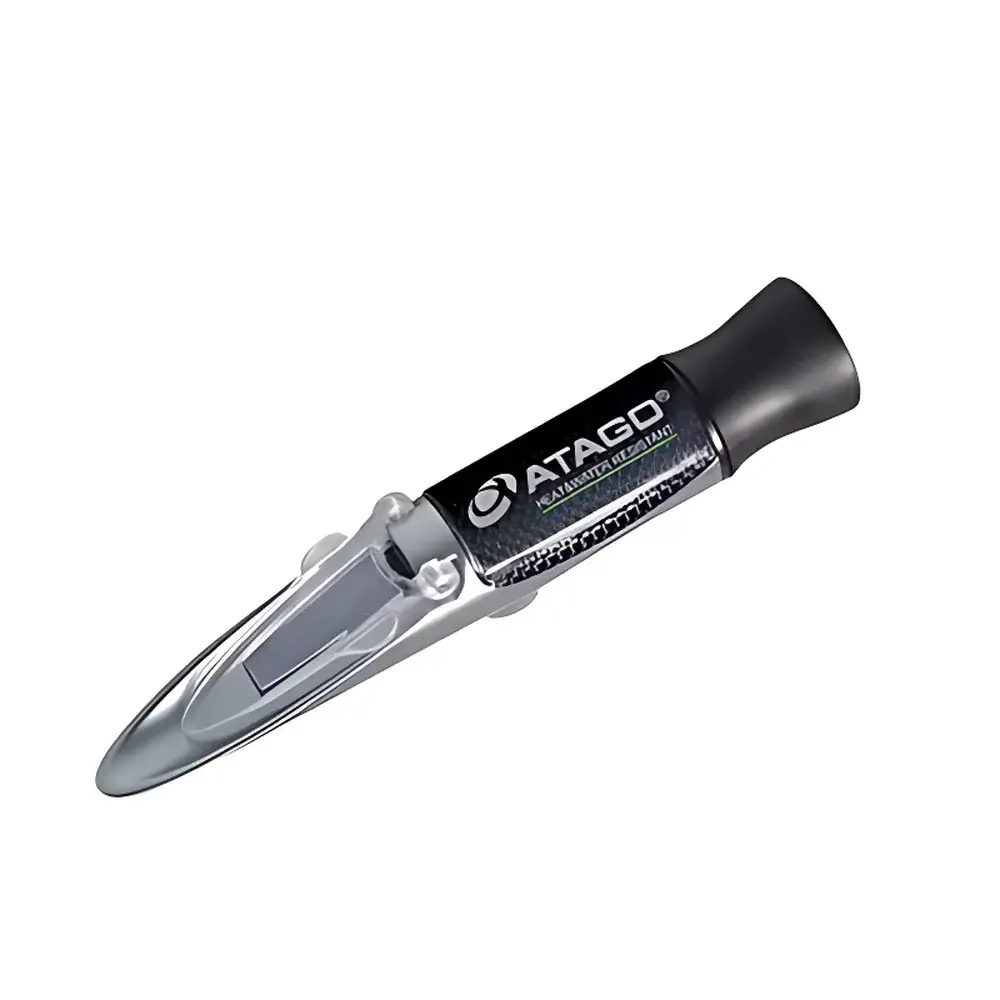
Atago MASTER-50H Handheld Digital Refractometer with Automatic Temperature Compensation
| Origin | Japan |
|---|---|
| Manufacturer Type | Authorized Distributor |
| Origin Category | Imported |
| Model | MASTER-50H |
| Product Type | Handheld Refractometer |
| Temperature Control | Built-in ATC (Automatic Temperature Compensation) |
| Display | Digital LCD |
| Measurement Range | Brix 0.0–50.0% |
| Accuracy | ±0.5% Brix |
| Repeatability | ±0.25% Brix |
| Dimensions | 3.2 × 3.4 × 16.8 cm |
| Weight | 130 g |
| IP Rating | IP65 (excluding eyepiece) |
| Prism Material | Reinforced optical glass |
Overview
The Atago MASTER-50H Handheld Digital Refractometer is a precision optical instrument engineered for rapid, field-deployable Brix concentration measurement in high-temperature and viscous food process environments—particularly optimized for real-time monitoring of chocolate, caramel, syrup, and confectionery melts during thermal processing. It operates on the fundamental principle of total internal reflection: light passing through a prism-sample interface undergoes refraction proportional to the sample’s refractive index, which correlates directly with dissolved solids concentration (expressed as % Brix). The integrated Automatic Temperature Compensation (ATC) system—calibrated to the standard sucrose/water reference curve per ISO 2173 and AOAC 932.12—ensures measurement stability across 10–50 °C without external thermostating. Its reinforced optical prism and sealed, IP65-rated housing (excluding the eyepiece) provide mechanical durability and resistance to steam, splashing water, and particulate ingress—critical for hygiene-sensitive production floors and R&D kitchens.
Key Features
- Reinforced optical prism designed for sustained exposure to elevated temperatures (up to 80 °C surface contact), minimizing thermal drift during hot-sample measurement
- Digital LCD display with backlight for clear readability under variable lighting conditions—including low-light factory or lab settings
- True ATC functionality compliant with ISO 2173:2003 Annex A, eliminating manual correction tables and reducing operator dependency
- Compact ergonomic form factor (130 g) with balanced weight distribution for one-handed operation during extended shifts
- IP65-rated body (excluding optical eyepiece) ensures protection against dust and low-pressure water jets—meeting basic hygiene requirements for food-grade environments
- Minimal sample requirement (0.3 mL) and rapid thermal equilibration (<3 seconds) support high-throughput QC checks on production lines
Sample Compatibility & Compliance
The MASTER-50H is validated for aqueous sucrose solutions and widely applicable to chocolate mass, cocoa liquor, sugar syrups, fruit concentrates, and dairy-based confections—provided samples are homogeneous, non-turbid, and free of suspended solids that scatter incident light. It is not suitable for opaque, highly viscous, or emulsified matrices without prior dilution or filtration. Calibration verification is supported by NIST-traceable sucrose standards (RE-110010 to RE-110050), each certified to ±0.03–0.05% Brix uncertainty. The instrument complies with ISO 2173 (fruit juice and related products), AOAC Official Method 932.12 (refractometric determination of soluble solids), and supports GLP documentation when paired with Atago’s optional data logging accessories. While not FDA 21 CFR Part 11–compliant as a standalone device, its measurement records can be manually transcribed into auditable QC logs meeting GMP traceability requirements.
Software & Data Management
The MASTER-50H operates as a self-contained analog-to-digital measurement system with no embedded firmware, Bluetooth, or USB connectivity. All readings are displayed and retained only on the LCD screen until the next measurement cycle. For regulated environments requiring electronic record retention, users may integrate the device with third-party digital loggers via optional analog output adapters (sold separately). Atago provides calibration certificate templates and SOP frameworks aligned with ISO/IEC 17025 laboratory accreditation guidelines. Traceable calibration using supplied sucrose standards enables internal verification intervals per ASTM E1254 and supports audit readiness for BRCGS Food Safety Issue 9 and IFS Food v7.
Applications
- Real-time Brix verification during chocolate tempering, conching, and batch blending to ensure consistent viscosity and crystallization behavior
- In-process monitoring of sugar syrup concentration in caramel and fondant production to prevent over-boiling or under-concentration
- QC release testing of cocoa paste and milk chocolate formulations prior to molding or enrobing
- R&D formulation development where rapid iteration requires immediate feedback on sugar-to-fat ratio impact on refractive index
- Supplier qualification of incoming raw materials such as invert sugar, glucose syrup, and concentrated fruit purees
- Training and education in food science laboratories for foundational principles of optical density and solution thermodynamics
FAQ
Does the MASTER-50H require periodic recalibration?
Yes—daily verification with a certified sucrose standard (e.g., RE-110020) is recommended before first use and after significant ambient temperature shifts. Full recalibration by an authorized Atago service center is advised annually or after physical impact.
Can it measure non-sucrose-based solutions like fructose or HFCS?
It provides Brix values only; conversion to true dry matter or specific sugar concentration requires empirical correlation curves due to differing refractive indices. Use only for comparative process control unless validated against HPLC or enzymatic assay.
Is the prism resistant to chocolate residue buildup?
The reinforced prism surface resists scratching and thermal shock but requires cleaning with lint-free tissue and distilled water after each use—never abrasive solvents or paper towels, which may micro-scratch the optical surface.
What does IP65 rating mean for daily use in a chocolate production line?
It certifies full dust-tightness and protection against water projected from a 6.3 mm nozzle at 12.5 L/min from any direction—sufficient for washdown zones excluding direct high-pressure spray on the eyepiece.
How does ATC function without a temperature sensor visible on the unit?
A bimetallic thermal element embedded adjacent to the prism expands/contracts with sample temperature, mechanically adjusting the optical path length to offset refractive index drift—no batteries or electronics required.




