
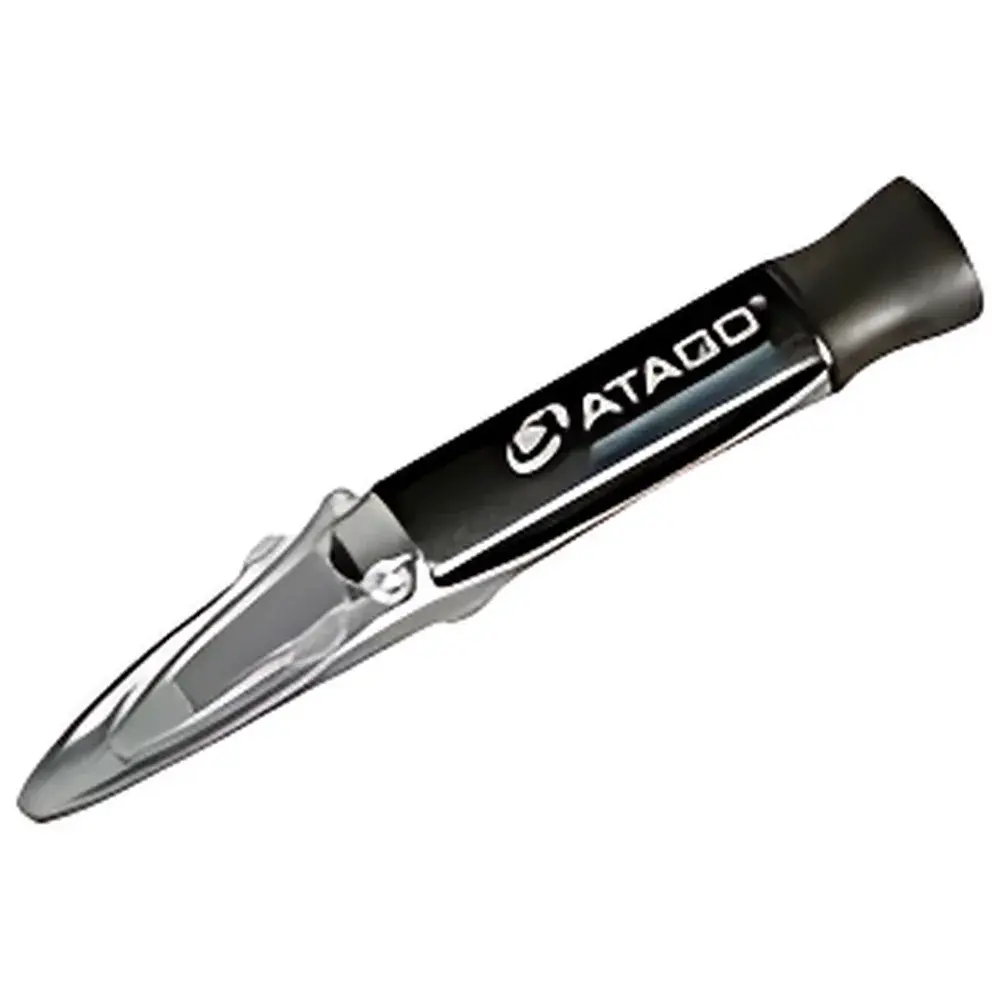
ATAGO MASTER-53α Analog Handheld Refractometer
| Brand | ATAGO |
|---|---|
| Origin | Japan |
| Model | MASTER-53α |
| Type | Analog Handheld Refractometer |
| Measurement Range | 0.0–53.0% Brix |
| Accuracy | ±0.2% Brix |
| Temperature Compensation | Automatic (ATC) |
| Waterproof Rating | IP65 |
| Display | Etched Glass Scale with Magnifier |
| Calibration | Single-point using distilled water or standard sucrose solution |
| Compliance | ISO 2173, AOAC 932.12, ASTM D1074 |
Overview
The ATAGO MASTER-53α is a precision analog handheld refractometer engineered for rapid, field-deployable measurement of soluble solids concentration expressed as % Brix in aqueous solutions. Based on the fundamental optical principle of total internal reflection, the instrument determines refractive index by measuring the critical angle at the prism-sample interface. Light passes through a high-grade optical glass prism; when a liquid sample is applied, its refractive index alters the boundary between light transmission and cutoff, producing a sharp shadow line visible through the eyepiece. This line aligns with an etched Brix scale calibrated to the sucrose/water standard at 20 °C. The MASTER-53α incorporates ATAGO’s proprietary Automatic Temperature Compensation (ATC) system, utilizing a bimetallic strip mechanism that dynamically adjusts the optical path length in response to ambient temperature fluctuations (10–30 °C), ensuring stable readings without manual correction or external thermometry.
Key Features
- Optical-grade BK7 prism with anti-scratch coating for long-term stability and resistance to chemical exposure
- High-contrast black-on-white engraved scale with integrated magnifier lens for precise visual interpolation to 0.1% Brix
- Robust aluminum alloy housing rated IP65 for dust-tight and low-pressure water jet resistance—suitable for production floors, orchards, and food processing lines
- No battery or electronics required: fully mechanical operation ensures zero downtime, no firmware updates, and intrinsic compliance with explosion-proof environments
- ATC mechanism compliant with ISO 2173 Annex A requirements for temperature-induced refractive index correction in sucrose solutions
- Ergonomic, non-slip grip design optimized for single-hand operation during repetitive sampling
Sample Compatibility & Compliance
The MASTER-53α is validated for use with homogeneous, non-viscous, transparent aqueous solutions containing dissolved sugars (e.g., sucrose, glucose, fructose) and other soluble solids such as organic acids, salts, and alcohols within typical food and beverage matrices. It is routinely employed in QC labs and process lines adhering to HACCP, GMP, and ISO 22000 frameworks. While not intended for turbid, highly viscous, or strongly colored samples (which may scatter light and obscure the shadow line), it meets the performance criteria outlined in AOAC Official Method 932.12 for fruit juice and soft drink analysis. Calibration verification follows ASTM D1074 protocols using NIST-traceable sucrose reference standards. Device documentation supports GLP audit trails when paired with lab-controlled calibration logs and operator sign-off records.
Software & Data Management
As a purely analog optical instrument, the MASTER-53α does not incorporate digital interfaces, data logging, or software connectivity. All measurements are visually interpreted and manually recorded—ensuring full traceability under FDA 21 CFR Part 11 Subpart B §11.10(a) for systems where electronic records are not generated. This architecture eliminates cybersecurity vulnerabilities, firmware obsolescence risks, and validation overhead associated with digital instrumentation. For laboratories requiring digital archiving, users integrate the device into existing LIMS workflows via manual entry or barcode-assisted logging using standardized SOPs aligned with ISO/IEC 17025 Clause 7.7 on result reporting.
Applications
- Fruit and vegetable harvesting: real-time Brix assessment in orchards and greenhouses to determine optimal harvest timing
- Juice and syrup production: inline verification of concentrate strength prior to pasteurization and packaging
- Beverage formulation: consistency checks during blending of soft drinks, sports drinks, and flavored waters
- Honey grading: preliminary screening for moisture content estimation (in conjunction with dedicated honey refractometers)
- Academic teaching labs: hands-on demonstration of optical physics principles including Snell’s law, dispersion, and temperature-dependent refractive behavior
- QC in small-scale food manufacturing: cost-effective verification of incoming raw material specifications (e.g., invert sugar syrups, malt extracts)
FAQ
Does the MASTER-53α require battery power or charging?
No—it operates entirely optically and mechanically with no electrical components.
Can it measure non-sugar solutions such as saltwater or ethylene glycol?
It provides only Brix-scaled readings; quantitative conversion to other solutes requires empirical correlation curves and is outside the scope of ISO 2173 calibration.
How often should I calibrate the instrument?
Calibrate before each shift or after every 10 measurements using distilled water at ambient temperature; verify with a certified 10.0% Brix standard if used for regulatory reporting.
Is the prism surface resistant to acidic or alkaline samples?
Yes—the BK7 glass prism is chemically inert to pH 3–11 solutions; rinse immediately after contact with strong oxidizers (e.g., bleach) or organic solvents.
What is the minimum sample volume required?
Approximately 0.3 mL is sufficient to cover the prism surface uniformly without overflow into the hinge mechanism.






