
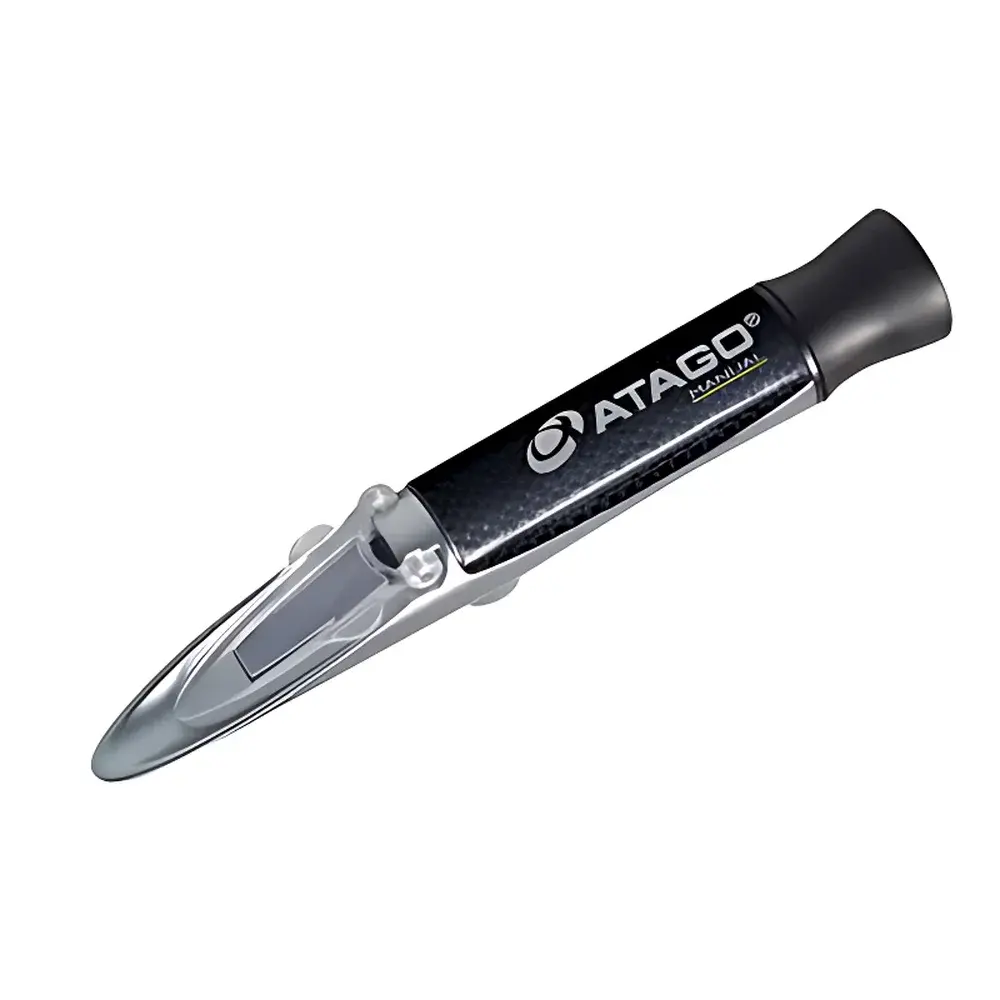
ATAGO MASTER-53M Analog Brix Refractometer
| Brand | ATAGO |
|---|---|
| Origin | Japan |
| Model | MASTER-53M |
| Product Type | Handheld Analog Refractometer |
| Temperature Compensation | Manual (No ATC) |
| Display Type | Scale-Reading (Optical Eyepiece) |
| Measurement Range | 0.0–53.0% Brix |
| Accuracy | ±0.2% Brix at 20°C |
| Resolution | 0.2% Brix |
| Repeatability | ±0.1% Brix |
| Prism Cover | RE-2311-67M (Micro-sample) |
| Daylight Plate | RE-2315-60M |
| Dimensions | 3.2 × 3.4 × 16.8 cm |
| Weight | 130 g |
| Housing Material | Metal |
Overview
The ATAGO MASTER-53M is a precision-engineered analog handheld refractometer designed for rapid, field-deployable Brix concentration measurements in liquid samples. It operates on the fundamental optical principle of total internal reflection: light passing through a prism-sample interface undergoes refraction proportional to the sample’s solute concentration, which alters its refractive index. This change is translated into a calibrated Brix scale reading visible through the eyepiece. Unlike digital or temperature-compensated models, the MASTER-53M relies on manual temperature control and user interpretation of the shadow line against a fixed optical scale—making it ideal for routine quality checks where robustness, portability, and zero power dependency are critical. Its 0.0–53.0% Brix range supports applications from fruit juice and syrup production to industrial cleaning solutions and fermentation monitoring. The instrument is optimized for use at 20°C; deviation from this reference temperature requires correction using standard Brix/temperature conversion tables per ISO 2173 and AOAC 932.12.
Key Features
- Metal-body construction ensures mechanical durability and thermal stability during repeated field handling.
- High-contrast optical scale with 0.2% Brix resolution enables reliable visual interpolation between刻度 marks.
- Integrated daylight plate (RE-2315-60M) maximizes ambient light utilization—no external illumination required.
- Micro-sample prism cover (RE-2311-67M) reduces sample volume to ≤0.3 mL, minimizing waste and contamination risk.
- No batteries or electronics: fully operational in remote locations, cleanrooms, or hazardous environments where electromagnetic interference must be avoided.
- Calibration performed with distilled water at 20°C; verification traceable to NIST-traceable sucrose standards.
Sample Compatibility & Compliance
The MASTER-53M is compatible with aqueous solutions containing sugars, salts, organic acids, and glycols—provided they do not corrode optical glass or aluminum alloy components. For highly acidic (pH 15% NaCl) samples, ATAGO recommends the resin-bodied MASTER-53PM variant to prevent long-term degradation. The instrument complies with general laboratory safety requirements per IEC 61010-1 and meets optical performance criteria outlined in ISO 5725 (accuracy and repeatability). While not equipped with automatic temperature compensation (ATC), its ±0.1% Brix repeatability under controlled conditions satisfies routine QC thresholds defined in USP for non-sterile liquid preparations and ASTM D1078 for industrial glycol testing.
Software & Data Management
As an analog optical instrument, the MASTER-53M does not incorporate embedded firmware, connectivity interfaces, or digital data output. All measurements are manually recorded, supporting paper-based GLP documentation workflows. Users may integrate readings into LIMS or Excel-based tracking systems via manual entry. For laboratories requiring audit trails, the device supports calibration log maintenance per FDA 21 CFR Part 11 guidelines when paired with controlled procedural documentation—including operator ID, date/time stamp, reference standard lot number, and environmental temperature recording.
Applications
- Fruit processing: Rapid Brix screening of raw juice, concentrates, and finished beverages pre-bottling.
- Food service: On-site verification of syrup dilution ratios in coffee shops and soft-drink dispensing systems.
- Agriculture: Field assessment of sugar content in harvested grapes, citrus, and melons for harvest timing decisions.
- Chemical manufacturing: Monitoring glycol concentration in heat-transfer fluids and antifreeze blends.
- Education: Teaching core principles of refractometry, Snell’s law, and solution thermodynamics in undergraduate physics and food science labs.
- Pharmaceutical excipient QC: Semi-quantitative verification of sucrose or dextrose concentrations in oral solutions.
FAQ
Does the MASTER-53M have automatic temperature compensation (ATC)?
No. It requires measurement at 20°C or application of published temperature correction factors.
Can I measure viscous or suspended samples?
Only clear, particle-free liquids yield accurate readings; centrifugation or filtration is recommended prior to analysis.
What is the minimum sample volume required?
Approximately 0.2–0.3 mL when using the optional micro-prism cover (RE-2311-67M).
How often should I calibrate the instrument?
Before each measurement session and after exposure to extreme ambient temperatures or physical shock.
Is the MASTER-53M suitable for ISO/IEC 17025-accredited testing?
Yes—as a secondary reference tool—provided calibration is performed against certified standards and environmental conditions are documented.





