
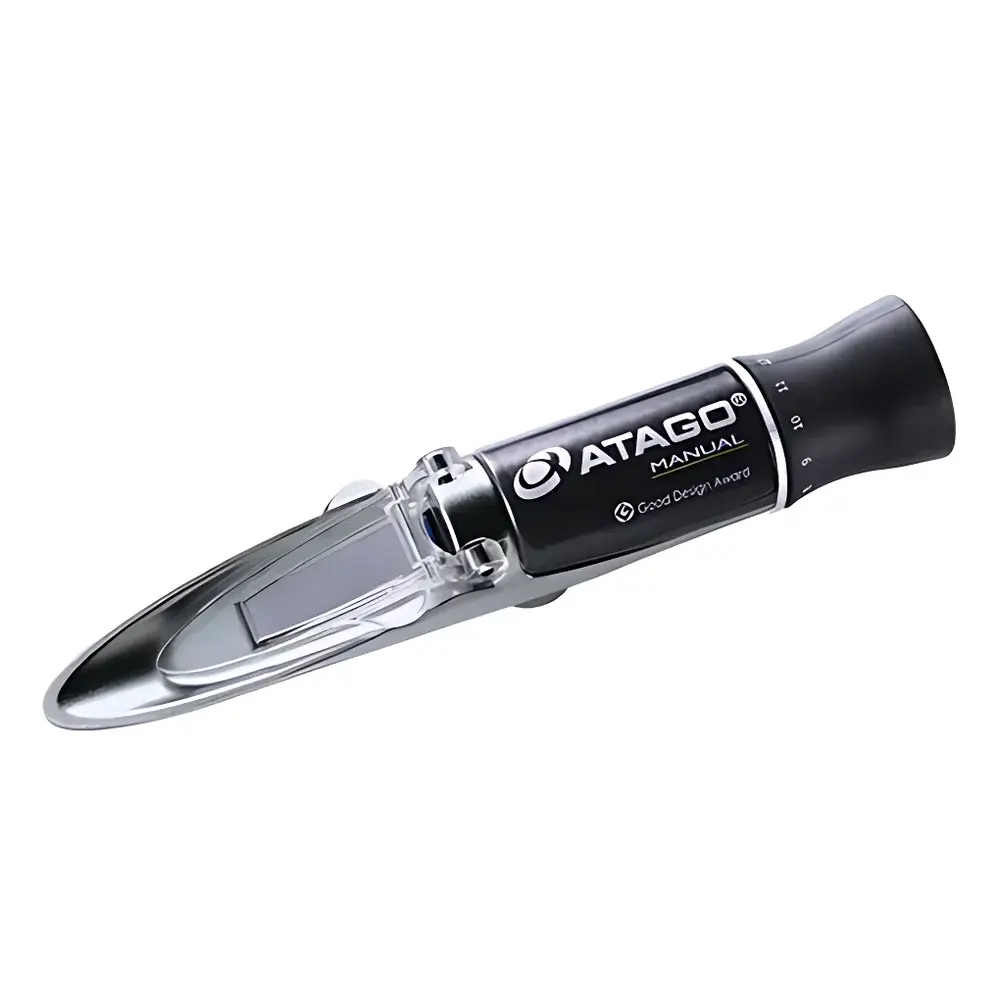
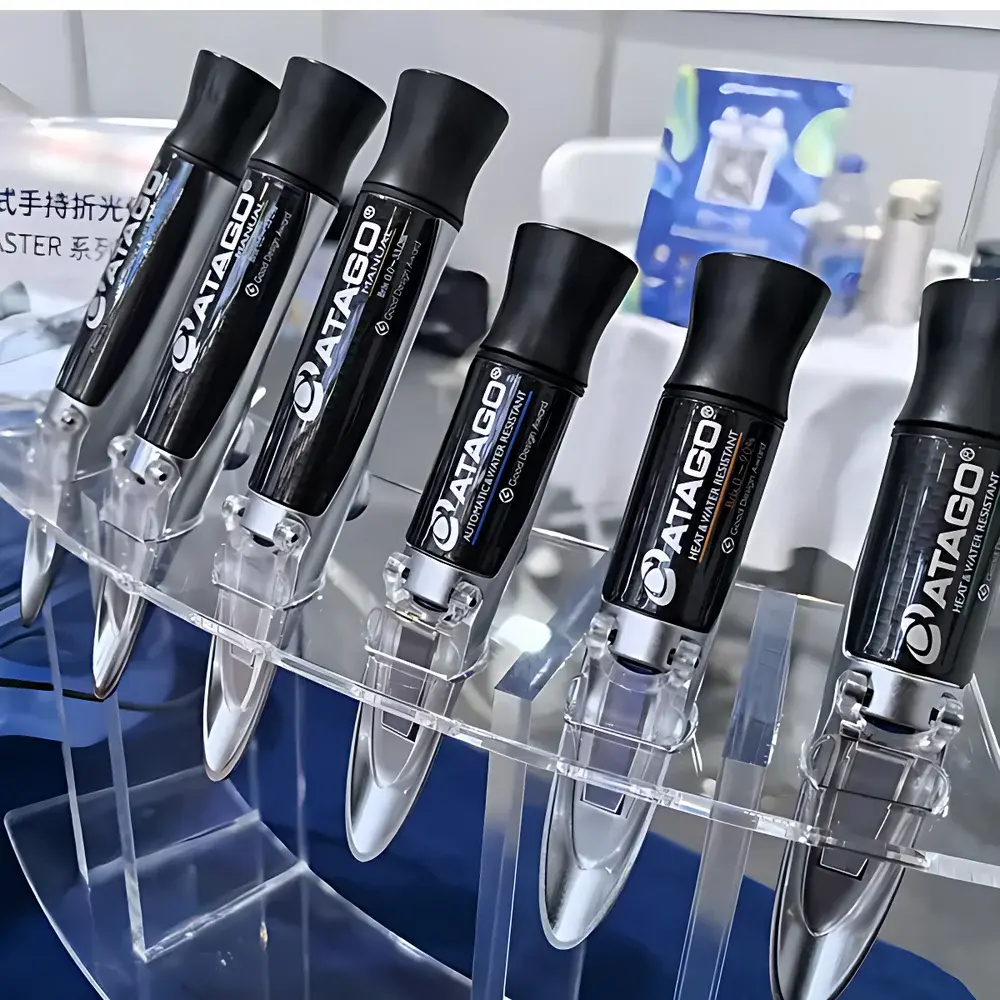
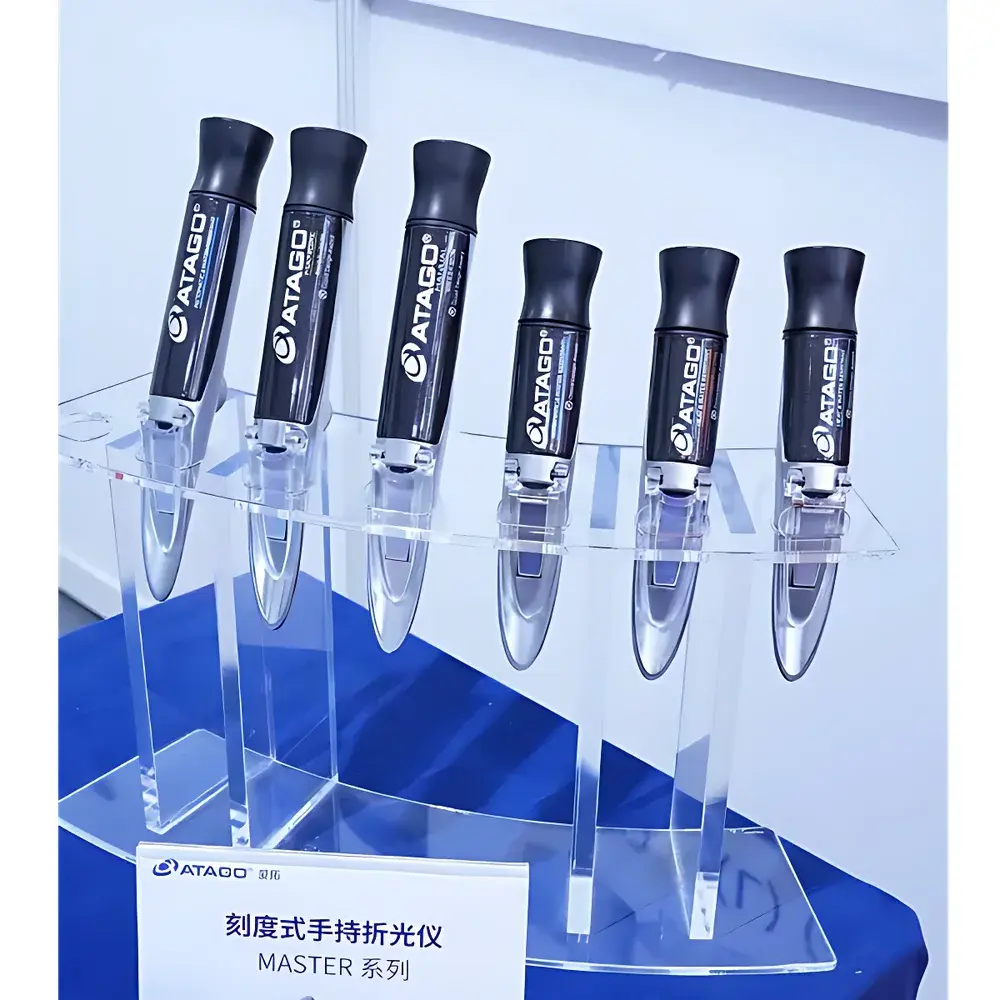
ATAGO MASTER-53M Wide-Range Handheld Refractometer
| Brand | ATAGO |
|---|---|
| Origin | Japan |
| Model | MASTER-53M |
| Product Type | Handheld Refractometer |
| Measurement Range | 0.0–53.0% Brix |
| Scale Division | 0.2% Brix |
| Accuracy | ±0.2% Brix |
| Body Material | Metal |
| Dimensions | 3.2 × 3.4 × 16.8 cm |
| Weight | 130 g |
| Temperature Compensation | None |
| Waterproof Rating | Not specified |
| Display Type | Analog (optical scale view) |
| Accessories | Dedicated daylight plate |
Overview
The ATAGO MASTER-53M is a precision-engineered handheld refractometer designed for rapid, field-deployable measurement of aqueous solution concentration expressed as Brix (% w/w sucrose equivalent). Operating on the fundamental optical principle of critical angle refraction, the instrument determines refractive index by analyzing the boundary between light transmission and total internal reflection at the prism–sample interface. Unlike digital or temperature-compensated models, the MASTER-53M relies on ambient daylight illumination and a fixed optical scale calibrated to the standard Brix scale per ISO 2173:2003 and AOAC Official Method 932.12. Its robust metal housing ensures mechanical stability during repeated use in production lines, agricultural field testing, food processing facilities, and quality control laboratories where portability and immediate visual readout are prioritized over automated data logging or thermal correction.
Key Features
- Wide Brix measurement range of 0.0–53.0%, supporting applications from low-concentration fruit juices to highly concentrated syrups, honey, and condensed dairy products.
- Mechanically stable all-metal construction (aluminum alloy body), engineered for durability under frequent handling and moderate industrial environments.
- High-contrast analog optical scale with 0.2% Brix minimum division—enabling visual interpolation to ±0.1% Brix under optimal lighting conditions.
- No electronic components or batteries required; fully operational using natural daylight via the integrated daylight plate—ideal for hazardous or power-restricted zones.
- Compact ergonomic form factor (3.2 × 3.4 × 16.8 cm; 130 g) optimized for single-hand operation and rapid sample turnover.
- Compliant with international refractometry standards for manual Brix determination, including ISO 2173 and AOAC 932.12, ensuring traceable and inter-laboratory comparable results.
Sample Compatibility & Compliance
The MASTER-53M is suitable for clear to moderately turbid aqueous solutions where particulate interference is minimal. It is routinely used for sugar-based matrices including soft drinks, jams, marmalades, maple syrup, and fermentation broths. Due to the absence of automatic temperature compensation (ATC), measurements must be performed at 20 °C or corrected manually using published Brix–temperature conversion tables (e.g., ICUMSA Tables or NIST SRM 84d reference data). For samples containing high concentrations of salts, organic acids, or aggressive solvents, ATAGO recommends the resin-bodied MASTER-53PM variant (model #23532973) to mitigate corrosion and long-term prism degradation. The instrument does not meet IP67 or equivalent ingress protection ratings and is not intended for immersion or washdown environments.
Software & Data Management
As a purely optical, non-digital instrument, the MASTER-53M does not incorporate embedded firmware, Bluetooth connectivity, or software interfaces. All readings are recorded manually—supporting integration into paper-based QC checklists, LIMS entry workflows, or Excel-based trend analysis. While it lacks audit trail functionality or 21 CFR Part 11 compliance features, its simplicity ensures full transparency and eliminates calibration drift associated with sensor aging or firmware inconsistencies. Laboratories operating under GLP or GMP frameworks may validate the MASTER-53M through documented periodic verification using certified Brix reference standards (e.g., NIST-traceable sucrose solutions at 5%, 20%, and 45% Brix).
Applications
- On-site Brix verification during fruit harvesting and post-harvest sorting to assess ripeness and harvest timing.
- Routine QC checks in beverage concentrate manufacturing, where batch consistency depends on precise sugar solids content.
- Monitoring evaporation endpoints in syrup production and confectionery boiling processes.
- Field evaluation of honey adulteration screening (in conjunction with other tests such as HPLC or stable isotope analysis).
- Educational use in food science and analytical chemistry laboratories to demonstrate fundamental principles of refractometry and solution thermodynamics.
FAQ
Does the MASTER-53M have automatic temperature compensation?
No. It requires manual temperature correction or standardized measurement at 20 °C per ISO 2173.
Can I measure salty or acidic samples with this model?
Metal-body models like the MASTER-53M are not recommended for prolonged exposure to high-salt or low-pH solutions; use the resin-bodied MASTER-53PM instead.
Is the daylight plate included with the instrument?
Yes—the dedicated daylight plate is supplied as standard equipment to optimize incident light coupling for consistent scale illumination.
What is the expected service life of the prism surface?
With proper cleaning using lens tissue and distilled water after each use, the optical glass prism maintains calibration integrity for >10 years under typical industrial usage.
How do I verify accuracy between calibrations?
Use NIST-traceable sucrose reference standards at two points across the range (e.g., 10% and 40% Brix); deviation beyond ±0.2% Brix indicates need for professional recalibration.






