
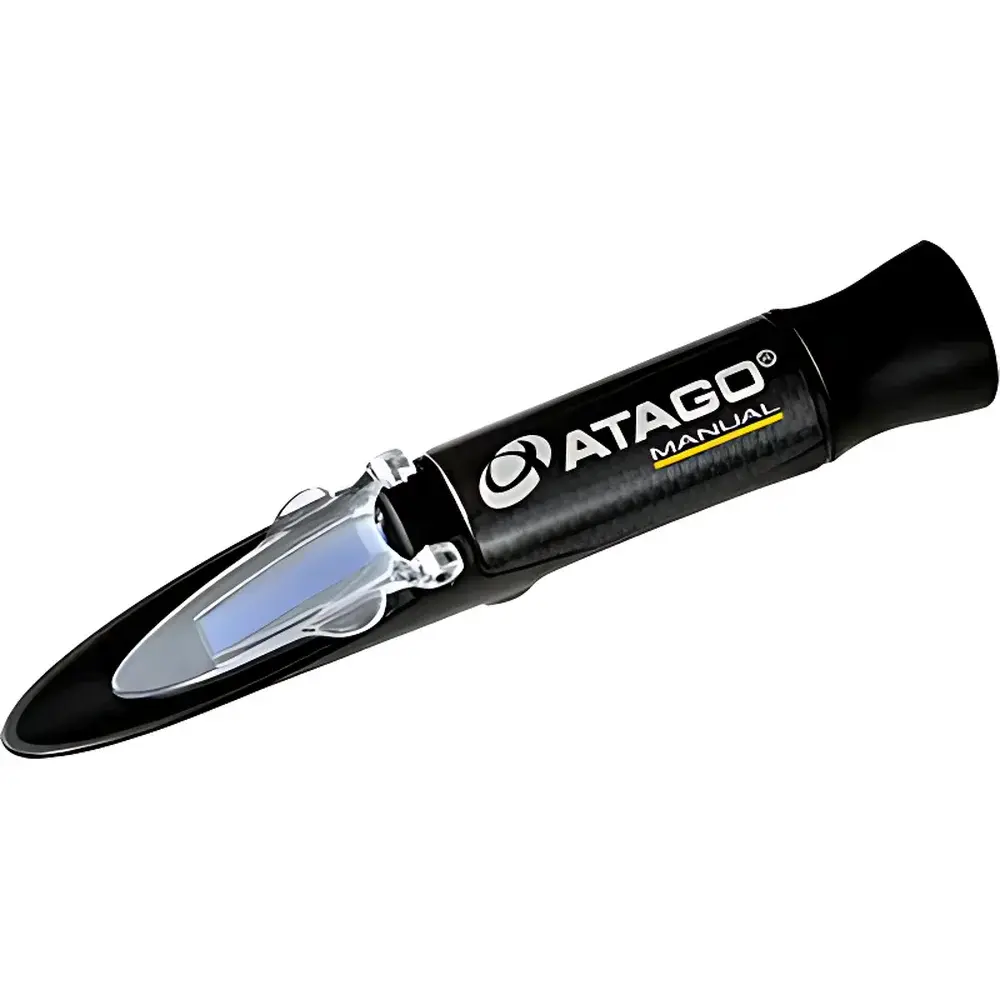
ATAGO MASTER-BC Battery Electrolyte Refractometer
| Brand | ATAGO |
|---|---|
| Origin | Japan |
| Product Type | Handheld Refractometer |
| Temperature Control | Yes |
| Digital Display | Yes |
| Measurement Range | Ethylene Glycol Freezing Point: 0 to −50 °C |
| Propylene Glycol Freezing Point | 0 to −50 °C |
| Battery Electrolyte (D20/20) | 1.150–1.300 |
| Resolution | 0.01 for Electrolyte Scale |
| Minimum Scale Interval | 5 °C for Glycols, 0.01 for D20/20 |
| Dimensions | 3.2 × 3.4 × 20.3 cm |
| Weight | 105 g |
| Housing Material | Acid- and Salt-Resistant Polymer |
Overview
The ATAGO MASTER-BC Battery Electrolyte Refractometer is a precision handheld optical instrument engineered for rapid, on-site determination of refractive index and derived physical properties in lithium-ion battery electrolyte solutions and glycol-based coolant formulations. Based on the fundamental principle of Snell’s Law, the device measures the angle of light refraction at the interface between the sample and a high-stability prism surface, converting this optical response into calibrated scale readings. Unlike generic refractometers, the MASTER-BC integrates application-specific optical calibration for three critical industrial parameters: freezing point depression of ethylene glycol and propylene glycol solutions (0 to −50 °C), and specific gravity (D20/20) of aqueous lithium battery electrolytes ranging from 1.150 to 1.300. Its design addresses the stringent requirements of battery manufacturing QC labs, EV coolant formulation facilities, and solar thermal system maintenance teams—where real-time verification of electrolyte concentration and antifreeze efficacy directly impacts electrochemical stability, thermal management reliability, and long-term cell cycle life.
Key Features
- Application-optimized optical scale with simultaneous dual-readout capability: direct freezing point (°C) for glycols and density (D20/20) for battery electrolytes
- Integrated temperature compensation circuitry ensures measurement stability across ambient conditions (10–30 °C), minimizing manual correction errors
- Acid- and salt-resistant polymer housing withstands exposure to LiPF6-based electrolytes, hydrofluoric acid traces, and chloride-rich cooling fluids
- Digital LCD display with 0.01 resolution on the electrolyte scale and 5 °C graduation on glycol freezing point scales
- Compact ergonomic form factor (3.2 × 3.4 × 20.3 cm; 105 g) enables one-handed operation in glove-box environments or production line sampling points
- No external power supply required—operates via standard CR2032 battery with >5,000 measurements per charge
Sample Compatibility & Compliance
The MASTER-BC is validated for use with aqueous lithium battery electrolytes containing LiPF6, LiTFSI, or LiBOB dissolved in carbonate solvent blends (e.g., EC/DMC, EMC/DEC), as well as industrial-grade ethylene and propylene glycol solutions up to 70 wt%. It complies with ISO 21748:2017 (Guidance for repeatability and reproducibility of measurement methods) and supports GLP-aligned documentation practices through traceable scale calibration certificates (NIST-traceable reference standards available upon request). While not intrinsically rated for hazardous locations, its non-sparking construction and absence of moving parts meet IEC 61000-4-2 ESD immunity requirements for laboratory and light-industrial settings.
Software & Data Management
As a standalone optical instrument, the MASTER-BC does not incorporate Bluetooth, USB, or data logging functionality. All measurements are displayed in real time on the integrated LCD. For audit-trail compliance in regulated environments (e.g., ISO 9001-certified battery cell production lines), users are advised to record readings manually in controlled logbooks or integrate observations into LIMS via secondary entry. Calibration verification can be performed using certified ATAGO reference fluids (e.g., SR-100 for electrolyte scale, GR-10 for glycol freezing point), with documented intervals aligned to internal QA protocols or ASTM D1152–16 (Standard Test Method for Refractive Index of Ethylene Glycol).
Applications
- Quantitative verification of Li-ion electrolyte concentration during electrode slurry preparation and cell filling processes
- Routine monitoring of glycol-based thermal management fluid integrity in electric vehicle battery packs and charging station heat exchangers
- Field validation of antifreeze mixture ratios in solar thermal collector loops and industrial chiller systems
- QC release testing of incoming electrolyte batches against supplier specifications (e.g., D20/20 = 1.220 ± 0.005)
- Troubleshooting capacity fade anomalies linked to electrolyte decomposition or water ingress via refractive index deviation trends
FAQ
Does the MASTER-BC require periodic recalibration?
Yes—ATAGO recommends calibration verification before each shift using certified reference fluids, especially after exposure to extreme temperatures or aggressive solvents.
Can it measure non-aqueous electrolytes such as sulfolane-based formulations?
No—the optical calibration is specific to aqueous LiPF6 systems and glycol/water mixtures; non-polar solvents yield inaccurate readings due to refractive index mismatch with the prism coating.
Is temperature control active or passive?
Passive: The unit incorporates a built-in bi-metallic temperature compensator aligned to the D20/20 reference condition; no Peltier or external thermostat is integrated.
What is the minimum sample volume required?
Approximately 0.3 mL—sufficient to cover the prism surface uniformly without overflow into the ocular housing.
How does it differ from the MASTER-S series?
The MASTER-BC features dedicated battery electrolyte and glycol freezing point scales, whereas MASTER-S models target sucrose, salt, or general-purpose Brix applications with different prism coatings and calibration curves.




