
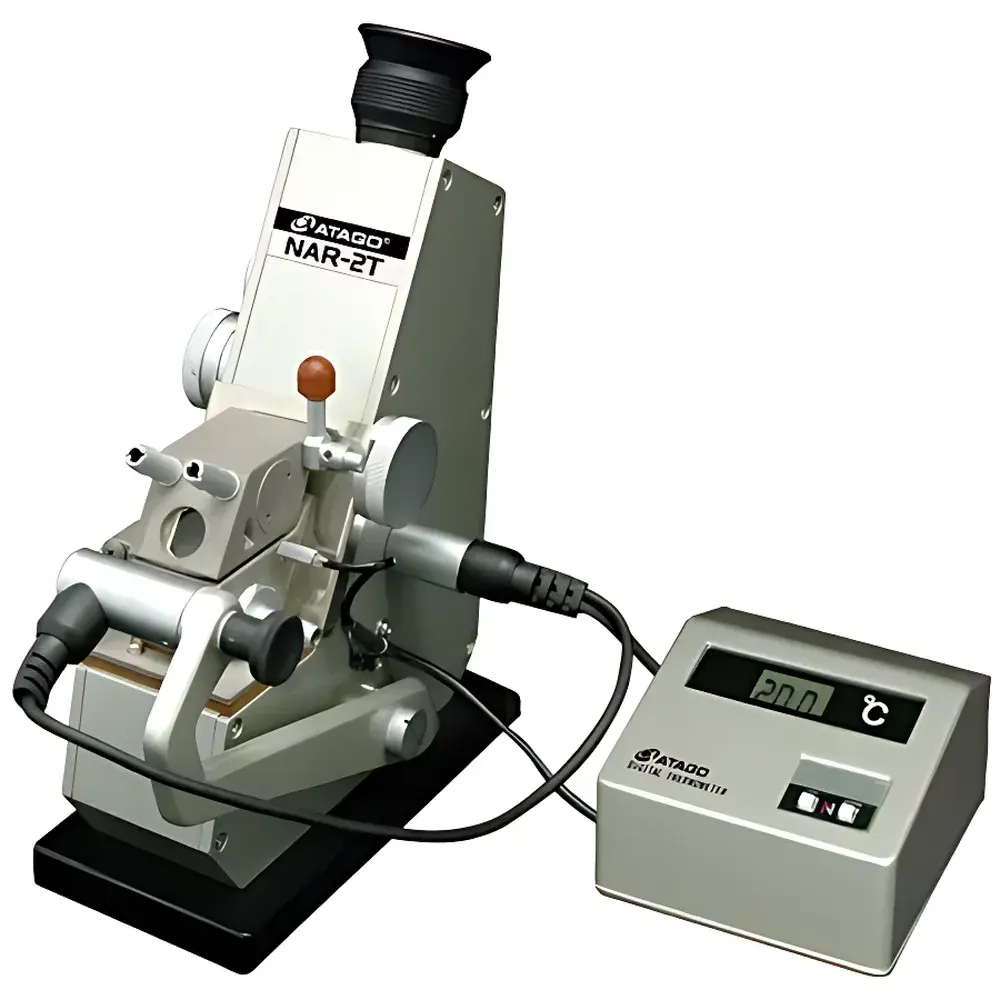
ATAGO NAR-2T·UH High-Index Abbe Refractometer
| Brand | ATAGO |
|---|---|
| Origin | Japan |
| Model | NAR-2T·UH |
| Product Type | Benchtop Refractometer |
| Temperature Control | Yes |
| Digital Display | Yes |
| Measurement Range | Refractive Index (nD) 1.7000–2.0800, Brix 0.0–95.0% |
| Accuracy | ±0.0002 (nD), ±0.1% (Brix) |
| Temperature Range | 5–120°C |
| Temp. Accuracy | ±0.2°C (5–100°C), ±0.5°C (100–120°C) |
| Resolution | 0.001 (nD), 0.5% (Brix) |
| Power Supply | AC 100–240 V, 50/60 Hz |
| Power Consumption | 5 VA |
| Dimensions (Main Unit) | 12 × 20 × 25 cm |
| Weight (Main Unit) | 5.8 kg |
| Dimensions (Temp. Display Module) | 10 × 11 × 7 cm |
| Weight (Temp. Display Module) | 0.5 kg |
Overview
The ATAGO NAR-2T·UH is a precision benchtop Abbe refractometer engineered for high-accuracy measurement of refractive index (nD) and Brix concentration in optically dense, thermally stable, or high-refractive-index samples. Unlike conventional Abbe instruments limited to nD ≤ 1.7000, the NAR-2T·UH extends its optical path and prism design to accommodate materials with nD up to 2.0800 — making it uniquely suited for specialty optical glasses, high-index polymers, semiconductor dopant solutions, sapphire processing fluids, and advanced ceramic slurries. Its operation follows classical Abbe principle: collimated sodium-D light (589.3 nm) passes through a double-prism assembly, generating a critical angle boundary between sample and prism surface; this boundary is imaged onto a calibrated reticle and digitized via high-resolution CCD detection. The integrated Peltier-based temperature control system ensures thermal stabilization across the full operational range (5–120°C), enabling reproducible measurements under elevated temperature conditions required for viscous resins, molten salts, or high-boiling-point solvents.
Key Features
- Extended refractive index range: 1.7000–2.0800 nD, supporting characterization of high-index optical materials and inorganic melts
- Precise thermostatic control with dual-zone Peltier module: maintains sample temperature within ±0.2°C (5–100°C) and ±0.5°C (100–120°C)
- Digital CCD-based detection system eliminates parallax error and subjective visual interpolation; delivers direct nD and Brix readouts with 0.001 resolution
- Modular architecture: separates main optical unit (5.8 kg) from compact remote temperature display module (0.5 kg), facilitating ergonomic placement in confined lab spaces
- RS-232 interface enables direct data export to PC or thermal printer for GLP-compliant recordkeeping
- Low power consumption (5 VA) and universal AC input (100–240 V, 50/60 Hz) ensure compatibility with global laboratory infrastructure
Sample Compatibility & Compliance
The NAR-2T·UH accommodates liquid, semi-solid, and low-viscosity paste samples compatible with standard Abbe prism contact geometry. Its high-temperature capability supports analysis of hot-melt adhesives, molten fluxes, and polymer precursors without pre-cooling. Sample volume requirement remains minimal (≈0.1 mL), reducing material consumption for costly or hazardous formulations. The instrument complies with ISO 21148:2022 (Refractometers — Specifications and methods of testing) and meets essential performance criteria referenced in ASTM D1218 (Standard Test Method for Refractive Index of Hydrocarbon Liquids) and USP (Refractometry). Its digital output architecture supports audit-trail-ready data logging when paired with compliant third-party software — aligning with FDA 21 CFR Part 11 requirements for electronic records in regulated QC environments.
Software & Data Management
While the NAR-2T·UH operates as a standalone instrument, its RS-232 serial port allows seamless integration with Windows-based laboratory data systems. Raw nD and Brix values, along with timestamped temperature readings, are transmitted in ASCII format at user-selectable intervals. ATAGO provides optional communication protocol documentation for custom SCADA or LIMS integration. When used with validated data acquisition software, the system supports automated report generation, trend analysis, and deviation flagging per predefined specification limits — fulfilling traceability and data integrity expectations under ISO/IEC 17025 and GMP Annex 11 frameworks.
Applications
- Quality control of high-index optical lens blanks and AR-coating precursor solutions
- In-process monitoring of borosilicate glass melt homogeneity during furnace operations
- Concentration verification of concentrated lithium bromide absorbent solutions in absorption chillers
- Characterization of high-refractive-index photoresists and spin-on glass (SOG) formulations
- Thermal stability assessment of ionic liquid electrolytes (e.g., [EMIM][TFSI]) across 25–110°C
- Research on chalcogenide glass compositions (As2S3, GeSe2) requiring nD > 2.0
FAQ
What types of high-refractive-index materials can be measured accurately with the NAR-2T·UH?
The instrument is validated for transparent or translucent liquids and gels with nD up to 2.0800 — including optical crown/flint glasses, heavy metal oxide solutions, doped sapphire slurries, and certain rare-earth-containing sol-gels.
Is temperature calibration traceable to national standards?
Yes. The integrated Pt100 sensor is factory-calibrated against NIST-traceable reference thermometers; users may perform field verification using certified thermostatic baths per ISO 17025 procedures.
Can the NAR-2T·UH measure samples above 100°C without degradation of optical components?
The quartz-prism assembly and heat-resistant optical coatings are rated for continuous operation at 120°C; thermal expansion compensation is embedded in firmware to maintain alignment stability.
Does the instrument support automatic Brix-to-concentration conversion for non-sucrose systems?
No — Brix scale is sucrose-specific. For non-sucrose matrices (e.g., glycols, LiBr), users must apply custom calibration curves or density-corrected refractive index correlations.
What maintenance is required to sustain long-term accuracy?
Annual verification of prism surface flatness and light-source wavelength stability is recommended; cleaning with reagent-grade ethanol and lint-free wipes after each use prevents residue buildup affecting critical angle definition.



