
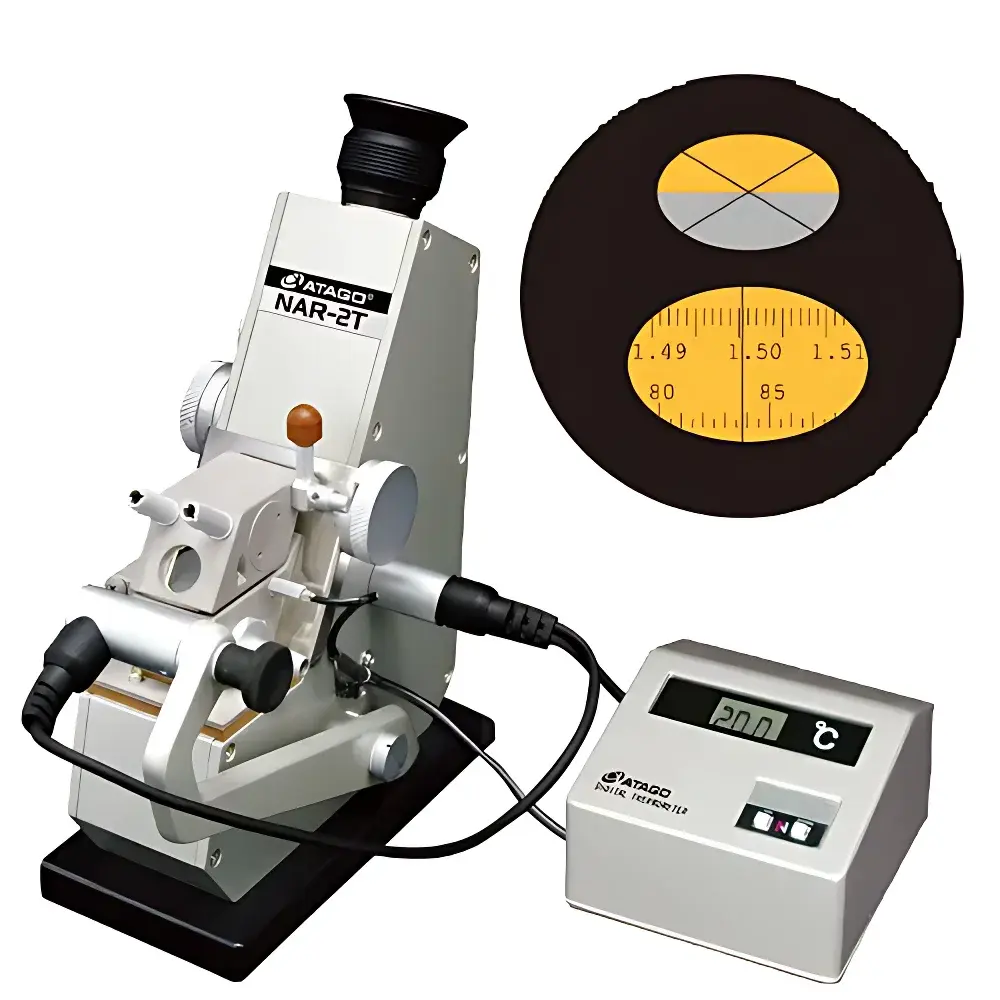
ATAGO NAR-2T·UH High-Index Abbe Refractometer
| Brand | ATAGO |
|---|---|
| Origin | Japan |
| Model | NAR-2T·UH |
| Instrument Type | Benchtop Abbe Refractometer |
| Temperature Control | Yes |
| Digital Display | Yes |
| Refractive Index (nD) Range | 1.7000 to 2.0800 |
| Refractive Index (nD) Accuracy | ±0.0002 |
Overview
The ATAGO NAR-2T·UH High-Index Abbe Refractometer is a precision optical instrument engineered for accurate measurement of refractive index (nD) in materials with exceptionally high optical density. It operates on the fundamental principle of critical angle refraction—based on the classical Abbe refractometer design—where light passes through a prism-sample interface, and the critical angle is determined via a calibrated scale or digital sensor array. Unlike standard refractometers limited to nD < 1.70, the NAR-2T·UH incorporates a custom-designed high-dispersion glass prism, optimized optical path geometry, and multi-wavelength illumination (589.3 nm sodium D-line primary, with optional auxiliary wavelengths for dispersion analysis), enabling stable and repeatable measurements up to nD = 2.0800. This extended range supports rigorous characterization of advanced optical media where conventional instruments fail—such as heavy flint glasses, lanthanum-doped crystals, thermoset polyesters, and high-refractive-index polymer films used in AR/VR waveguides and photonic laminates.
Key Features
- Extended refractive index range: 1.7000–2.0800 nD, validated per ISO 21147:2022 (Refractometers — Performance requirements and test methods)
- Thermostatically controlled sample stage with Peltier-based temperature regulation (range: 10–120 °C; stability: ±0.1 °C), supporting high-temperature liquid and semi-solid measurements
- Digital readout with 0.0001 resolution and ±0.0002 nD accuracy (traceable to NIST SRM 1484 and JIS Z 8014 standards)
- Integrated Abbe number calculation function (νD = (nD − 1)/(nF − nC)) when paired with optional dual-wavelength calibration modules
- Robust all-metal housing with anti-vibration base and ESD-safe optical bench, suitable for GLP-compliant laboratory environments
- Manual and semi-automated operation modes—no consumables, no moving parts in optical train, ensuring long-term calibration stability
Sample Compatibility & Compliance
The NAR-2T·UH accommodates viscous, thermally sensitive, and optically dense samples—including molten thermosets (e.g., epoxy resins at 100 °C), UV-curable acrylates, silicone optical adhesives, borosilicate and crown glass melts, and thin-film-coated substrates (measured via micro-drop technique). Its prism surface is coated with ultra-hard diamond-like carbon (DLC) to resist scratching from abrasive polymer slurries or crystalline suspensions. The instrument complies with ISO/IEC 17025:2017 for testing laboratories, supports audit-ready calibration logs, and meets key regulatory expectations for optical metrology in FDA-regulated environments (e.g., USP “Refractometry” and ICH Q5E “Comparability of Biotechnological/Biological Products”). CE marking confirms conformity with EU Directive 2014/30/EU (EMC) and 2014/35/EU (LVD).
Software & Data Management
While the NAR-2T·UH operates as a standalone instrument, it interfaces via RS-232 or optional USB-to-serial adapter with ATAGO’s proprietary RefraLink Pro software (Windows 10/11 compatible). This application enables automated data logging, multi-point temperature ramping protocols, statistical process control (SPC) charting (X̄-R, Cpk), and export to CSV, PDF, or LIMS-compatible XML formats. All measurement records include embedded metadata: timestamp, operator ID, ambient temperature/humidity, calibration certificate ID, and traceable reference standard used. Software audit trails comply with FDA 21 CFR Part 11 requirements when configured with electronic signatures and role-based access control.
Applications
- Optical Materials Development: Quantifying nD and νD of prototype lens materials, chalcogenide glasses, and metasurface substrates during R&D and formulation screening
- Pharmaceutical Process Analytics: Real-time monitoring of refractive index shifts during solvent exchange, polymer precipitation, or lyophilization endpoint determination
- Advanced Packaging & Coatings: Verifying refractive index uniformity across multilayer PET/PC films and anti-reflective coatings for display and solar applications
- Academic Research: Supporting undergraduate and graduate coursework in physical optics, material dispersion theory, and solid-state spectroscopy labs
- Quality Assurance in Precision Manufacturing: Incoming inspection of optical-grade resins, batch release testing of specialty monomers, and final verification of fiber preform homogeneity
FAQ
What calibration standards are recommended for the NAR-2T·UH?
ATAGO recommends certified reference liquids traceable to NIST SRM 1484 (benzyl alcohol, bromonaphthalene) and JIS Z 8014-certified glass blocks (BK7, SF6, LaF2) for full-range validation.
Can the instrument measure solid samples directly?
Yes—using the optional solid-sample attachment kit, which includes a contact fluid (nD = 1.8500) and pressure-adjustable clamping stage for flat, polished surfaces ≥10 mm × 10 mm.
Is temperature correction applied automatically during measurement?
No—temperature compensation is not algorithmic; instead, the built-in Peltier system maintains precise isothermal conditions at user-defined setpoints, eliminating reliance on post-hoc correction models.
How often does the instrument require recalibration?
Under GLP conditions, annual recalibration against primary standards is advised; however, daily verification using a certified control sample is required before critical measurements.
Does the NAR-2T·UH support GMP documentation workflows?
Yes—when used with RefraLink Pro and configured with 21 CFR Part 11-compliant settings, it generates fully auditable electronic records meeting Annex 11 and EU GMP Chapter 4 requirements.






