
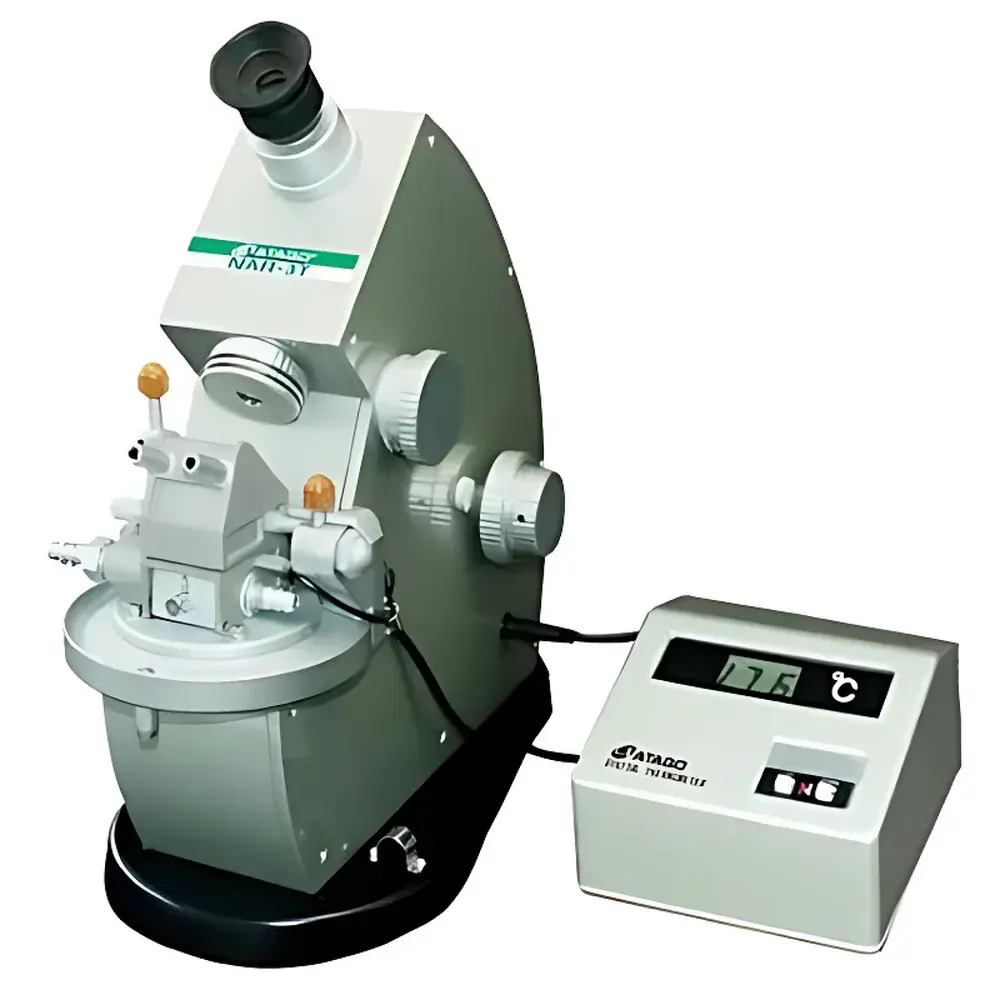
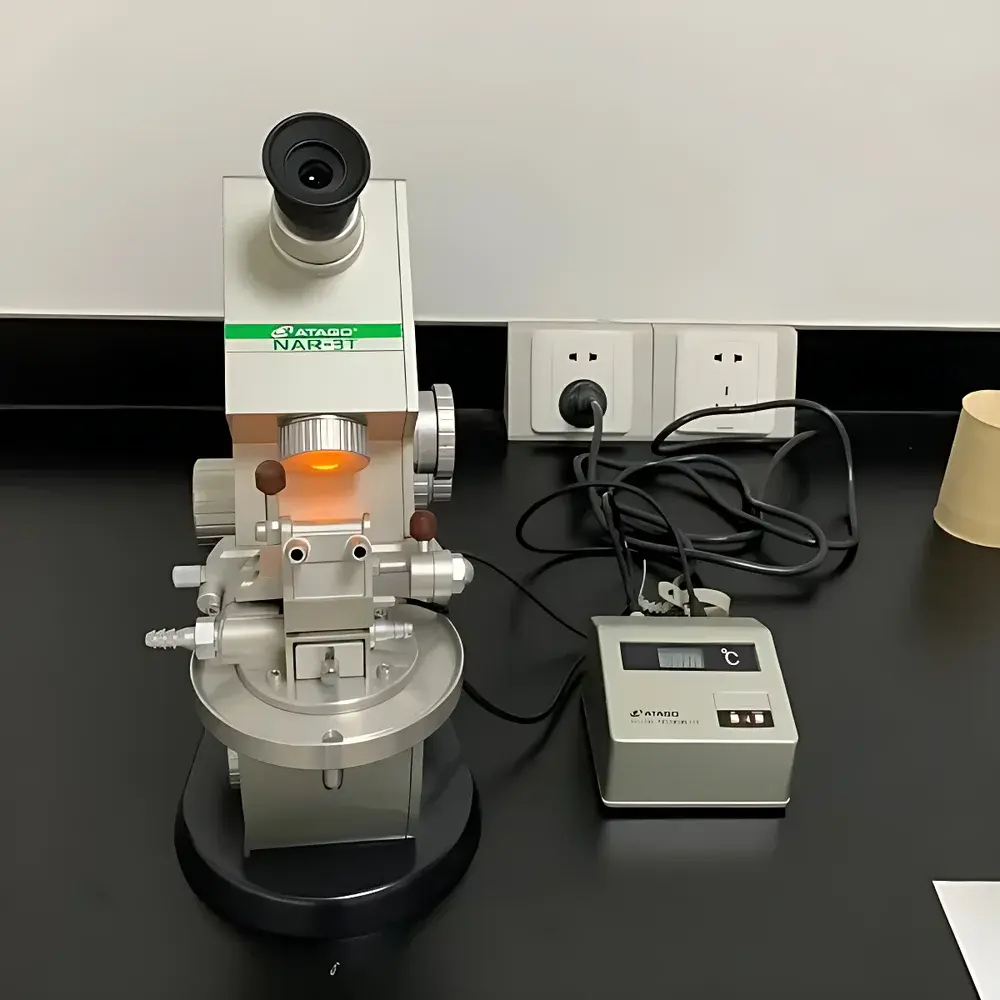
ATAGO NAR-3T High-Precision Abbe Refractometer
| Brand | ATAGO |
|---|---|
| Origin | Japan |
| Model | NAR-3T |
| Type | Benchtop Abbe Refractometer |
| Temperature Control | Yes |
| Digital Display | Yes |
| Refractive Index Range | 1.30000–1.71000 |
| Brix Range | 0.00–95.00% |
| Refractive Index Accuracy | ±0.0001 |
| Brix Accuracy | ±0.05% |
| Temperature Range | 5–50°C |
| Temperature Accuracy | ±0.2°C |
| Power Supply | AC 100–240 V, 50/60 Hz |
| Dimensions (main unit) | 12 × 31 × 34 cm |
| Weight (main unit) | 9.0 kg |
Overview
The ATAGO NAR-3T High-Precision Abbe Refractometer is a benchtop optical instrument engineered for rigorous quantitative analysis of refractive index (nD) and calculated mean dispersion (nF – nC) in transparent and semi-transparent homogeneous media—primarily liquids such as oils, solvents, glycerin-based formulations, and purified organic compounds. Based on the classical Abbe principle, it employs critical angle measurement via a high-intensity halogen light source and a precision-ground double-prism assembly (illuminating and measuring prisms), enabling direct nD determination at the sodium D-line (589.3 nm). Its extended refractive index range (1.30000–1.71000) accommodates low-index hydrocarbons (e.g., hexane, nD ≈ 1.375) and high-index specialty fluids (e.g., bromonaphthalene, nD ≈ 1.659), making it particularly suited for quality control in oleochemical processing, where feedstock purity, esterification degree, and additive concentration must be verified with metrological traceability.
Key Features
- High-stability halogen illumination system delivering consistent spectral output at 589.3 nm, minimizing drift during extended measurement sessions
- Dual-temperature-controlled optical path: integrated Peltier element maintains prism surface temperature within ±0.2°C across 5–50°C operating range, ensuring thermal equilibrium critical for nD repeatability
- Digital readout with 0.0002 resolution for nD and 0.1% for Brix, calibrated against NIST-traceable reference standards (e.g., distilled water, nD = 1.3330 at 20°C)
- Optimized prism geometry and anti-reflection coatings reduce stray light and improve contrast in the shadow line, facilitating precise manual or semi-automated endpoint detection
- Benchtop architecture with rigid aluminum alloy chassis (9.0 kg mass) minimizes vibration-induced measurement noise in shared laboratory environments
- Compliant with ISO 21748:2017 (Guidance for the use of repeatability, reproducibility and trueness estimates in measurement uncertainty evaluation) and ASTM D1218–19 (Standard Test Method for Refractive Index of Hydrocarbon Liquids)
Sample Compatibility & Compliance
The NAR-3T accepts samples ≥0.5 mL applied directly onto the temperature-regulated measuring prism. It supports viscous liquids (e.g., triglycerides, fatty acid methyl esters, polyol blends) without requiring dilution, provided surface homogeneity and absence of suspended particulates are confirmed prior to measurement. Solid samples (e.g., optical glasses, polymer films) may be evaluated using optional contact liquid (e.g., monobromonaphthalene) under controlled humidity conditions. Instrument validation aligns with GLP requirements for routine QC: documented calibration logs, operator ID tracking (via external lab management software), and audit-ready temperature stability records support FDA 21 CFR Part 11 readiness when integrated into validated workflows. Compliance documentation includes CE marking per Directive 2014/30/EU (EMC) and 2014/35/EU (LVD).
Software & Data Management
While the NAR-3T operates as a standalone analog-digital hybrid instrument, its RS-232 interface enables bidirectional communication with third-party laboratory information management systems (LIMS) or custom data acquisition platforms. Exported datasets include timestamp, sample ID, nD, Brix, temperature reading, and operator code—structured for direct ingestion into statistical process control (SPC) modules. For regulated environments, optional ATAGO DataLogger Pro software provides electronic signature capability, change history logging, and automated report generation compliant with ISO/IEC 17025:2017 clause 7.7 (Results reporting). All firmware updates are delivered via secure USB key to maintain configuration integrity.
Applications
- Oleochemical QA/QC: verification of saponification value, iodine value (via correlation models), and glycerin content in biodiesel feedstocks
- Pharmaceutical excipient release testing: refractive index profiling of polyethylene glycols (PEGs) and polysorbates across batch lots
- Coating & ink formulation: real-time monitoring of solvent evaporation kinetics and resin concentration in alkyd-based systems
- Academic research: determination of molar refraction and polarizability in structure-property relationship studies of bio-based surfactants
- Food-grade oil authentication: differentiation of adulterated olive oil via nD deviation from Codex Alimentarius STAN 252–2006 specifications
FAQ
What calibration standards are recommended for daily verification?
Distilled water (nD = 1.3330 at 20°C) and certified glass reference blocks (e.g., Schott SF10, nD = 1.7230) are used for two-point verification. Calibration frequency follows ISO/IEC 17025:2017 clause 7.6.3—typically before first use, after maintenance, and at 4-hour intervals during continuous operation.
Can the NAR-3T measure samples below 5°C or above 50°C?
No. The Peltier cooling/heating module is rated for 5–50°C only. Sub-ambient measurements require external cryostat integration (not supported by standard configuration); super-ambient operation risks prism coating degradation and thermal lensing errors.
Is Brix measurement valid for non-sugar solutions like ethylene glycol–water mixtures?
Brix scale is empirically derived for sucrose–water systems. For other solutes, users must apply solute-specific conversion factors or correlate nD to concentration via in-house calibration curves per IUPAC Technical Report “Refractometry in Solution Chemistry” (2021).
How does the NAR-3T handle volatile or hazardous samples?
A fume hood-compatible sample chamber cover (optional accessory) and rapid 15-second thermal equilibration minimize vapor loss. For Class II/III solvents, use of inert gas purging (N2) over the prism surface is advised to prevent oxidation or condensation artifacts.





