
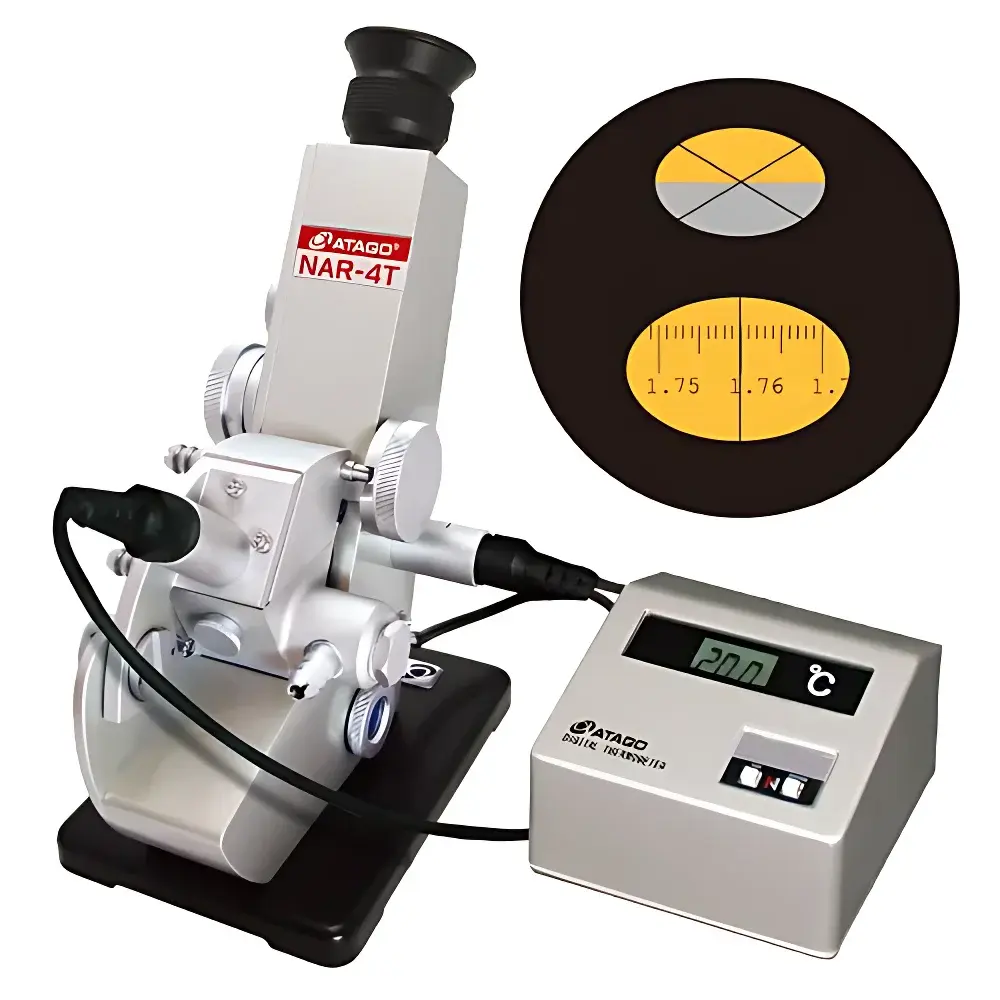
ATAGO NAR-4T High-Index Abbe Refractometer
| Brand | ATAGO |
|---|---|
| Origin | Japan |
| Model | NAR-4T |
| Type | Benchtop Abbe Refractometer |
| Temperature Control | Yes |
| Digital Display | No |
| Refractive Index Range | 1.4700–1.8700 |
| Accuracy | ±0.0002 nD |
| Resolution | 0.001 nD |
| Temperature Measurement Range | 5–50 °C |
| Temp. Display Range | 0.0–50.0 °C (±0.2 °C accuracy, 0.1 °C resolution) |
| Light Source | 8 V, 0.15 A tungsten lamp |
| Power Supply | AC 100–240 V, 50/60 Hz |
| Power Consumption | 5 VA |
| Dimensions (main unit) | 13 × 18 × 23 cm |
| Weight (main unit) | 1.8 kg |
| Dimensions (temp. display unit) | 10 × 11 × 7 cm |
| Weight (temp. display unit) | 0.5 kg |
Overview
The ATAGO NAR-4T High-Index Abbe Refractometer is a precision optical instrument engineered for accurate measurement of refractive index (nD) in materials with exceptionally high optical density—specifically those exceeding the upper limit of conventional Abbe refractometers. Based on the principle of critical angle refraction, the NAR-4T utilizes a calibrated glass prism assembly and monochromatic sodium D-line illumination (589.3 nm) to determine nD values across an extended range of 1.4700 to 1.8700. This capability addresses a critical gap in optical characterization for advanced polymers, specialty resins, optical adhesives, liquid crystal monomers, semiconductor encapsulants, and high-refractive-index thin-film precursors—materials increasingly deployed in photonic devices, AR/VR optics, and next-generation display technologies. Unlike standard Abbe instruments limited to ~1.7000 nD, the NAR-4T incorporates an optimized prism geometry and enhanced optical path design to maintain linearity and repeatability at elevated indices, delivering traceable measurements with ±0.0002 nD accuracy under controlled thermal conditions.
Key Features
- Extended refractive index range: 1.4700–1.8700 nD, enabling characterization of high-index polymers, epoxies, and optical-grade liquids not measurable with standard Abbe refractometers
- Integrated temperature-controlled sample stage with external digital thermometer (0.0–50.0 °C, ±0.2 °C accuracy), supporting ISO 2114 and ASTM D1218-compliant thermal stabilization protocols
- High-stability tungsten lamp (8 V, 0.15 A) providing consistent D-line illumination without spectral drift over extended operation cycles
- Mechanical vernier scale with 0.001 nD resolution, optimized for parallax-free visual interpolation and operator-independent reading
- Benchtop architecture with rigid aluminum alloy housing (1.8 kg main unit), designed for vibration resistance and long-term optical alignment stability in QC laboratories
- Universal AC power input (100–240 V, 50/60 Hz) and low power consumption (5 VA), suitable for regulated environments including GLP-compliant analytical suites
Sample Compatibility & Compliance
The NAR-4T accommodates viscous, non-volatile, and thermally stable liquid or semi-solid samples—including uncured polymer prepolymers, UV-curable resins, silicone oils, and high-boiling-point solvents—provided they are optically homogeneous and non-corrosive to BK7 prism surfaces. Sample volume requirement is ≤0.2 mL per measurement. The instrument complies with core international standards governing refractometric analysis: ISO 2114 (plastics — determination of refractive index), ASTM D1218 (refractive index of hydrocarbon liquids), and JIS K 0061 (general rules for refractometry). Its temperature control architecture supports adherence to USP requirements for thermal equilibration prior to optical measurement. While the NAR-4T itself does not generate electronic audit trails, its mechanical readout and external temperature logging enable full manual documentation for GMP and ISO/IEC 17025 quality systems.
Software & Data Management
The NAR-4T operates as a standalone optical bench instrument with no embedded microprocessor or digital interface. All readings are obtained visually via the calibrated ocular scale; temperature data is recorded manually from the dedicated external digital thermometer unit. This analog-digital hybrid architecture ensures immunity to firmware obsolescence, electromagnetic interference, and cybersecurity vulnerabilities—critical for regulated manufacturing environments where validation stability is prioritized over automation. Users may integrate temperature readings into LIMS or ELN platforms using standard manual entry workflows compliant with FDA 21 CFR Part 11 when paired with appropriate procedural controls (e.g., dual-operator verification, timestamped logbooks).
Applications
- Quality control of high-refractive-index optical adhesives (e.g., NOA series, LOCA formulations) in display module assembly
- R&D screening of novel acrylate and epoxy monomers for lens coatings and waveguide fabrication
- Batch release testing of silicone-based dielectric fluids used in high-voltage insulation systems
- Characterization of liquid crystal mixtures during formulation development for TFT-LCD and micro-LED backplanes
- Verification of refractive index matching in photonic packaging materials (e.g., underfill epoxies, mold compounds)
- Academic research in soft matter physics involving colloidal dispersions and polymer nanocomposites with tunable optical dispersion
FAQ
What is the minimum sample volume required for measurement?
Approximately 0.15–0.20 mL is sufficient to fully cover the prism surface without overflow.
Can the NAR-4T measure opaque or highly scattering samples?
No. The instrument requires optically transparent, homogeneous samples; turbid or particulate-laden liquids will yield unreliable critical angle detection.
Is temperature calibration traceable to national standards?
The external digital thermometer is factory-calibrated against NIST-traceable references; users may perform periodic recalibration using certified PT100 probes per ISO/IEC 17025 procedures.
Does ATAGO provide certification documentation for regulatory submissions?
Yes—upon request, ATAGO issues Manufacturer’s Certificate of Conformance and calibration reports aligned with ISO/IEC 17025-accredited laboratories, including uncertainty budgets for nD and temperature measurements.
How often should the prism surface be cleaned and maintained?
Prism cleaning is recommended before and after each sample series using lint-free wipes and reagent-grade ethanol or acetone; avoid abrasive solvents. Annual professional optical inspection is advised for sustained metrological integrity.




